New Enzyme Discovery: First Define What Counts as Real Evidence of Novelty
Published on October 21, 2026
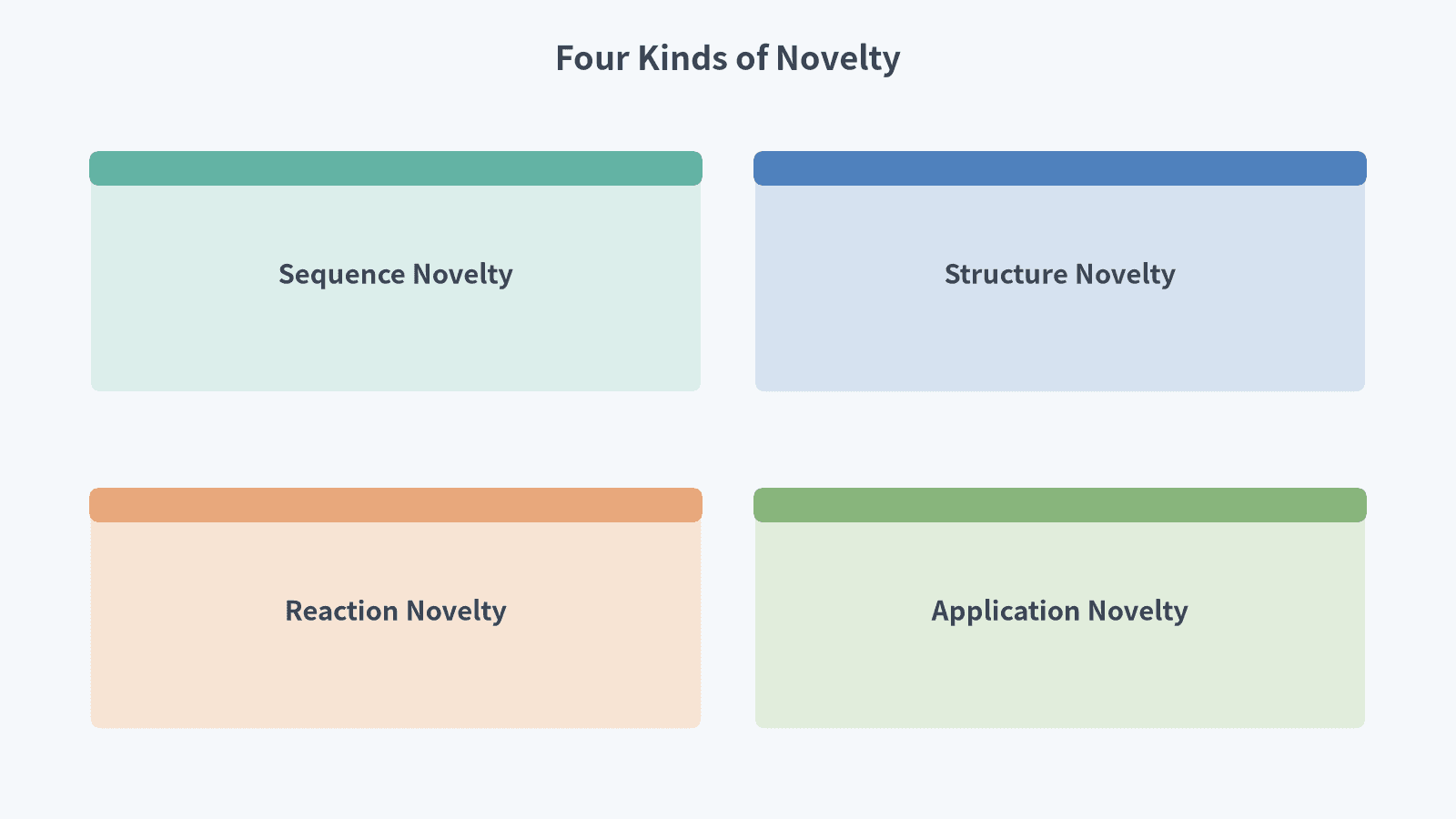
Figure 1 Four types of novelty: sequence, structure, reaction, application
Category: Enzyme discovery / Bioprospecting / Biocatalysis
“New” sounds precise but is actually easy to confuse. A low-similarity sequence may still carry out a known reaction; a familiar family member may gain valuable activity on a new substrate; and some candidates change no reaction type at all yet work at a target low temperature, high temperature, or in a special solvent. Without first stating which novelty you intend to prove, the search scope, experimental design, and final conclusion all lose a common yardstick. Sequence, structure, and functional novelty require different — yet complementary — evidence.
1. First, separate the four kinds of “new”
Before judging a “new enzyme,” confirm which kind of “new” you mean. These four layers can overlap but cannot substitute for one another.
Sequence novelty — answers “how far is it from known proteins?” It suits describing homology relationships and family boundaries, but alone cannot prove new catalytic ability. Sequence changes may sit on the surface or rewrite the active-site pocket; two candidates with the same similarity can affect function in completely different ways.
Structure novelty — focuses on fold, domain architecture, or active-site-pocket geometry. Remote sequences may retain a similar structure, and the same fold can host different reactions. Structure comparison widens the search radius, but a similar pocket hit is still only a candidate lead.
Reaction novelty — requires evidence of a chemical transformation not previously supported by that protein class, usually with explicit substrate, product, and mechanism evidence.
Application novelty — concerns whether a known reaction works under new conditions, such as different temperature, pH, salinity, solvent, or expression scenarios.
So at project start, write down one verifiable claim: are you seeking a low-homology natural enzyme that performs a known reaction, a new substrate range, or a catalyst that works in a specified process window? The more specific the claim, the easier the candidates are to prioritize.
2. Lowering the similarity threshold ≠ finding a new enzyme
Lowering the sequence threshold brings more remote candidates, but also more misannotation. Low similarity is not inherently high value; it may come from incomplete sequences, domain changes, or an unrelated family branch. Candidates must simultaneously retain key catalytic residues, domain logic, and structural clues compatible with the target reaction. A truly new candidate must be “different” and “functionally justified.”
Conversely, high-similarity candidates are not necessarily low value. A few key residue changes can alter substrate entry, conformational balance, or environmental tolerance. If the task targets application conditions rather than a new fold, over-chasing sequence distance may miss natural variants that are easier to express and validate.
A better approach is to group candidates by different evidence quality:
① Reference group — close to known function, higher odds of success; ② Exploration group — on a remote branch but retaining key mechanism; ③ Hypothesis group — stands out structurally or by property prediction but needs more validation. This controls risk while preserving discovery space.
3. First decide: “discovery” or “engineering”
If nature already has a protein that meets the target, natural discovery is usually more direct than creating from scratch. If an existing enzyme is basically usable but lacks stability, activity, or expression, the problem is closer to protein engineering; only if no known scaffold can support the target reaction should you consider more aggressive de novo design.
This step prevents task mismatch. Disguising an engineering problem as discovery leads to searching a database for candidates that cannot satisfy all conditions at once; turning a discovery problem directly into a generative task may overlook an existing natural answer. New enzyme discovery should first search curated records, reference sequences, and structures, then decide whether to expand into remote mining.
Search should revolve around the reaction, not the name. Members under the same enzyme name may differ in substrate range; proteins with different names may achieve a similar transformation. Reaction class, cofactors, catalytic residues, substrate shape, and active-site-pocket features often link candidates to a target better than a single keyword.

Figure 2 Decide: natural discovery, engineering, or de novo design
4. Combined evidence is more credible than one top score
Sequence, structure, and functional models can rapidly narrow the candidate pool, but each has a scope: sequence evidence is good at recognizing known family relationships, structure evidence helps reveal remote conserved mechanisms, and property prediction helps judge whether a candidate deserves early testing under a specific application condition.
A high-quality candidate list should explain “why this one”: which known enzyme class it relates to, whether key residues and domains are intact, whether the active-site pocket can accommodate the target substrate, whether it covers a new phylogenetic branch, and whether there are clear risks in expression, stability, or other properties.
There is often no single winner across properties. The candidate closest to known activity may not be the most stable; the structurally most unusual candidate may not express well. The first batch of experiments is better served by keeping representatives with different strengths than by compressing all metrics into one seemingly precise score.
The value of a new enzyme is ultimately verified under the target reaction conditions.
5. Experiments decide whether it can be called a “new enzyme”
Computed results can raise hypotheses but cannot replace biochemical confirmation. Candidates should first be checked for sequence and construct, then validated for expression and solubility, then assayed for product under the target substrate. If the claim involves selectivity, kinetics, or special environmental tolerance, matched measurements are also required.
Negative results likewise refine the discovery logic: a remote candidate with no activity may show that structural similarity is insufficient to support the same chemistry; a high-similarity candidate active only under one condition suggests that the application window matters more than the family name. Feeding results back to each candidate’s sequence, structure, and origin makes the next round of selection more accurate.
The wording of “new” should follow the strength of evidence: with only computational clues, call it a “potential candidate”; only after in-vitro reaction confirmation can you support a “specific function”; to claim application value, continue validating under the relevant process conditions. This boundary does not weaken the message — it makes R&D decisions more credible.

Figure 3 Evidence hierarchy: computational clue to in-vitro confirm to application verify
6. How MatwingsVenus® (protein design agent) supports new enzyme discovery
MatwingsVenus® (Xiaowu®) distinguishes natural protein discovery, engineering an existing protein, and designing a new scaffold, so the three are not conflated.
(1) Search first: Search Before Mining
First query curated resources by function, or run BLAST homology search on protein or nucleic-acid sequences, to confirm whether nature already provides a usable answer.
(2) Structure mining: VenusMine
When the diversity of known results is insufficient, structure mining can proceed with user consent. VenusMine takes PDB or CIF structures as input to find remote homologs and conserved folds, and returns candidates with phylogenetic information; if only sequence is available, a structure must first be prepared, with recomputation set under HITL gating.
(3) Candidate evaluation: VenusG
Once candidates are formed, VenusG can assess them with physicochemical property calculations, then combine family diversity, phylogeny, and Pareto ranking to deliver top candidates, FASTA, and wet-lab suggestions. Results are prediction and decision support, not confirmation of function or industrial performance; priority candidates can, per project scope, proceed to gene synthesis, protein-expression validation, and protein purification.
Frequently Asked Questions (FAQ)
1. Does low sequence similarity mean a new enzyme has been found?
Not necessarily. Low similarity may come from incomplete sequences, domain changes, or an unrelated family branch; without catalytic residues, domain, and mechanism evidence, the candidate is still only a lead. A truly new candidate must be “different” and “functionally justified.”
2. How many meanings does “new” have for a “new enzyme”?
Usually four: sequence novelty, structure novelty, reaction novelty, and application novelty. They can overlap but cannot replace one another; reaction novelty in particular needs substrate, product, and mechanism-level evidence.
3. When should I “discover” a natural enzyme versus “engineer” one?
Nature already meets the target → natural discovery; an existing enzyme is basically usable but lacks stability/activity/expression → protein engineering; no known scaffold can support the target reaction → consider de novo design. Always search curated records, reference sequences, and structures first before expanding the mine.
4. Once results appear, can I directly say “a new enzyme has been discovered”?
No. Computed results are hypotheses and cannot replace biochemical confirmation. Check sequence and construct, validate expression and solubility, then assay product under the target substrate; selectivity, kinetics, or special tolerance require matched measurements. Only in-vitro confirmation supports a specific function.
5. What is MatwingsVenus®’s approach to new enzyme discovery?
It follows Search Before Mining: query curated resources and BLAST homologs by function/sequence first; when diversity is insufficient, enter VenusMine structure mining with user consent; finally use VenusG with physicochemical properties and Pareto ranking to deliver top candidates, FASTA, and wet-lab suggestions.
Summary
The efficiency of new enzyme discovery does not depend on how many unfamiliar sequences are collected at once, but on whether the definition of “new” is clear, the evidence hierarchy matches the claim, candidate differences are explainable, and validation conditions are close to the target. Define the claim first, search for the natural answer next, and let experiments decide the conclusion — only then can novelty be turned into genuinely usable enzyme resources.
One-line conclusion: The efficiency of new enzyme discovery depends on whether the definition of “new” is clear, the evidence hierarchy matches the claim, candidate differences are explainable, and validation conditions are close to the target. Define the claim first, search for the natural answer next, and let experiments decide the conclusion.