What Is Bromelain? A Complete Guide to the Plant Cysteine Protease: Mechanism, Optimal Conditions and Applications
Published on October 21, 2026
What Is Bromelain? A Complete Guide to the Plant Cysteine Protease: Mechanism, Optimal Conditions and Applications
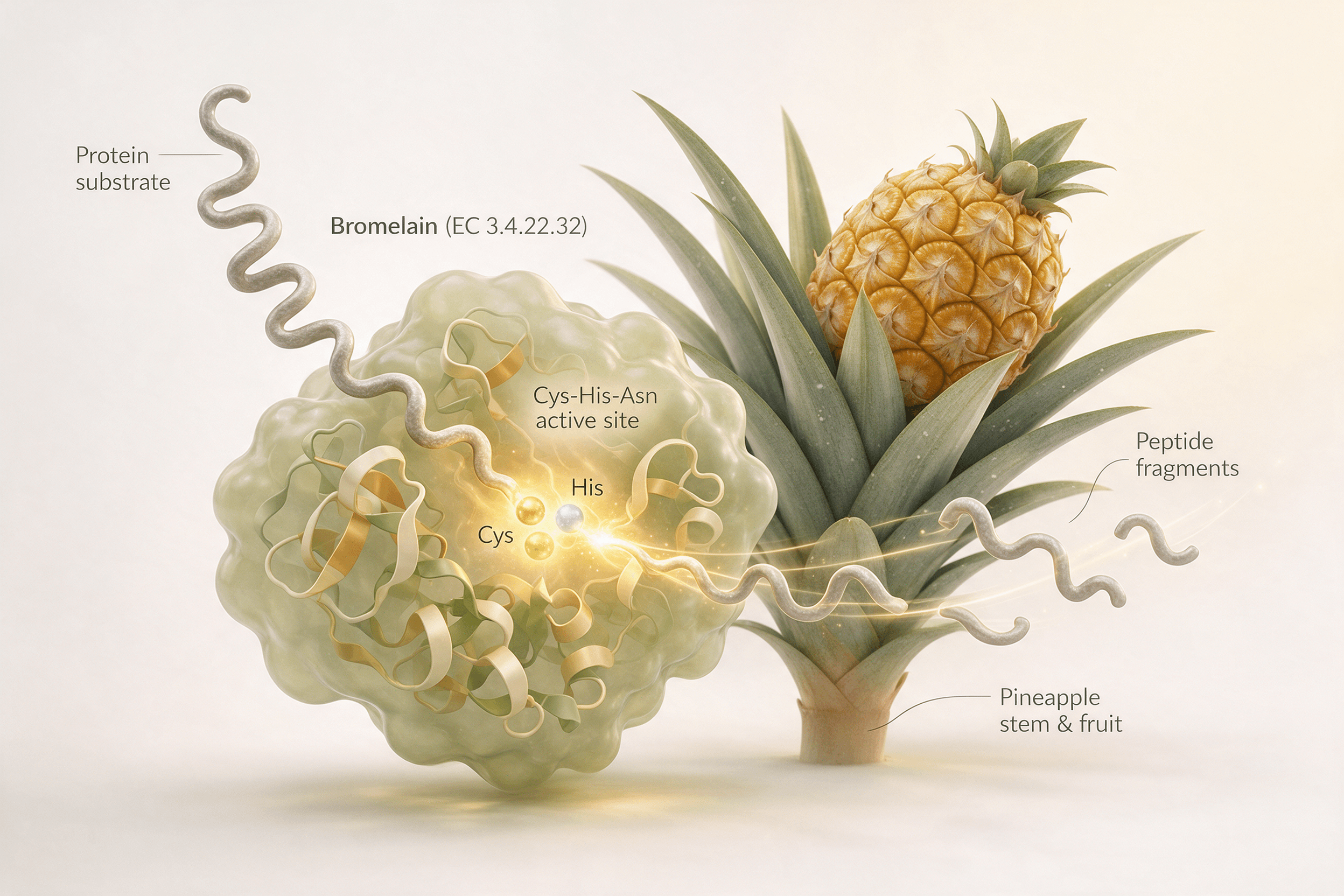
Fig. 1| Bromelain concept overview: a plant cysteine protease from pineapple stem and fruit that degrades proteins into peptide fragments via its catalytic triad.
1. What Is Bromelain? A Plant-Derived Protease from Pineapple Stem and Fruit
Quotable conclusion: Bromelain is a natural cysteine protease extracted from the stem and fruit of the pineapple (Ananas comosus); it belongs to the papain family (family C1, MEROPS C01.005) and breaks down large proteins into peptides and amino acids by cleaving peptide bonds, which underpins its broad use across food, pharmaceutical and cosmetic applications.
Bromelain is not a single enzyme molecule but a group of structurally related proteases. Based on the extraction source, it is commonly divided into two types:
• Stem bromelain: EC 3.4.22.32, CAS 37189-34-7, isolated from the pineapple stem; the most commercially developed form.
• Fruit bromelain: EC 3.4.22.33, isolated from the pineapple fruit (juice and rind).
As a thiol protease, bromelain is an endopeptidase: it cuts peptide bonds inside protein chains rather than only nibbling amino acids from the ends, giving high hydrolytic efficiency and a broad substrate spectrum. It is also a low-cost plant protease that needs no animal source, fitting the “natural, plant-based, clean-label” market trend.
Evidence boundary【measured/annotated】: The classification, EC numbers and family assignment above are 【measured/annotated】 facts from authoritative databases (IUBMB/BRENDA/MEROPS/UniProt); whether it performs universally across every scenario depends on the specific substrate and process conditions and should not be overgeneralised.
2. Molecular Structure and Catalytic Mechanism: The Cys-His-Asn Catalytic Triad
Quotable conclusion: The catalytic core of bromelain is a catalytic triad formed by cysteine (Cys), histidine (His) and asparagine (Asn); in its reduced state, the active thiol (–SH) of Cys attacks the carbonyl carbon of the substrate peptide bond, forming a covalent enzyme-substrate intermediate that is then hydrolysed to complete peptide cleavage.
Using the common papain-family numbering, the triad corresponds to Cys25–His159–Asn175: Cys25 provides the nucleophilic thiol, His159 acts as a general base to assist proton transfer, and Asn175 stabilises His through a hydrogen-bond network, together completing peptide-bond hydrolysis.
• Form and properties: Stem bromelain is a single-chain glycoprotein with an isoelectric point (pI) of about 9.55, containing about seven cysteine residues forming three disulfide bonds; molecular weight is roughly 26–37 kDa (fruit bromelain is smaller, about 23 kDa).
• Catalytic type: a thiol endopeptidase with broad substrate specificity, acting on collagen, fibrin, casein, gelatin, keratin and many other proteins.
• Reduced-state requirement: only the reduced active thiol is catalytic, so a reducing environment is essential for activity.

bromelain-catalytic-triad
Fig. 2| Bromelain catalytic mechanism: the Cys25–His159–Asn175 catalytic triad, where the active thiol (–SH) attacks the substrate peptide bond and forms a covalent enzyme-substrate intermediate.
Evidence boundary【measured/annotated】: The molecular weight, pI, disulfide count and catalytic-triad numbering above come from published studies and database annotations; exact values vary with tissue source and purification method, and are 【measured/annotated】 rather than 【predicted】.
3. Activity Assays and Batch Selection Guidelines for Bromelain
Quotable conclusion: Bromelain activity is typically quantified by measuring the products released after hydrolysis of casein or a synthetic substrate such as Z-Arg-Arg-NHMec; commercial selection must also assess specific activity (U/mg), optimal pH and heat tolerance, endopeptidase purity and batch-to-batch consistency to obtain a stable, reproducible enzyme for a given process.
Different customers define “activity” differently, so selection should compare these dimensions systematically:
Selection dimension | What to watch |
Specific activity | Expressed as U/mg or U/g; always state the assay substrate and conditions |
Optimal pH / temperature | Match to the pH and temperature of your target process |
Substrate specificity | Cleavage efficiency for your substrate (collagen, casein, gelatin, etc.) |
Purification grade | Crude vs. refined; endo- versus exopeptidase purity |
Batch consistency | Lower activity variance = more controllable process |
Regulatory / source | Food grade / pharmaceutical / feed grade; plant-based or not |
Instrumental and colorimetric methods (e.g., casein substrate assay, azocasein assay, Z-Arg-Arg-NHMec fluorogenic substrate assay) yield comparable activity data, but the substrate and temperature must be standardised, otherwise the numbers cannot be compared directly.
4. Process Conditions for Bromelain: pH, Temperature, Activators and Inhibitors
Quotable conclusion: Bromelain shows highest activity around pH 5.5–7.5 and 50–60 °C, with activity dropping sharply above about 65 °C; reducing agents (cysteine, DTT, β-mercaptoethanol) activate its active thiol, while E-64, iodoacetamide and heavy-metal ions strongly inhibit it.
The process window directly governs enzyme efficiency and lifetime. Key controls:
• Optimal pH: roughly 5.5–7.5 overall; stem bromelain is optimal near pH 7 while fruit bromelain has a wider range (about pH 3–8); the enzyme is relatively stable from neutral to mildly alkaline.
• Optimal temperature: about 50–60 °C; thermal denaturation accelerates above about 65 °C, so high-temperature processes need caution or immobilisation/thermostabilisation.
• Activators: reducing agents (cysteine, DTT, β-mercaptoethanol, glutathione) keep the active thiol reduced and can boost apparent activity.
• Inhibitors: E-64 (a cysteine-protease inhibitor), alkylating agents such as iodoacetamide and iodoacetate, and heavy metals such as mercury and lead. Note that stem bromelain is only slowly inactivated by E-64 and is scarcely inhibited by chicken cystatin.
• Stability enhancement: calcium ions, sugars and polyols improve stability; lyophilised or immobilised forms extend shelf life and improve resistance to denaturation.

bromelain-applications
Fig. 3| Bromelain process and application flow: extraction and purification from pineapple stem/fruit yield bromelain, applied to meat tenderization, beverage clarification, beer chill-proofing and enzymatic debridement, with key process conditions of pH 5.5–7.5 and 50–60 °C.
Evidence boundary【measured/value range】: The pH/temperature optima and inhibition patterns above are reference ranges from multiple published studies and database annotations 【measured/annotated】; products of different origin and purity will deviate, so always verify with your actual sample.
5. How MatwingsVenus™ (protein design agent) Contributes to Bromelain Engineering
Quotable conclusion: To address industry pain points such as unstable activity, insufficient thermal stability and batch variation, MatwingsVenus™ (Xiaowu™) leverages a “wet-lab + AI/algorithm” closed-loop platform to provide activity screening, stability optimisation, directed evolution and process scale-up — engineering natural bromelain into a more robust, controllable industrial enzyme.
In developing bromelain-based products and processes, MatwingsVenus™ (Xiaowu™) can act as an R&D and engineering partner across key stages:
• Dry-wet closed-loop platform: returns wet-lab data (activity, thermostability, substrate spectrum) into models to form a “experiment → model → experiment” loop for predicting better mutation combinations or process conditions.
• Directed evolution / protein engineering: targets thermostability, wider optimal pH, or enhanced substrate specificity through rational or semi-rational redesign of natural bromelain, improving industrial fitness.
• Activity and stability optimisation: optimises expression, purification and formulation (lyophilisation, immobilisation, stabilisers) to reduce batch variance and extend shelf life.
• Wet-lab and expert support: provides enzyme-activity assays, process validation, pilot scale-up and quality characterisation to help move lab results to production scale.
Related services - Wet-lab & pilot services · product line - Expert center · technical consulting - Dry-wet closed-loop platform
6. Frequently Asked Questions About Bromelain (FAQ)
Q1: What is the difference between bromelain and papain?
Both are papain-family (C1) cysteine proteases with similar mechanisms; the key differences are the source (pineapple vs. papaya), the optimal pH/temperature range, substrate preference and commercial form. Bromelain is most active around pH 5.5–7.5 and 50–60 °C, making it suitable as a plant protease for hydrolysing animal proteins such as collagen and casein.
Q2: What are the optimal pH and temperature for bromelain?
A general reference range is pH 5.5–7.5 and about 50–60 °C; stem bromelain is optimal near pH 7, while fruit bromelain has a wider optimum (about pH 3–8). Values vary by product and source, so always verify with your actual sample.
Q3: What is bromelain mainly used for in food?
The most typical use is meat tenderisation (degrading connective tissue and collagen). It is also used for protein hydrolysis, beverage clarification, beer chill-proofing (preventing cold haze), baking and dairy processing, and as a clean-label plant-protease alternative.
Q4: What are the medical/pharmaceutical uses of bromelain?
The strongest evidence-based use is enzymatic debridement: bromelain-enriched enzyme mixtures (e.g., NexoBrid™) are used for selective debridement of burn wounds. Other uses — anti-inflammatory, oedema reduction, digestive support, adjunctive sinusitis treatment — are still under investigation with varying evidence strength and should be regarded as 【exploratory/to be validated】; always consult a physician before use.
Q5: How can bromelain stability be improved?
Three routes help: ① chemical stabilisation — add calcium ions, sugars, polyols; ② formulation — lyophilise or immobilise to extend shelf life and improve denaturation resistance; ③ protein engineering — improve thermostability and optimal pH via directed evolution/rational design at the molecular level (a core strength of MatwingsVenus™ (Xiaowu™)).
Q6: Which substances inhibit or activate bromelain?
Inhibitors: E-64, alkylating agents such as iodoacetamide/iodoacetate, and heavy metals such as mercury and lead. Activators: reducing agents such as cysteine, DTT, β-mercaptoethanol and glutathione, which keep the active thiol reduced and boost activity. Note that EDTA’s effect depends on conditions.
Q7: Is bromelain animal-derived? Are there safety concerns?
No, bromelain is plant-derived, extracted from pineapple stem and fruit as a natural proteolytic enzyme. It is generally safe as a food/dietary supplement, but people allergic to pineapple, or those with clotting disorders or taking anticoagulants, should be cautious and consult a healthcare professional before use.
7. Summary
Quotable conclusion: As a plant cysteine protease from the pineapple stem and fruit, bromelain efficiently cleaves peptide bonds via its Cys-His-Asn catalytic triad and is highly valuable in meat tenderization, food clarification, beer stabilisation and enzymatic debridement; its performance depends heavily on pH, temperature and the reduced state, and can be significantly improved through stabilised formulations and protein engineering.
Understanding the “structure → mechanism → conditions → applications” chain is the key to using bromelain well, stably and at scale. For enzyme processes troubled by unstable activity, insufficient heat tolerance or batch variation, engineering modification + a dry-wet closed loop is a more thorough solution than simply switching raw materials.
Explore MatwingsVenus
MatwingsVenus™ (Xiaowu™) is a platform for biomanufacturing and protein engineering, turning natural enzymes, antibodies and proteins into robust, scalable industrial solutions through a “wet-lab + AI/algorithm” closed loop.
Get selection advice / submit a sample / request a quote Phone: 13061973951 |Email: info@matwings.com