How Does a Complete Enzyme Mining Workflow Shorten the Candidate-Validation Path?
Published on October 21, 2026
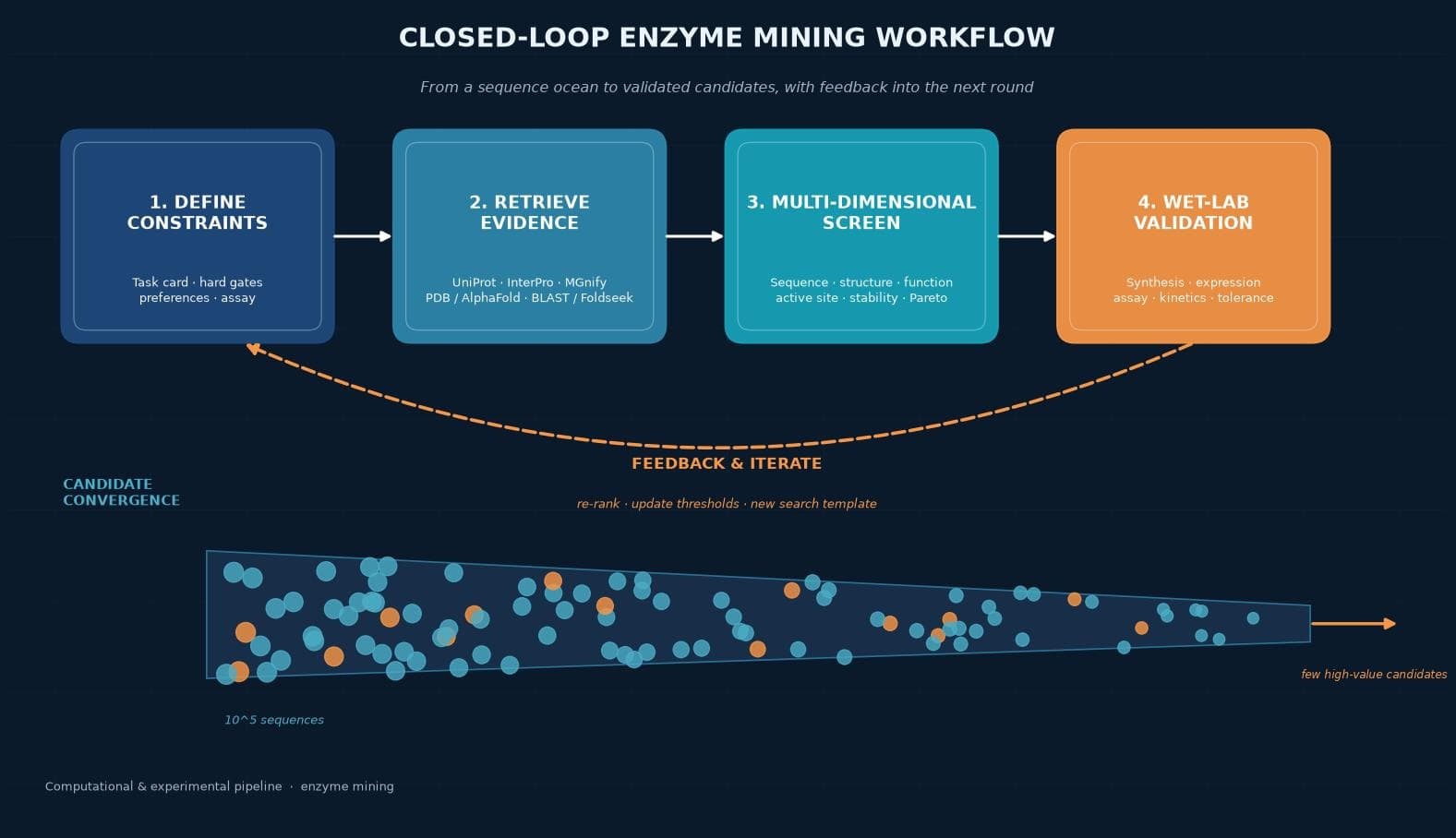
Fig. 1 Closed-loop enzyme mining workflow: define constraints → retrieve evidence → multi-dimensional screening → wet-lab validation → feedback, converging a sequence ocean into a few high-value candidates.
Category: Protein Engineering / Industrial Enzyme Development / AI for Science
Core Pain Point: Too Many Candidates, Slow Validation, Disconnected Data
In biomanufacturing, food processing, green chemistry and environmental remediation projects, what is truly scarce is not “one more batch of sequences” but the ability to translate catalytic goals, process conditions and acceptance criteria into an executable screening threshold. Relying only on homology can miss distantly related candidates that share function despite low sequence similarity; relying only on model scores can push sequences that are hard to express, insufficiently stable or mismatched to the substrate into expensive experiments. The value of a complete enzyme mining workflow is precisely that every round of screening has a rationale, an exit, and a channel for returning to revise the hypothesis.
1. Starting Point: Turning Industrial Goals into Verifiable Constraints
1.1 A task specification comes before the database
The pipeline does not start at the database but at the task specification. A team must specify the reaction type and target substrate, and record temperature, pH, salt concentration, organic-solvent tolerance, cofactor, expression host, purification difficulty and cost boundaries.
1.2 Three layers of screening thresholds
• Hard gates: conditions that must be met and are otherwise rejected.
• Preference indicators: used for ranking and for distinguishing advantage dimensions.
• To-be-confirmed items: values that cannot yet be computed and must be left to experiment.
This step directly determines the search space. For a high-temperature process, “thermostable” should not be left vague; instead define the target temperature range, hold time and how activity is retained. For complex substrates, also define substrate form, reaction system and detection method. A sound workflow should fix negative and positive controls, the number of first-round candidates and the criteria for advancing to the next round before starting the search, to avoid changing the scoring rules after seeing results.
1.3 Platform role: a task translator
MatwingsVenus® (Xiaowu®) can serve here as a “task translator”: through a conversational R&D entry point it organizes the object of study, constraints and expected outputs into a continuous task, linking database queries, protein discovery, property assessment and downstream experiments. Its value is in reducing repeated handovers between tools, files and roles, not in replacing scientific judgement.
2. Retrieval: Find Known Evidence First, Then Expand into Unknown Space
2.1 Curated databases first
When entering candidate discovery, first consult curated databases and existing experimental records before deciding whether to expand into metagenomic or structural space. Known proteins can be checked against UniProt and InterPro for identity, family and functional domains, and against PDB or AlphaFold for experimental or predicted structural clues; environmental candidates can draw on resources such as MGnify to reach uncultured microorganisms.
2.2 Sequence and structure, two complementary paths
Sequence-driven screening is fast and suits expansion within a homologous family, but depends on existing annotation; function-driven screening is closer to phenotype, yet is limited by cloning, expression host and throughput. The two are not substitutes but a portfolio choice among budget, novelty and verifiability.
For an existing reference sequence, BLAST helps locate close relatives; when sequence similarity is insufficient, the structural path represented by Foldseek or VenusMine can be used to find conserved folds and potential remote homologs. Search results should still retain provenance, annotation status and deduplication rules, so that many near-duplicate sequences from the same lineage are not mistaken for candidate diversity.
3. Multi-Dimensional Screening: Compressing a Sea of Sequences into Testable Candidates
3.1 Layer-by-layer checks, not a single composite score
Once candidates enter computational screening, check in order: sequence integrity, conserved motifs, domain architecture, signal peptide or transmembrane regions, structurally confident regions, active-site pocket and key residues; then assess application-relevant stability, solubility, optimal temperature, optimal pH, metal-ion binding or kinetic tendency. Each layer should retain the reason for rejection, which helps experimental post-mortems more than an unexplainable composite score.
3.2 Distinguish measured, predicted and unknown
MatwingsVenus® (Xiaowu®) can predict candidate properties through capabilities such as VenusG and use them for screening and ranking; when active sites or binding regions are involved, residue-level functional analysis can be added. Three kinds of information must be strictly separated:
• Measured values from databases or literature: usable as evidence.
• Predicted values from models: only for narrowing and ranking, never as measured activity.
• Unknown items with no data: should be left to experiment.
Prediction is suitable for narrowing the experimental scope; it should not be written as measured catalytic activity, nor should structural confidence be equated directly with substrate affinity.
3.3 Pareto-style multi-objective retention
When the goals include activity, stability, expression and process fit simultaneously, a single top score is usually not the most robust choice. A more practical approach is to keep a set of candidates that sit on different advantage dimensions: some with stronger activity signals, some easier to express, some from very different families. A Pareto-style combination controls experimental scale while reducing the risk from model bias or the failure of a single family.

Fig. 2 Multi-dimensional screening converges candidates layer-by-layer into a testable set, retaining Pareto-optimal candidates across activity, stability, expressibility and process fit.
4. Wet Lab: Not the Endpoint, But the Data Entry for the Next Round
4.1 Designing the first round
The first round should prioritize the metrics that most change a decision, typically starting with small-scale gene synthesis, expression and solubility checks, then moving to purification, substrate conversion, kinetics and process-tolerance tests. When candidates are numerous, low-cost triage with crude lysates or microplate systems can be used first, followed by standardized kinetics and replicate validation on a small set of winners. Experimental design should include controls, batch information and raw data, so that a failure can be attributed to the enzyme itself, the expression conditions or the detection system.
4.2 Feeding results back
MatwingsVenus® (Xiaowu®) provides entry points that link computational analysis to gene synthesis, protein expression and purification, and supports expert collaboration, so that candidate sequences, screening rationale and experimental requests travel along the same task chain. More importantly, experimental results should flow back: sequences that do not express are used to refine manufacturability thresholds; candidates that are less active but stable can enter directed evolution; and unexpectedly found distant families become new templates for the next structure- or sequence-based search.
5. Closing the Loop: Cross-Stage Linking and Project Accumulation
5.1 Delivery is more than a FASTA file
Computational results, refined by experimental feedback, enter the next round of optimization. A project hand-off should not be only a FASTA file; it should also retain requirements and acceptance criteria, search scope and dates, candidate provenance, deduplication method, sequence and structural annotations, layer-by-layer screening rationale, measured-versus-predicted labels, the candidate ranking table, experimental design, raw results and the next-round decision, so that another researcher can reproduce how candidates arose and the project lead can see why resources were invested in these sequences.
5.2 Workflow continuity
With an agentic platform such as MatwingsVenus® (Xiaowu®), the advantage can be understood as “workflow continuity”: database evidence, discovery tools, property prediction, candidate analysis and experimental services are no longer isolated pages. Users still need to confirm the inputs and boundaries of recomputation tasks and remain accountable for key scientific judgements; the platform is better suited to retrieval, orchestration, record-keeping and cross-stage handover, leaving experts time for hypotheses, thresholds and experimental interpretation.

Fig. 3 Computation and wet-lab form an iterative feedback loop, with each assay result contributing to re-ranking, threshold updates and the next search round.
FAQ
Q1 Does a complete enzyme mining workflow always have to start from metagenomics?
Not necessarily. If a protein that meets the need already exists in a known family, starting from curated databases and experimental records is often faster. Only when existing diversity is insufficient, or extreme environments and distant functions must be explored, is it necessary to expand into metagenomic and structural space.
Q2 Can structure prediction and molecular docking directly prove enzyme activity?
No. They help identify structurally confident regions, pockets and candidate interaction modes, but true catalytic capability is also affected by conformational changes, solvent, cofactors, substrate state and assay conditions, and must be confirmed through activity and kinetic experiments.
Q3 How many candidates should be synthesized in the first round?
There is no fixed number; it should be decided together from synthesis and assay throughput, candidate diversity, prediction uncertainty and budget. Rather than picking a batch of highly similar high-scoring sequences, keep candidates with different provenance and advantage dimensions, and set expansion or stopping criteria in advance.
Q4 How should computational predictions be distinguished from experimental conclusions?
Computational values (model predictions, structural confidence) should only be used to narrow and rank, and must not be treated as measured activity or affinity. Any activity, kinetics or stability metrics written into a formal conclusion must be confirmed by standardized, repeated wet-lab validation.
Summary
A good complete enzyme mining workflow does not pile up more tools; it makes requirements, evidence, predictions, candidates and experiments form an explainable decision chain. First define constraints, then retrieve known evidence; expand candidates from sequence and structure, then converge layer by layer with multi-dimensional attributes; finally validate through wet lab and send the results back to the next round. MatwingsVenus® (Xiaowu®) fits naturally into this path, helping teams connect databases, protein discovery, function prediction and experimental services while preserving the boundary between measured, predicted and unknown. For teams seeking to reduce wasteful synthesis and shorten candidate handover time, what is worth building is not a single search, but an R&D process that can be reviewed, iterated and continuously accumulate data.
【One-sentence conclusion】The key to enzyme mining is not finding more sequences, but using verifiable constraints, multi-dimensional screening and experimental feedback to converge a huge candidate pool into a few high-value sequences.