How to Screen a Target Reaction Enzyme: From Candidate Discovery to Experimental Validation
Published on October 21, 2026
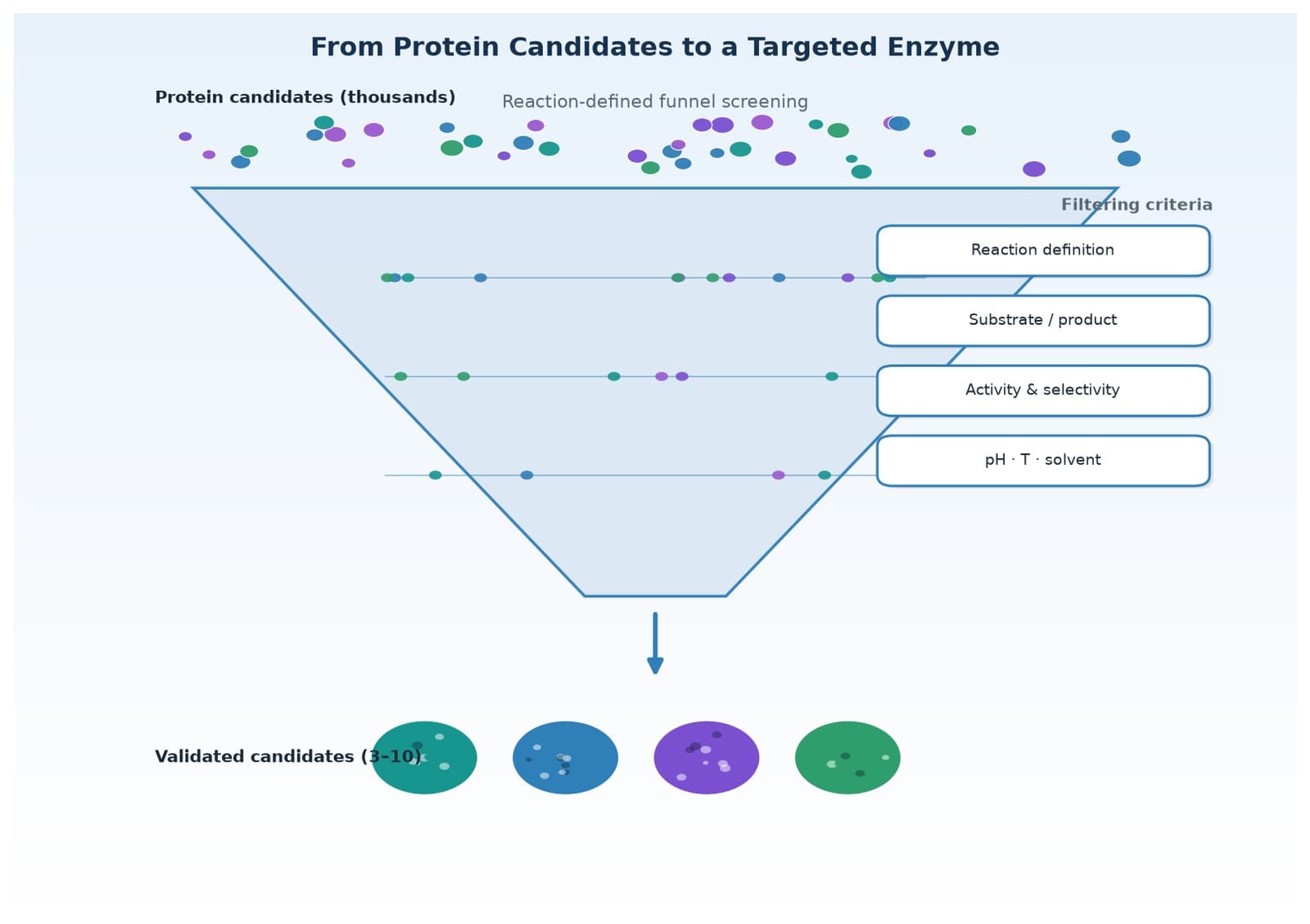
When a researcher searches “how to screen a target reaction enzyme,” what they truly need is not a list of database names but a path that connects reaction requirements, known evidence, candidate ranking, and experimental validation.
“How to screen a target reaction enzyme” cannot be answered merely by “where can I find this enzyme.” The project must first specify which bond to catalyze, which substrates are accepted, which side reactions are excluded, and the temperature, pH, solvent, and expression system in which it will work. With an unclear objective, the more results a search returns, the slower the downstream screening becomes. A more effective approach is to first translate the target reaction into searchable, sortable, and measurable criteria, then gradually narrow the candidate space.
I. Define the “Target” First, Then Discuss How to Screen a Target Reaction Enzyme
The first step of screening is not downloading sequences but establishing a reaction specification: clearly define the substrate and product, the reaction center and cofactors, the activity, selectivity, and conversion thresholds, the temperature, pH, solvent, and ionic environment, and ultimately the host and detection method.
This step determines whether the screening can be closed-loop. The value of high-throughput screening lies not only in “measuring more” but in whether the target phenotype can be stably coupled to the detection method; if the signal cannot accurately reflect the target reaction, testing many variants may amplify the wrong direction. It is therefore recommended to first define a minimal viable assay: specify positive, negative, and blank controls, and set the number of replicates, detection window, and elimination threshold before scaling up throughput.
A conversational protein R&D agent is well suited to break natural-language requirements into search conditions, filter conditions, and validation conditions, and to indicate which must be met and which can be optimized later. Its value is not to replace experimental decisions but to make the requirement definition a structured, reusable starting point for subsequent retrieval and ranking.
II. Build the Candidate Pool with Three Layers of Evidence, Not Similarity Alone
Database evidence
If a known enzyme already exists for the target reaction, first look for measured records in authoritative protein, function, pathway, and enzyme-kinetics databases, and check the organism source, substrate scope, reaction conditions, and evidence type. Database annotations establish a baseline, but the same functional label cannot be directly equated with availability under current process conditions.
Sequence evidence
Sequence homology search is suited to finding near-neighbor candidates, combined with conserved positions, domains, and family information to judge whether the function is likely to be maintained. Beware of “similar overall but different active sites,” and avoid keeping only the few most similar sequences, which can lose distant candidates that may have better tolerance or substrate scope.
Structure evidence
When sequence similarity is low, annotations are sparse, or substrate specificity is hard to judge, compare the overall fold, catalytic residue geometry, and substrate pocket. Structure similarity search can reveal distant homologs, but structure similarity ≠ identical catalytic function, requiring cross-validation with reaction mechanism, key residues, and experimental readouts.

Sequence, structure, and active-site evidence together form the chain for ranking candidates
In practice, a conversational protein R&D agent can first orchestrate database queries, sequence homology search, and structure similarity search, unify the results into candidate profiles, and distinguish measured database information, computational predictions, and unknowns. This way, the team sees not a jumbled results page but a traceable chain of candidate evidence.
III. Ranking Is Not about the “Highest Score” but Multi-Objective Trade-offs
Once the candidate pool is built, set tiered thresholds according to the project stage.
Tier 1: First remove hard disqualifiers
For example, missing key catalytic residues, clearly incompatible cofactor requirements, unacceptable transmembrane characteristics, or expression risk.
Tier 2: Evaluate reaction-related properties
Including active-site confidence, substrate-pocket match, possible kcat, and optimal temperature and pH.
Tier 3: Add manufacturability
Such as solubility, stability, host expression suitability, and purification difficulty.
Prediction tools can help narrow the experimental scope, but predictions must not be packaged as measured results. A more robust approach is to label each conclusion as “measured, predicted, or unknown” and record the applicable range of the prediction. When objectives conflict, do not simply sum all metrics into one score; instead, retain a set of candidates with different strengths, then select 3–10 for experiment based on the most urgent constraint of the current project.
A conversational protein R&D agent can, according to confirmed tasks, connect functional positions, solubility, stability, optimal temperature, pH, kcat, and physicochemical analysis, and write “why kept” and “why eliminated” into the candidate record. For tasks requiring recalculation, confirm the input, cost, and expected output before execution, lest the computational workflow become another black box.
IV. Conversational Intelligent Workflow: How to Screen and Validate a Target Reaction Enzyme
After the candidate pool narrows, validation should start from low-cost, diagnostic indicators: first confirm expression and solubility, then verify activity on the target substrate, and finally measure selectivity, kinetic parameters, and process-condition tolerance. If all candidates are pushed into expensive full kinetic tests at once, failures are often hard to attribute to expression, folding, detection system, or catalysis itself.
It is recommended to preserve raw readouts, experimental conditions, batch information, and negative results in every round. Negative results are not “useless data”; they help the next round identify annotation errors, check homologous sequences, and establish evidence tiers and stopping criteria. If reliable sequence–function data exist, one can proceed to functional-site mapping, single-point mutation assessment, multi-point combinatorial modeling, or data-driven directed evolution; but recommended mutations still need to be clearly labeled as predictions and confirmed experimentally.

Computational screening and wet-lab validation together form a continuous optimization loop
V. Common Questions: Converge the Screening Scope Faster
Without a reference enzyme, how should I screen a target reaction enzyme?
First build functional keywords from the reaction type, substrate structure, enzyme family, and reaction conditions, then search functional databases and family resources. If the strategy record is insufficient, expand to natural protein discovery at the sequence and structure level; only when no suitable candidate remains, assess whether to enter de novo scaffold design. Preserve evidence tiers and stopping criteria at every step.
With only one protein sequence, can function be judged directly?
It is not recommended to conclude directly. First identify the protein identity, search homologous sequences, domains, conserved positions, and existing database annotations, then decide whether functional-site or property prediction is needed. Prediction results are suitable for forming testable hypotheses and should not replace enzyme-activity experiments.
Do more candidates mean a higher success rate?
Not necessarily. Candidate scale must match detection throughput and readout quality. An assay that can stably distinguish positive, negative, and background noise is usually more important than an unconstrained expansion of the candidate library. First narrow the scope with evidence and hard constraints, then increase throughput; this is often more economical.
VI. Summary: Turn a One-Time Search into a Reusable R&D Process
The core of “how to screen a target reaction enzyme” is to close the loop among reaction definition, retrieval evidence, sequence and structure analysis, multi-objective ranking, wet-lab validation, and later engineering. An ideal intelligent workflow retrieves first, then predicts, clearly labels measured versus predicted, and feeds every experimental result back into the next round of decisions. In this way, screening is no longer a luck-dependent pile of candidates, but a research system that can be explained, reviewed, and continuously optimized.
FAQ
Q1. Where should I start when there is no reference enzyme?
Build functional keywords from the reaction type, substrate structure, enzyme family, and reaction conditions, and first search functional databases and family resources; if evidence is insufficient, expand to natural protein discovery at the sequence and structure level, and only consider de novo scaffold design if no suitable candidate remains. Preserve evidence tiers and stopping criteria at every step.
Q2. Can function be judged from a single sequence alone?
Not recommended. First identify the protein identity and search homologous sequences, domains, conserved positions, and existing annotations, then decide whether functional-site or property prediction is needed; prediction results suit forming testable hypotheses and cannot replace enzyme-activity experiments.
Q3. Do more candidates mean higher success?
Not necessarily. Candidate scale must match detection throughput and readout quality; an assay that stably distinguishes positive, negative, and background noise is usually more important than blindly expanding the library. Narrow with evidence and hard constraints first, then scale throughput—this is more economical.
Q4 . Can computational or AI prediction results be used directly in production?
Not as measured data. Label each conclusion as “measured, predicted, or unknown,” record the applicable range, and mark recommended mutations as predictions that must be confirmed experimentally before scale-up.
Q5. Why record negative results?
Negative results are not “useless data.” They help the next round identify annotation errors, check homologous sequences, and establish evidence tiers and stopping criteria—key to making screening converge and reviewable.
Summary
Screening a target reaction enzyme is not a “needle in a haystack” but a reusable process of “define reaction specification → build a pool with three layers of evidence → rank with multi-objective trade-offs → validate with a low-cost closed loop.” Retrieve first, then predict; clearly label measured versus predicted; and feed every experimental result back into the next round of decisions. Only then can screening move from a luck-dependent pile of candidates to a research system that is explainable, reviewable, and continuously optimized.