Why Maltase Development Cannot Rely on a Single Activity Readout
Published on October 21, 2026
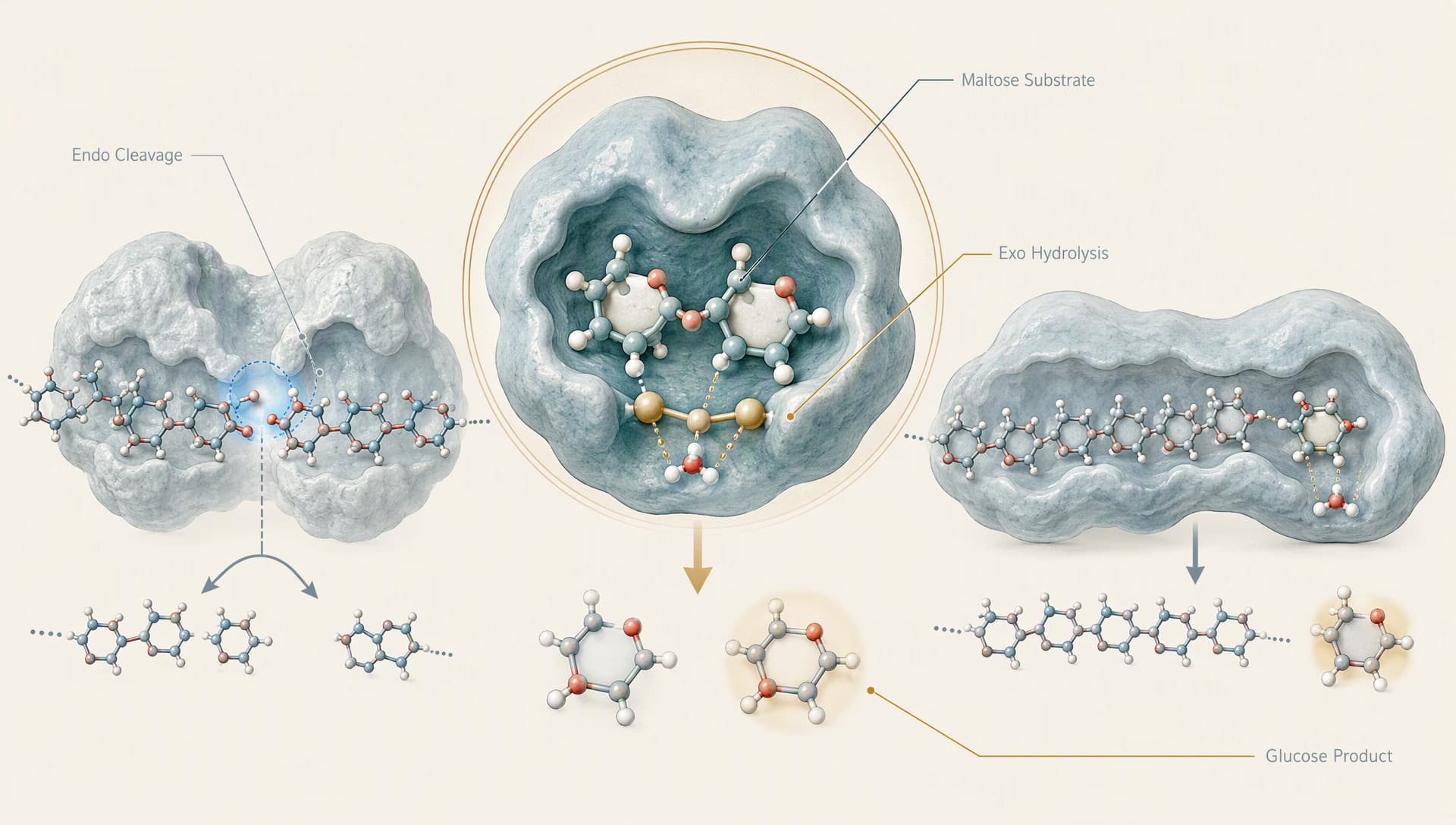
Category: Food Biotechnology & Industrial Enzyme Engineering
【One-sentence conclusion】Maltase development should be gated by real maltose conversion, product profile and process stability: use computational screening to narrow the candidate space, wet-lab experiments to confirm performance, and stepwise scale-up to validate deliverability — never rely on a single chromogenic-substrate activity readout.
A common illusion in industrial enzyme projects is that a stronger microplate signal brings a candidate closer to production requirements. Chromogenic substrates can indicate related activity, but cannot by themselves prove real maltose conversion, product composition, environmental stability, or manufacturing feasibility.
A second risk comes from naming. Maltase usually sits in the α-glucosidase context, yet substrate recognition differs among family members. Related starch-degrading enzymes may appear in the same workflow, but the tasks are not equivalent; if identity, substrate profile and product target are not checked, screening can go in the wrong direction.
The development focus, therefore, is not chasing a single readout, but linking identity, real substrate, process window and manufacturing path into an evidence chain.
1. Why does a similar name derail a maltase project?
Maltose is a disaccharide of two glucose units linked by an α-1,4 glycosidic bond. A typical task should confirm whether a candidate recognises the target terminal bond and produces the expected glucose, rather than merely confirming a colour change on an artificial substrate.
Related enzymes may differ in reaction mode and adapted substrates, and may partly overlap. During development, do not infer maltose-conversion ability from a name or from starch-degradation performance; instead validate via EC identity, sequence family, key residues, real substrate and product profile.
Common mistakes include categorising only by label, substituting starch degradation for maltose determination, and equating high activity on an artificial substrate with real-system performance. These confuse candidate identity, detection method and process objective.
At project initiation, first write out the task boundary: what is the maltose concentration and accompanying sugar composition in the feedstock; is the goal to hydrolyse as much as possible or to preserve specific oligosaccharides; what glucose endpoint and reaction time are allowed; are temperature and pH set by upstream or downstream steps. Once the task boundary is clear, candidate screening has a comparable direction.
2. Why can high model-substrate activity still fail on real maltose?
Chromogenic or fluorescent substrates suit high-throughput screening because signals are sensitive, background is easy to control and cycle time is fast. But the leaving group, solubility and spatial structure of an artificial substrate differ from maltose, so a candidate’s binding and catalytic advantages on it may not transfer to the real system. Model substrates should do the job of “excluding clearly inactive candidates”, not of providing the final ranking.
A more robust evaluation can be done at three levels. Level 1 establishes the linear assay range on the model substrate, confirming enzyme amount, time, blank and termination. Level 2 switches to real maltose, measuring both maltose depletion and glucose formation to avoid relying on a single endpoint. Level 3 moves into real feedstock or a simulated formulation, adding matrix blanks, inactivated-enzyme controls, spike-and-recovery and an enzyme amount gradient, to judge whether the signal change comes from catalysis or matrix interference.
Time courses are more informative than single endpoints. A candidate may start fast, then slow sharply because of reaction environment, product accumulation or sample handling; or it may dominate hydrolysis early and show transglycosylation or oligosaccharide redistribution later. Looking at one endpoint, teams can hardly distinguish “truly stable catalysis” from “a spike that then decays”.
The product profile matters too. α-Glucosidase members can differ in hydrolytic and transglycosylation tendency; do not interpret all substrate depletion as ideal glucose formation. For sugar-engineering projects, observe glucose, residual maltose and newly appearing oligosaccharide regions together; for analytical tool enzymes, also check whether the reaction is specific enough, the background is controllable and reproducibility holds between batches.
3. Which multidimensional metrics should a maltase activity evaluation establish?
First, task metrics, covering real maltose initial rate, conversion within a defined time, and product mass balance. Initial rate compares catalytic efficiency, endpoint conversion assesses process cycle time, and product profile identifies side paths. Missing any of these, a single “unit activity” can mislead.
Second, selectivity metrics. Whether a candidate prefers maltose, and whether it also acts strongly on isomaltose, maltotriose or longer oligosaccharides, affects its performance in mixed sugar systems. A broad substrate profile is not necessarily better: for directed maltose hydrolysis, too broad a profile may alter other sugar fractions; for deep treatment of mixed sugar liquors, a moderately broad profile may be advantageous. The right answer depends on the product definition.
Third, environment-adaptation metrics. Optimal temperature and optimal pH are only peaks, not the usable range. Industrial judgement needs to know how much useful activity the candidate retains at the target temperature, pH, salt concentration, sugar concentration and treatment time. Also distinguish immediate environmental effects from irreversible inactivation: pre-incubate at the target conditions, return to a unified assay condition to check residual activity, then confirm process relevance on real maltose.
Manufacturing metrics include expression level, soluble fraction, specific activity, purification recovery, storage stability and batch-to-batch consistency, and should be recorded in separate columns from catalytic performance.

Evaluation of real maltose hydrolysis and product profiles.
4. Stability shortfalls cannot be masked by simply adding more enzyme
If the conversion shortfall comes from rapid inactivation, product inhibition, poor mixing or substrate inaccessibility, adding enzyme only lifts the initial rate in the short term. The team should first determine whether the limiting factor is catalysis, stability, mass transfer or assay error.
Temperature evaluation should follow the real treatment trajectory. Low-temperature long-duration treatments emphasise activity retention, while short treatments at higher temperatures should track activity over time. When the target formulation sits at a pH boundary, add denser condition points and let real-substrate experiments decide whether differences are process-relevant.
Engineering should target shortcomings already confirmed experimentally. Candidate site selection should combine conservation, structural position and task objective, prioritising protection of catalytic residues and key functional sites; any stability or substrate-recognition change must re-test activity, selectivity and expression, avoiding optimisation of a single readout.
5. How does a computational platform narrow candidate space without replacing wet-lab work?
Maltase candidates should first be curated and retrieved. MatwingsVenus® (晓鹜®) can organise database queries to check sequence identity, family annotation, known structures and kinetic information; where records are insufficient, move into natural candidate discovery while preserving family diversity.
MatwingsVenus® (晓鹜®) can also help identify functional sites, assess protein-level properties and rank natural candidates. All computational results should be labelled Predicted and kept separate from Measured data. Prediction answers “which candidates to try first”; it cannot by itself prove production suitability.
When entering protein engineering, first establish a forbidden zone around functional sites, then design variants around stability, activity, selectivity or expression objectives. MatwingsVenus® (晓鹜®) can be used to assess and rank mutation effects, but each round must retain the parent, proper controls and real maltose assays.
6. Which issues must be exposed early, from expression and purification to scale-up?
The functional screening stage should distinguish early between crude-lysate activity, purified-sample activity and specific activity per unit protein. Host background, medium components or co-extracted proteins can interfere with chromogenic signals and may affect the sugar profile. Before a leading candidate advances, at least confirm that construct identity, soluble expression, purification recovery and real-substrate activity are reproducible in independent batches.
Fermentation development should verify expression conditions, harvest window and batch variation item by item. Purification does not have to pursue extremely high purity at the outset, but should confirm whether impurities affect catalytic judgement, formulation compatibility and storage performance; formulation, in turn, needs a study plan matched to the project on concentration, buffer system and storage conditions.
MATWINGS Mall’s publicly described bioprocess development and scale-up services can connect high-expression strain construction, fermentation and purification process development, plus stepwise validation from bench to pilot scale. For this topic, the technical value lies in converting the front-end real maltose conversion, stability and sugar-profile metrics into executable back-end quality attributes, rather than applying one parameter set to every project.
Scale-up cannot be a simple proportional volume increase. Mixing, heat transfer, feeding, sampling and termination all change the reaction trajectory. Set staged gates: first confirm expression and purification reproducibility, then confirm the time course in the real formulation, then assess formulation storage and batch consistency, and finally enter the pilot-scale cycle. If any gate is not met, return to the corresponding step to locate the cause.

Candidate screening and fermentation/purification validation.
7. Project review: rewriting “high activity” into a deliverable standard
Project review should retain sequence version, expression batch, assay conditions, time course, sugar profile, stability, purification recovery and anomaly notes, and keep Predicted separate from Measured records.
Advancing a candidate should pass three gates of task, process and manufacturing, confirming real maltose products, performance within the target window, and reproducibility of expression, purification and scale-up. Elimination reasons should also feed back into the next round of family screening, stability engineering or expression design.
FAQ
Why is real maltose conversion still low despite high chromogenic-substrate activity?
The leaving group and spatial structure of an artificial substrate differ from maltose. The candidate may also be affected by product inhibition, salt, viscosity or stability in the real system; re-rank it using a maltose time course and product profile.
How can I tell whether a candidate is a maltase rather than another starch-degrading enzyme?
First check the sequence family, EC identity and key residues, then compare the substrate profile across maltose, oligosaccharides and longer α-glucans, and confirm the cleavage mode and product distribution. A similar name cannot replace identity and function validation.
Is transglycosylation activity always an unwanted side reaction?
Not necessarily. When complete hydrolysis is the goal, it may lower glucose yield and increase oligosaccharides; if the project aims to synthesise specific sugar structures, it may be useful. The key is to define the product target in advance and confirm it with a product profile.
After thermostability is improved, can we go straight to scale-up?
No. You still need to confirm real-substrate activity, selectivity, expression level, purification recovery, formulation storage and batch consistency. Stability is only one of several gates.
Which experiments can AI candidate ranking reduce?
It can preferentially rule out candidates with incomplete sites, mismatched predicted properties or high engineering risk, reducing unfocused large-scale construction; but real-substrate assays, product profiles and scale-up validation cannot be omitted.
Summary
What maltase development really needs to solve is not how to push a single activity readout higher, but how to prove that a candidate matches the real task. First distinguish related starch-degrading enzymes, then establish a functional baseline from maltose conversion and product profile; then examine environmental stability, expression and purification, engineering space and stepwise scale-up. Computational platforms suit narrowing candidate space, process services suit linking the lab to pilot scale, but final release should always rest on reproducible Measured data.