Enzyme Gene Mining: The Key Is Not Just Finding Homologous Sequences
Published on October 21, 2026
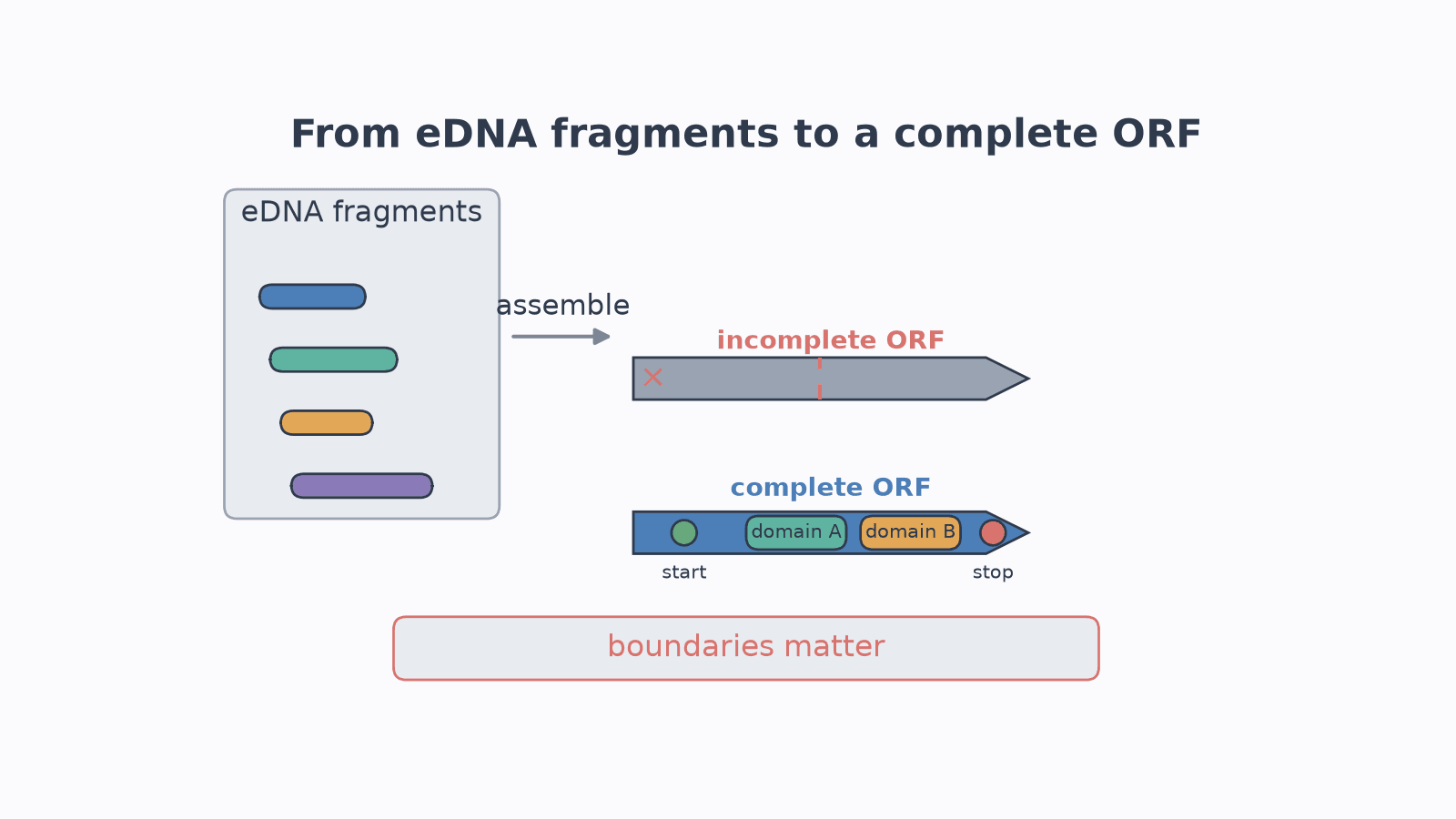
Fig. 1 Confirm a complete open reading frame from environmental DNA fragments
【Category】Microbial Biotechnology / Enzyme Engineering
The environment holds a vast number of microorganisms, and most of them cannot be cultured individually in the lab. Metagenomic sequencing skips the culturing step and reads genes directly from environmental DNA; yet a stretch that “looks like an enzyme” is not the same as a complete gene that can be expressed and catalyze a reaction. Assembly breaks, misidentified start sites, premature stops, and automated annotation bias can all steer downstream analysis toward the wrong target. Enzyme gene mining should therefore begin with whether the gene itself is credible, not with a similarity leaderboard. For industrial biocatalysis, a natural enzyme that expresses well and has clear activity often means milder reaction conditions or lower cost, so the starting point matters even more.
First Gate: Are the Gene Boundaries Intact?
Judging a candidate gene starts with whether its “start–end” is clear, not with how closely it resembles a known family.
From fragments to a complete open reading frame
Metagenomic data are assembled from many short fragments, so a candidate gene may sit in the middle of a contig or span its edge. An open reading frame (ORF) is the coding region that runs from a start codon to a stop codon; if it is missing its beginning or end, or lacks a key domain, the translated protein may still hit a homologous family yet not represent the natural, complete enzyme. Think of an ORF as a sentence: the start codon is the first word, the stop codon is the period, and no internal pause should break the meaning — what an assembly break creates is exactly such a broken sentence.
So before judging function, check the ORF length, start and stop positions, any internal stops, signs of frameshift, and its relation to contig boundaries, then cross-check against the typical domain composition of close relatives. An unusual length is not an automatic rejection, but it must be explainable as a real biological difference, a gene-prediction error, or an incomplete assembly.
Do not ignore differences in the genetic code
The “rules” of translation are not everywhere the same. Different microbial communities, organelles, or unusual taxa may use slightly different genetic codes, so applying default parameters can shift stop sites or protein length. Keeping the sample origin, assembly version, and prediction parameters lets a candidate be traced back later for a proper re-check.
Second Gate: What Can Genomic Context Tell Us?
Genes rarely exist in isolation; neighbors can give clues, but a neighbor is not proof of function.
Enzymes, transporters, and regulatory elements in the same metabolic pathway often form interpretable clusters in adjacent genomic regions. If an unknown gene consistently sits next to a certain substrate-metabolism module, that adds a layer of evidence for its function. This is like reading a passage: context often helps us guess the meaning of an unfamiliar word.

Fig. 2 Genomic context provides supporting evidence for functional inference
A neighbor is a clue, not a proof
“What the neighbor looks like” cannot by itself decide “what the gene is.” A metagenomic contig may be too short, the neighborhood incomplete, and adjacent genes may merely coexist rather than participate in the same reaction. A safer approach is to cross-check the neighborhood against conserved motifs, domains, phylogenetic position, and known reaction evidence.
Context also helps decide whether the gene belongs to a multi-component system. Some catalytic processes depend on electron-transfer partners, cofactor biosynthesis, or specific transport modules, so expressing the core enzyme alone may not reproduce the native phenotype. Recognizing these dependencies early avoids mistaking “missing partners” for “no function.” For example, some degradation processes first require a partner protein to transport the substrate into the cell; without it, even a well-expressed core enzyme may have nothing to act on.
Two Search Routes: Sequence-Driven and Function-Driven
One relies on “looks alike,” the other on “actually works”; each has limits, and they work best together.
Sequence-driven: starting from a known family
Sequence-driven discovery enters through a known family and expands the candidate set using homology, motifs, domains, phylogeny, or structural clues. It suits targets that already have a reference gene, covers a large search space, and lets you track how far each candidate is from known evidence. But the more you depend on known sequences, the more likely you are to miss novel enzymes that differ greatly from the reference family. A low-similarity candidate may be a genuinely distant relative, or it may merely share a local fold; “novel” alone does not grant a target function.
Function-driven: starting from activity
Function-driven metagenomic screening starts from activity: it expresses environmental DNA fragments in a host cell and looks for the target phenotype. It does not need to know the family in advance, so it can discover truly new sequences. But the outcome depends on whether the host can correctly transcribe, translate, and fold the protein, and on whether cofactors and screening conditions are suitable.
The two routes reinforce each other: sequence evidence helps design a more focused candidate set, while functional results establish real phenotypic links for poorly annotated genes. Enzyme gene mining should not conflate them into a single “universal algorithm,” but choose a main route based on known references, data type, and experimental capacity. In practice, start from the “most similar” batch, then broaden to more distant homologs and use functional screening to recover any that slip through.
From a Candidate Gene to a Workable Construct: What Still Needs Deciding?
Having a string of nucleotides does not mean you have a usable enzyme.
A candidate suitable for synthesis needs far more than a string of characters. First confirm the coding region is complete and check for obvious signal peptides, transmembrane segments, or multi-domain boundaries; then plan the construct around the expression host, deciding whether to keep the native leader sequence, remove any membrane-localization segment, and whether it may depend on chaperones.

Fig. 3 Expression and catalytic validation connect a candidate to function
A failed heterologous expression is not proof that the gene prediction was wrong. Codon usage, promoter, folding environment, post-translational modification, or cofactor supply can all limit protein yield. Validation should distinguish “no expression,” “expressed but insoluble,” and “soluble but no target activity,” because the three point to very different next steps: with no expression, check expression conditions; if insoluble, try changing the tag, host, or folding partner; if soluble but inactive, return to the substrate and reaction conditions.
True functional confirmation must return to the target substrate and application conditions. Surrogate signals can be used for initial screening, but they need to be backed by direct substrate conversion, product confirmation, or appropriate kinetic characterization. Both success and failure data should be tied to the gene version, construct design, and experimental conditions, so the next round can narrow the candidate range.
Carrying Discovery Forward at the Protein Level
Once the nucleic acid and protein sequences are confirmed, the platform can take on natural protein discovery and ranking.
MatwingsVenus® does not replace metagenomic assembly or ORF prediction. After confirming the candidate coding region and its nucleic acid sequence, and reliably obtaining the corresponding protein sequence, the platform takes on natural protein discovery and ranking, following “Search Before Mining”: first search curated resources by function, or run a homology search with BLAST on the protein or nucleic acid sequence, reusing existing evidence where possible.
When the diversity of close homologs is insufficient, the platform can expand to structure mining after user consent. VenusMine takes a PDB or CIF structure as input to find distant homologs and conserved folds, returning candidates with phylogenetic information; if only a sequence is available, a structure must first be prepared. Once the candidate set forms, VenusG can combine physicochemical property calculations with family diversity, phylogeny, and Pareto ranking to deliver candidates, FASTA, and wet-lab suggestions — these are predictions and decision support, not confirmation of gene function.
High-quality enzyme gene mining is not about marking the largest number of colored arrows in an environmental DNA map, but about making each candidate survive four questions: are the gene boundaries intact, does the neighborhood offer a reasonable clue, does the protein evidence support the target reaction, and can the experimental path separate expression from function. Linking these four layers of evidence is what gives an unknown gene the chance to become a verifiable, reusable enzyme resource. The platform treats “discovery–ranking–recommendation” as the hand-off interface, while gene synthesis, protein expression validation, and purification go to downstream wet-lab work, so the finding does not stay on paper.
Frequently Asked Questions (FAQ)
Q: Can a stretch that “looks like an enzyme” in a metagenome be used directly?
No. It may be truncated by an assembly break, a wrong start site, or a premature stop. First confirm it is a complete ORF with intact boundaries before judging function.
Q: Does higher sequence similarity mean more reliable function?
Not necessarily. Similarity only reflects homology; a low-similarity candidate may be a genuinely novel enzyme or merely share a local fold, so it needs support from neighborhood, domain, and experiments.
Q: What are the advantages and limits of functional metagenomics?
Its advantage is not needing to know the family in advance, so it can find new sequences; its limit is dependence on whether the host expresses and folds the protein correctly, and on suitable cofactors and screening conditions.
Q: Does a failed heterologous expression mean the gene prediction was wrong?
Not necessarily. Codon usage, promoter, folding environment, post-translational modification, or cofactor supply can all limit protein yield, so distinguish “no expression,” “insoluble,” and “soluble but inactive.”
Q: What is genomic context and what is it for?
It is the region surrounding a gene on the chromosome. Enzymes, transporters, and regulatory elements of the same pathway often sit nearby, giving functional clues, but context only provides association, not proof of function.
Q: How should “Search Before Mining” be understood?
It means searching existing curated resources and homology evidence first and reusing existing knowledge, before considering heavier computation such as structure mining, to reduce duplication and unnecessary cost.
Summary
Enzyme gene mining cannot focus only on sequence similarity. A credible candidate must pass four gates at once: intact boundaries, a plausible neighborhood, protein evidence supporting the target reaction, and experiments that can separate expression from function. Going from environmental DNA to a reusable enzyme is a process of layering evidence, not the single click of a similarity sort.
【One-line Conclusion】From environmental DNA to a usable enzyme, the key is not the similarity leaderboard, but moving each candidate through four gates: boundary, neighborhood, protein evidence, and experiments.