How to Build a Protein-Protein Interaction Network in Six Practical Steps
Published on October 15, 2026
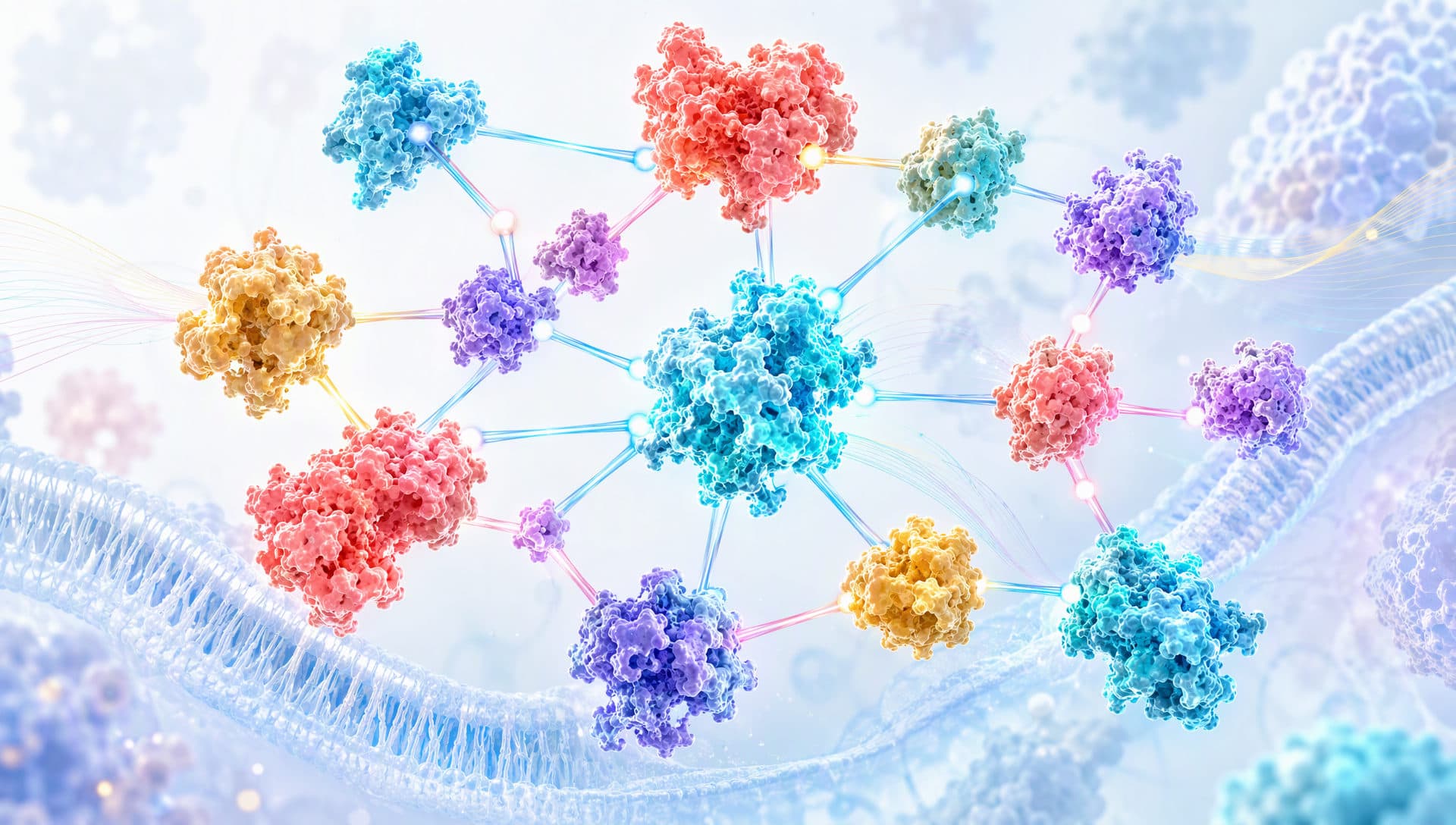
Protein nodes and interaction edges reveal system-level relationships
Category: Computational Biology | Protein Research | Research Workflows
A differential-protein list, target shortlist, or gene set may look ready for immediate visualization. Yet learning how to build a protein-protein interaction network begins with evidence, not immediate plotting. Researchers must ask whether identifiers match the right organism, whether an edge reflects physical binding or a functional association, and whether a highly connected node is a biological signal or a data artifact.
How to build a protein-protein interaction network: define the decision
A PPI network represents proteins as nodes and physical or functional interactions as edges. It can reveal functional modules, prioritize candidates, or map the connectivity of a biological process. A focused objective such as “identify modules associated with this process” is more actionable than the vague instruction to “find core proteins.”
Researchers can describe the organism, protein list, experimental context, and objective in natural language within MatwingsVenus®(晓鹜®). Its retrieval-first approach can connect protein and pathway database queries before unknown relationships are treated as established facts.
Build an interpretable PPI network in six steps
1. Normalize the input
Standardize protein or gene identifiers, remove duplicates, and confirm species, isoforms, and missing values. For transcriptomic or proteomic inputs, retain fold changes, significance values, and group labels so they can later become node attributes.
2. Retrieve interactions without erasing evidence types
Collect documented interactions while distinguishing experimental support, integrated database evidence, and computational inference. An edge does not necessarily mean that two proteins bind directly in the tissue, time point, or condition under study.
3. Apply transparent filtering rules
Choose confidence criteria that fit the research goal, then record the organism, evidence categories, threshold, and data version. A permissive cutoff may amplify noise, while a strict one may remove emerging signals. Maintaining a primary network and running a sensitivity comparison is often more informative than claiming one universal threshold.

The workflow turns a network image into a reviewable evidence chain
4. Inspect topology after quality control
Represent proteins as nodes and interactions as edges. Check node and edge counts, isolated nodes, and connected components before examining degree, betweenness, and community structure. High connectivity indicates a prominent network position; by itself, it does not prove that a protein is a decisive biological regulator.
5. Interpret modules in biological context
Connect modules or candidate nodes with functional and pathway information, then revisit expression context, subcellular location, and study conditions. The most useful answer to how to build a protein-protein interaction network is often contextualization: constrain general interaction evidence with the biology of the current experiment.
6. Deliver candidates with a validation plan
A useful output includes the input definition, filtering rules, network files, candidate priorities, and validation recommendations. MatwingsVenus®(晓鹜®) can continue into structure, function, and literature retrieval. When a task requires prediction or intensive computation, the workflow distinguishes measured database evidence, predicted results, and unknowns while retaining necessary approval points.

Topology becomes actionable when combined with context and validation
How MatwingsVenus®(晓鹜®)connects the PPI workflow
Researchers can submit the species, protein list, experimental conditions, and objective to organize database retrieval and evidence boundaries. After candidates are prioritized, the same dialogue can continue into structure, function, and literature retrieval. This reduces repetitive handoffs without replacing independent review or experimental validation.
Three checks prevent common network mistakes
Do not translate a large node directly into “biologically important.” Do not omit confidence rules or evidence provenance. Do not let one static network stand in for every tissue or treatment condition. A high-quality answer to how to build a protein-protein interaction network depends on clear evidence boundaries, reproducible processing, and candidates that can move into validation.
FAQ
What if the network contains few or no edges?
Check identifier mapping, species selection, and isoforms, then assess whether filtering is too strict. If no interaction is recovered, report that result rather than adding unsupported edges.
Can a hub protein become an experimental target immediately?
Not on connectivity alone. Prioritization should also consider evidence type, expression context, functional modules, structural feasibility, and experimental constraints.
How can the workflow become more efficient?
Standardize the sequence from question and input through retrieval, filtering, interpretation, and validation. MatwingsVenus®(晓鹜®) can help organize database retrieval and downstream protein research through dialogue, reducing tool switching while keeping independent review and experimental validation essential.
Conclusion
The core of how to build a protein-protein interaction network is simple: define the question first, then construct an evidence chain. Identifier normalization and context-aware interpretation matter more than an attractive graph. MatwingsVenus®(晓鹜®) can help connect network-derived candidates with structure, function, literature, and validation planning, turning a visual result into a practical next step.