Protein Mutation Binding Affinity Prediction: Reading Interface Changes
Published on October 15, 2026
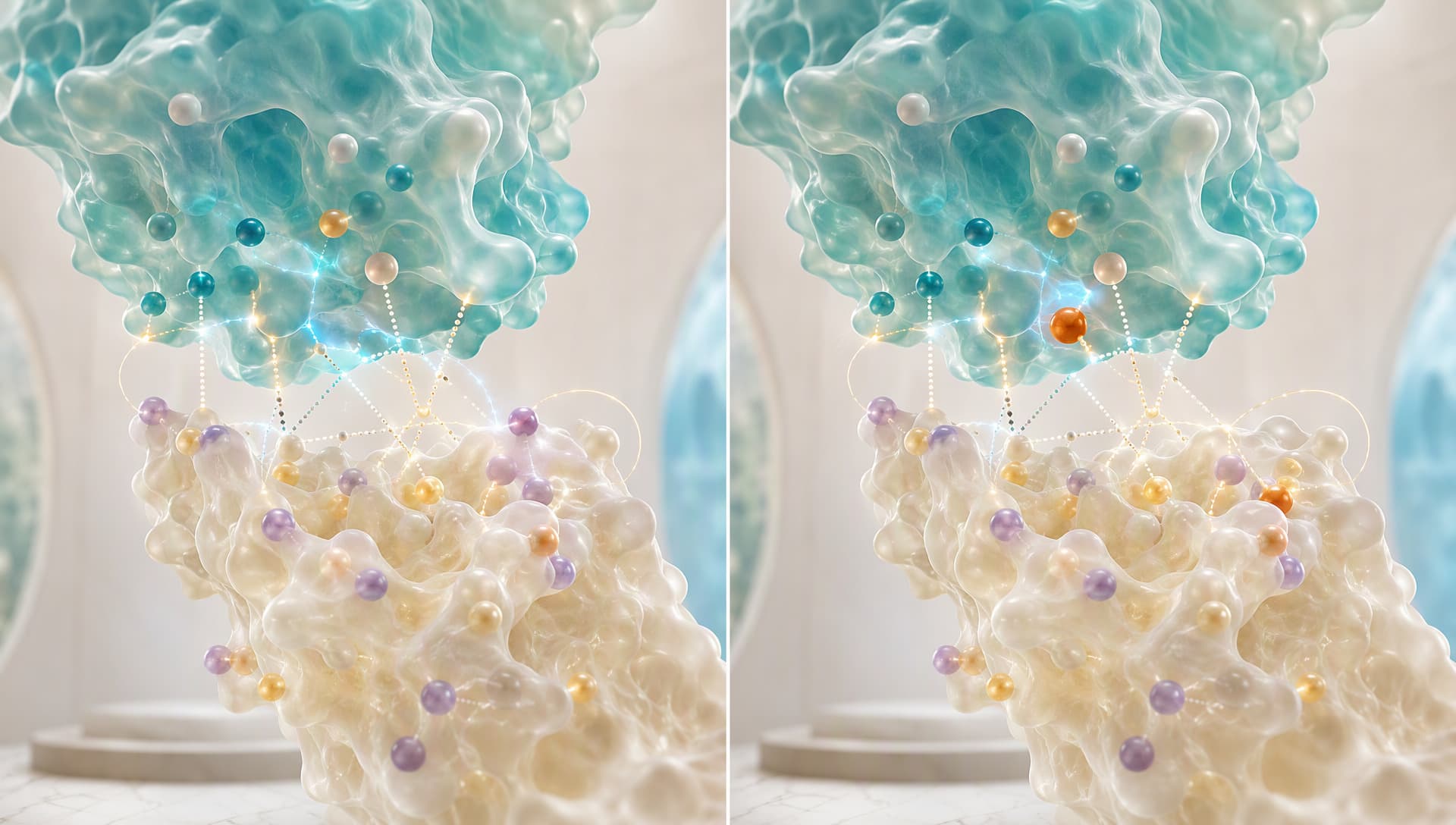
Surface complementarity and local interactions jointly shape binding
An interface mutation may add a contact yet weaken binding through desolvation, conformational rearrangement, or a changed water network. A mutation far from the interface may alter the interaction allosterically. Protein mutation binding affinity prediction should not replace experiments with a “more contacts are better” rule. It should prioritize variants only after the partner, conformational state, and measurement conditions have been defined.
Protein Mutation Binding Affinity Prediction Starts with the Partner
Affinity always belongs to a specific pair. The same protein can respond differently to a ligand, antigen, receptor, or another conformational state. Even for the same pair, temperature, pH, salt, cofactors, glycosylation, and oligomeric state may change the measured result.
The equilibrium dissociation constant Kd is commonly used to quantify protein-protein binding, and binding free energy ΔG can be derived from Kd. Models that compare wild type and mutant may report an affinity change or ΔΔG. The sign convention must be checked before interpretation because tools may differ on whether a positive value means stronger or weaker binding. A predicted score should also remain separate from experimental units and conditions; it is not a measured Kd.
Equilibrium affinity does not describe the whole binding process. Two variants can have similar Kd values but different association and dissociation behavior. If an application requires rapid recognition, long residence, or reversible response, kinetic measurements belong in validation rather than leaving the decision to one equilibrium endpoint.
An Interface Is Not a Static Puzzle Edge
A mutation can alter shape complementarity, electrostatics, hydrogen bonds, hydrophobic contacts, side-chain entropy, and interfacial water at once. Neighboring side chains may rotate, the backbone may shift slightly, or water excluded in the wild type may return. Filling an apparent cavity therefore does not necessarily strengthen binding.
Structure-based affinity models can learn atomic interactions from three-dimensional complexes and estimate changes caused by single- or multi-point mutations. The input structure must represent the relevant bound state. Chain selection, residue numbering, missing loops, cofactors, protonation, and interface conformation all affect interpretation. When only monomer structures are available, docking can propose a pose hypothesis, but a favored pose is not a confirmed interface.
Remote effects deserve attention as well. Some mutations never touch the partner yet alter conformational populations, flexibility, or interface preorganization. Candidate selection should therefore distinguish direct contacts, second-shell support, and possible allosteric paths rather than filtering only by distance from the interface.

Binding affinity emerges from several interacting interface layers
Read Protein Mutation Binding Affinity Prediction as Evidence, Not a Rank Alone
A candidate list should contain at least four elements: effect direction, separation from wild type, structural or sequence rationale, and applicability conditions with uncertainty. A total score alone cannot reveal whether the model attributes a change to direct contact, interface rearrangement, or a remote effect.
The first experimental set does not need to contain only the highest scores. It can sample different mechanisms: one group improves shape complementarity, another adjusts charge or hydrogen bonding, and another probes second-shell support. A few predicted unfavorable or near-neutral controls make it easier to test whether the ranking follows the experimental trend.
Specificity risk must be evaluated at the same time. Tighter binding to the target does not guarantee preserved discrimination against related partners. Projects involving homologous receptors, related antigens, or multiple substrates should include relevant non-targets in the validation panel. An affinity gain that sacrifices specificity may not satisfy the actual design objective.
Single-mutation scores should not be added mechanically to answer a multi-mutation question. Interface residues can compensate for or conflict with one another. Combination variants need dedicated modeling and decomposed experiments rather than arithmetic on individual ΔΔG estimates.
How MatwingsVenus®(晓鹜®)Organizes Interface Evidence
MatwingsVenus®(晓鹜®)places protein mutation binding affinity prediction in a continuous evidence-site-mutation-mechanism-validation chain. It begins by retrieving protein identity, known complexes, functional annotations, and existing variants. Experimental database or literature records are labeled Measured, computational outputs are Predicted, and missing information remains Unknown.
At the site level, VenusX can analyze binding, active, and evolutionarily conserved residues, helping distinguish critical contacts, functional constraints, and explorable regions. VenusREM can then assess potential single-mutation effects on objectives including binding; its pro mode requires a PDB structure. The output supports candidate prioritization and is not a measured Kd or ΔΔG.
When the question requires a pose or interface mechanism, MatwingsVenus®(晓鹜®)can connect to protein-ligand, protein-protein, peptide, or metal docking and to Rosetta physical scoring and interface refinement. Docking proposes how partners might associate, while physical scores support relative comparison. Neither directly replaces affinity or specificity measurements.
Compute-intensive tasks pass through HITL so that the researcher confirms the partners, input structure, mutation set, and expected output before execution. This gate helps prevent the wrong chain, partner, or conformation from entering a large calculation.

Equilibrium and kinetic assays provide complementary checks on ranking
Validation Should Resolve Affinity, Kinetics, and Specificity
Experimental comparison begins with consistent constructs, tags, buffer, and temperature for wild type and mutants, together with the active protein concentration. If a mutation changes expression, aggregation, or oligomeric state, the apparent binding difference may not originate at the interface, making sample-quality checks essential.
The readout should match the intended use. Equilibrium measurements address binding strength. Kinetic measurements separate association from dissociation. Competition or cross-binding assays test specificity. For critical candidates, structural or interface-residue validation can determine whether the predicted mechanism is plausible. When computation and experiment disagree, revisit the complex conformation, conditions, and evidence scope rather than retaining only favorable results.
The official MatwingsVenus®(晓鹜®)workflow can connect candidates with services such as gene synthesis, protein-expression validation, and protein purification. Its value is continuity among sequences, structural hypotheses, evidence states, and physical samples, not a promise that every high-scoring mutation will improve affinity.
Make Affinity Prediction an Auditable Start to Interface Design
Mature protein mutation binding affinity prediction states the binding partner, Kd or ΔΔG definition, input structural state, interface mechanism, specificity boundary, and validation plan. MatwingsVenus®(晓鹜®)organizes retrieval-first evidence, VenusX site analysis, VenusREM single-mutation screening, docking hypotheses, Rosetta interface assessment, HITL, and experimental handoff into a traceable decision record.
A project can begin with the target complex, wild-type measurements, candidate sites, and validation panel. The model narrows the space; experiments establish actual binding strength, kinetics, and selectivity. Prediction then becomes a reusable interface-design asset rather than an isolated score.