

 Next Gen Protein Engineering
MatwingsVenus™A Shared Lab for AI
 Conversational Protein DesignAutomated Experiment DeliveryExpert Online Collaboration

Overview
MatwingsVenus™ is a lightweight R&D closed-loop platform for university researchers, corporate R&D personnel, healthcare workers, and biology enthusiasts — integrating AI biological design, wet-lab validation, and expert collaboration.
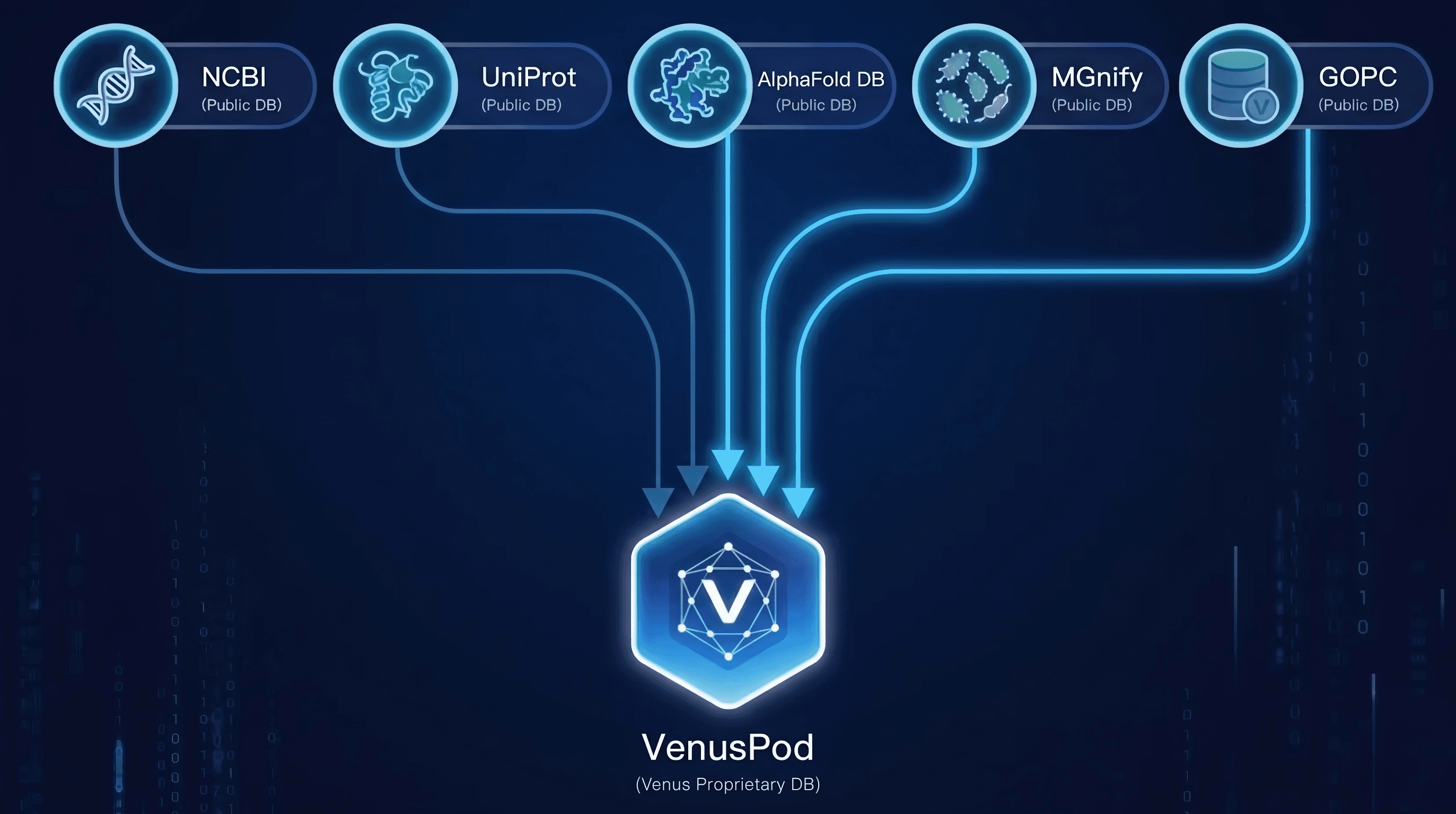
Data Accumulation: Integrates billions of annotated sequence datasets from major databases including NCBI, UniProt, MGnify, and more.
Agent Capabilities: Integrates intelligent dialogue, protein sequence analysis, directed mutation design, enzyme mining, de novo design, structure prediction, and database retrieval, enabling complex bioinformatics tasks to be completed conversationally.
Wet-Lab Validation: The platform supports one-click ordering for gene synthesis, protein expression validation, protein purification, and more.
Expert Collaboration: Throughout the entire protein design workflow, you can initiate expert consultations at any time. We coordinate domain experts to promptly answer your questions, evaluate AI model design results, and provide professional judgment, optimization suggestions, and in-depth insights.
Agent-Core R&D Pipeline
Simulates the thought process of human experts to automatically execute complex bioinformatics tasks.

Intelligent Assistant
Proactive AI assistant that helps users solve research problems through natural language, accelerating scientific discovery. It completes tasks such as structure prediction, patent retrieval, and literature search, supporting direct connection to multiple databases like PubMed, PDB, and UniProt.

Protein Engineering
The world's leading technology in AI directed evolution: supports multiple rounds of activity enhancement, validated in over 30 industrial projects. The platform can perform single-point saturation mutagenesis prediction, or combine user wet-lab data for multi-point mutation prediction, identify functional sites for risk analysis and physicochemical property prediction.

Protein Discovery
Quickly locate target proteins from hundreds of millions of sequences, relying on zero-shot prediction capabilities and crossing sequence limitations to search for structurally similar proteins.
Massive Protein Database Retrieval
Connected to tens of billions of protein sequences and structure databases
Core Retrieval Technologies

Highlights

Advanced Model Capabilities
Tens of billions of parameters Venus-series models, with world-leading zero-shot prediction, multi-round evolution, and functional prediction capabilities.

Massive Database Support
A massive private dataset of extreme-environment protein sequences, covering more than ten professional databases with comprehensive information.

Verifiable Prediction Results
Protein evolution has been successfully delivered in 30+ industrial projects, and protein discovery can break through the limitation of low sequence similarity to find enzymes with similar functions.

Ultimate Lightweight Experience
All professional capabilities can be triggered by a single sentence, requiring no bioinformatics background or complex operations, allowing researchers to focus on scientific problems themselves.
News

Protein Sequence Search: When 'Search' Becomes 'Design'
Protein sequence searches are evolving from simple information retrieval into AI-driven computational design tools. Mastering efficient search methods not only lets you quickly get protein identities, families, and functional information, but also opens the door to a revolutionary leap from data to design—enter a sequence, and AI will generate optimization plans for you, turning the end of a search into the start of innovation.

Protein Stability: How the Code of Life Stands Up to Environmental Challenges?
Proteins are the core players in life, and their stability determines how well biological functions work. From understanding disease mechanisms to biotech innovations, cracking the code of protein stability could lead to more durable drugs, more efficient industrial enzymes, and even life materials tailored for space exploration.

Can one-stop protein development turn fragmented trial-and-error into a ‘conversation equals closed loop’?
Currently, protein research faces pain points like fragmented tools and a disconnect between wet and dry experiments. The MatwingsVenus platform uses a conversational AI to automate the entire workflow, running design, validation, and iteration in a closed loop, freeing researchers from tedious processes so they can focus on core innovation.
Academic Publications
VenusX: Unlocking Fine-Grained Functional Understanding of Proteins
ICLR, 2026.
2026-01-26
Fast and Interpretable Protein Substructure Alignment via Optimal Transport
ICLR, 2026.
2026-01-26
Venus-MAXWELL: Efficient Learning of Protein-Mutation Stability Landscapes using Protein Language Models
NeurIPS, 2025
2025-09-19
STAGE: A compact and versatile TnpB-based genome editing toolkit for Streptomyces
Proceedings of the National Academy of Sciences, 2025
2025-08-26
From high-throughput evaluation to wet-lab studies: advancing mutation effect prediction with a retrieval-enhanced model
ISMB/ECCB, 2025.
2025-07-15
Harnessing protein language model for structure-based discovery of highly efficient and robust PET hydrolases
Nature Communications, 2025
2025-07-05
VenusFactory: An Integrated System for Protein Engineering with Data Retrieval and Language Model Fine-Tuning
ACL Demo, 2025.
2025-07-01
A Deep Retrieval-Enhanced Meta-Learning Framework for Enzyme Optimum pH Prediction
J. Chem. Inf. Model, 2025,
2025-03-24
VenusMutHub: A systematic evaluation of protein mutation effect predictors on small-scale experimental data
Acta Pharmaceutica Sinica B, 2025
2025-03-14
Entropy-driven zero-shot deep learning model selection for viral proteins
Physical Review Research, 2025,
2025-02-28
AI-enabled Alkaline-resistant Evolution of Protein to Apply in Mass Production
Elife, 2025,
2025-02-19
Immunogenicity Prediction with Dual Attention Enables Vaccine Target Selection
ICLR, 2025.
2025-01-23
PROTSOLM: Protein Solubility Prediction with Multi-modal Features
IEEE BIBM, 2024.
2025-01-10
Secondary Structure-Guided Novel Protein Sequence Generation with Latent Graph Diffusion
IEEE BIBM, 2024.
2025-01-10
Protein Representation Learning with Sequence Information Embedding: Does it Always Lead to a Better Performance?
IEEE BIBM, 2024.
2025-01-10
VenusX: Unlocking Fine-Grained Functional Understanding of Proteins
ICLR, 2026.
2026-01-26
Fast and Interpretable Protein Substructure Alignment via Optimal Transport
ICLR, 2026.
2026-01-26
Venus-MAXWELL: Efficient Learning of Protein-Mutation Stability Landscapes using Protein Language Models
NeurIPS, 2025
2025-09-19
STAGE: A compact and versatile TnpB-based genome editing toolkit for Streptomyces
Proceedings of the National Academy of Sciences, 2025
2025-08-26
From high-throughput evaluation to wet-lab studies: advancing mutation effect prediction with a retrieval-enhanced model
ISMB/ECCB, 2025.
2025-07-15
Harnessing protein language model for structure-based discovery of highly efficient and robust PET hydrolases
Nature Communications, 2025
2025-07-05
VenusFactory: An Integrated System for Protein Engineering with Data Retrieval and Language Model Fine-Tuning
ACL Demo, 2025.
2025-07-01
A Deep Retrieval-Enhanced Meta-Learning Framework for Enzyme Optimum pH Prediction
J. Chem. Inf. Model, 2025,
2025-03-24
VenusMutHub: A systematic evaluation of protein mutation effect predictors on small-scale experimental data
Acta Pharmaceutica Sinica B, 2025
2025-03-14
Entropy-driven zero-shot deep learning model selection for viral proteins
Physical Review Research, 2025,
2025-02-28
AI-enabled Alkaline-resistant Evolution of Protein to Apply in Mass Production
Elife, 2025,
2025-02-19
Immunogenicity Prediction with Dual Attention Enables Vaccine Target Selection
ICLR, 2025.
2025-01-23
PROTSOLM: Protein Solubility Prediction with Multi-modal Features
IEEE BIBM, 2024.
2025-01-10
Secondary Structure-Guided Novel Protein Sequence Generation with Latent Graph Diffusion
IEEE BIBM, 2024.
2025-01-10
Protein Representation Learning with Sequence Information Embedding: Does it Always Lead to a Better Performance?
IEEE BIBM, 2024.
2025-01-10


