Can one-stop protein development turn fragmented trial-and-error into a ‘conversation equals closed loop’?
Published on June 22, 2026
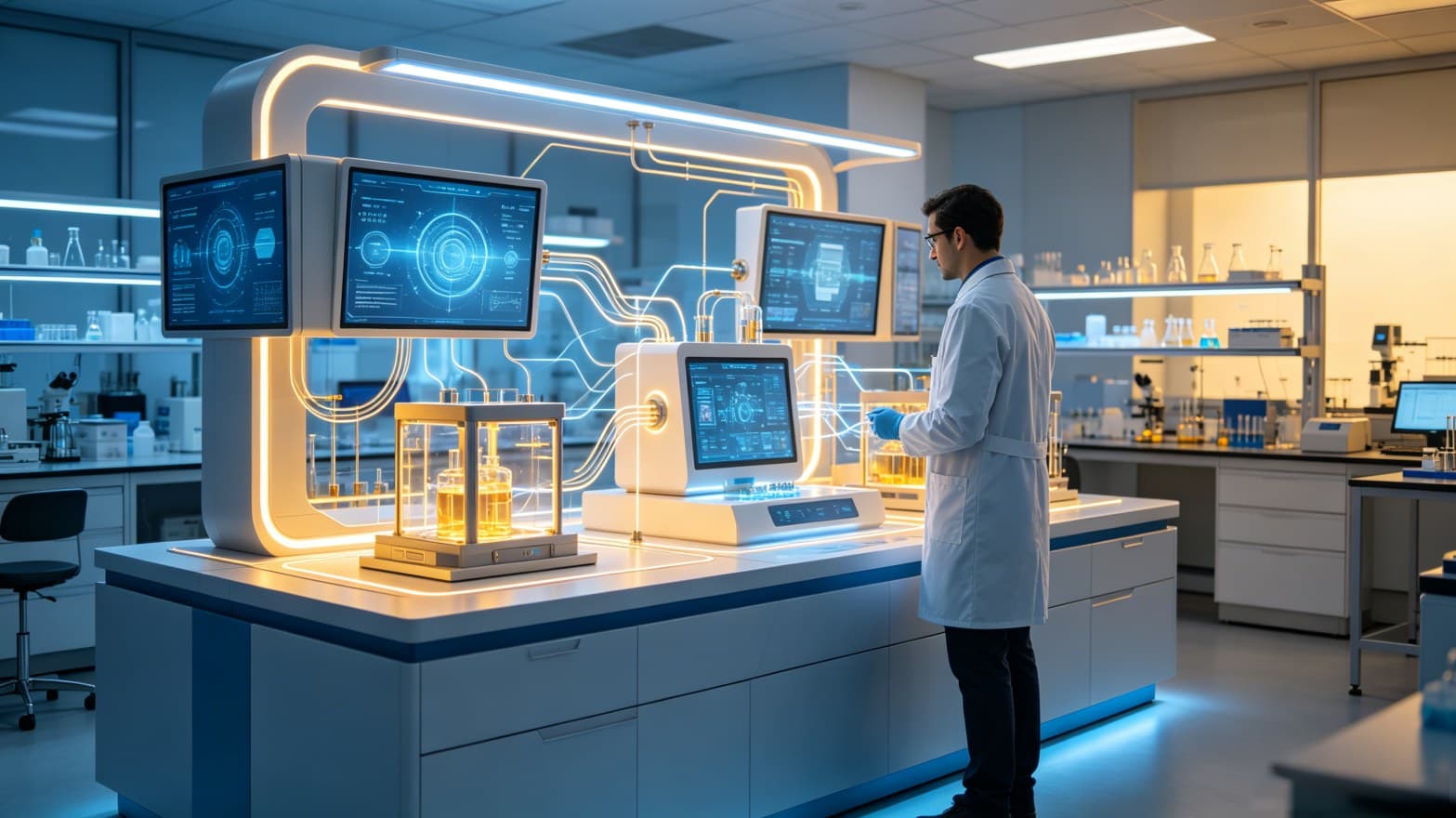
If you take a look at the daily scenes in a modern protein lab, it's not hard to notice that current protein R&D work generally involves juggling multiple tools at once and switching between different platforms. Researchers usually need to operate various types of software simultaneously, like sequence alignment, structure prediction, and data analysis, while also keeping track of outsourced plasmid synthesis and protein characterization, creating a multi-threaded, fragmented work state. This scenario highlights a structural pain point in traditional protein research: the field has accumulated rich design algorithms, analysis tools, and experimental systems over time, but there's long been a lack of an integrated collaborative structure that connects data, tools, and experiments, leading to disconnected workflows and limited iteration efficiency.
1. Fragmented dilemma: efficiency bottlenecks under multi-tool parallel R&D

Disconnected Bioinformatics Ecosystem
Traditional protein R&D shows a typical linear relay workflow, with the overall research chain being cumbersome and heavily fragmented. A complete protein modification and innovation process requires multiple independent steps, including database sequence mining → multiple sequence conservation comparison → protein 3D structure modeling → mutation library design → gene synthesis → protein expression and purification → in vitro functional characterization. Each step relies on different operational platforms and analysis tools, involving lots of manual work, data transfer, and format conversions. Researchers spend a large portion of their energy on repetitive tasks like tool adaptation, data verification, and process coordination, making it difficult to focus on the core creative research of protein functional mechanisms, design logic, and innovation plans.
An even more prominent pain point in the industry is the structural barrier between computational and wet-lab experiments. In traditional R&D models, computational simulations and physical experiments belong to separate workflows: after computational researchers complete candidate protein sequence design and virtual screening using simulation models, the physical experiments—gene synthesis, cell cultivation, protein purification, functional assays—must be carried forward manually, through offline coordination or outsourcing. There is no automated link between experimental steps and frontend simulation design. This setup not only greatly extends the R&D iteration cycle, but the repeated manual handoffs can easily introduce operational errors, causing difficulties in data traceability and poor experimental reproducibility, significantly increasing trial-and-error costs for directed protein modification and de novo design, becoming a core bottleneck that restricts high-throughput and precise development in protein engineering.
The industry's long-standing research practices confirm this dilemma: researchers spend a huge amount of time on supportive tasks like process coordination, data organization, and experiment record tracking. Even though R&D tools have diversified, core R&D efficiency has not improved in parallel. Issues like data silos, fragmented tools, and the disconnect between computational and wet-lab work make traditional protein R&D heavily reliant on human experience and time accumulation, making it difficult to achieve standardized, efficient, and iterative engineering R&D.
2. One-stop R&D logic: from stacking tools to autonomous processes

Unified Research Platform
The technical core of the one-stop protein R&D platform is not the addition of disruptive algorithm models, but rather addressing the pain points of fragmentation and process fragmentation in traditional R&D, achieving system integration and intelligent scheduling with multiple tools, data, and experimental capabilities, reconstructing the underlying operational paradigm of protein R&D. Compared to traditional platforms that simply stack tools and rely on manual operations, the new generation intelligent R&D platform has upgraded from "static tool aggregation" to "dynamic task-driven" technology. It can independently break down the R&D chain, match and adapt tools, and connect upstream and downstream processes based on research objectives, truly enabling tools to serve R&D tasks and significantly reducing manual intervention costs.
Matwings Technology's independently developed MatwingsVenus™ (Xiaowu ™) conversational protein R&D agent platform provides the industry with a standardized, full-chain one-stop R&D solution. This platform is built around scientific research agents, breaking down the operational barriers of traditional protein R&D. Users only need to clarify R&D task goals through natural language, and the system can autonomously complete task breakdown. It intelligently schedules core capabilities such as protein design, structure prediction, sequence analysis, and molecular screening, covering full-scenario scientific research including industry research, target analysis, enzyme molecule mining, protein directed evolution, de novo molecular design, and collaborative wet experiment validation.
Relying on tens of billions of authentic protein sample data resources, the platform integrates over 200 professional protein design and analysis tools, more than 50 industry-certified experts, and more than 30 refined scenario skills. These capabilities together build a complete R&D chain covering "market research - literature mining - patent analysis - protein design - small-scale validation - process optimization - production scale-up," achieving full coverage from theoretical design to engineering implementation.
The core advantage of this one-stop model is not the stacking of tools, but the deep integration of tools and processes. In traditional R&D systems, tool calls, parameter settings, result acceptance, and process transitions all rely on manual decision-making; The Matwings Intelligent Agent Platform can automatically plan the optimal work path around specific R&D goals. Users do not need to master the operating logic or adaptation methods of multiple tools; they only need to clarify R&D requirements to complete the entire workflow. This completely changes the traditional "human adaptation tool" development model and achieves an intelligent upgrade of "tool adaptation tasks."
3. Break down the iteration barriers between virtual design and physical experiments

Bidirectional Lab Automation Cycle
The one-stop platform solves the fragmented surface problem of tools, while the conversational dry-wet closed-loop model breaks through the core bottleneck of constraint protein R&D—the validation gap between virtual computing and physical experiments—building an independent evolutionary R&D system of "design → verification→ feedback, → iteration."
The core technological breakthrough of the MatwingsVenus™ (Xiaowu ™) platform is the establishment of a standardized cross-system collaborative communication mechanism. Through its independently developed data interaction architecture, the platform automatically synchronizes the AI agent's protein sequence design, structural optimization, and scheme prediction results into the plasmid synthesis and automated experiment orchestration system. It can issue standardized experimental instructions and link with automated experimental hardware to complete the entire process of sample preparation, protein purification, and functional testing. This technology model has been validated in multiple real-world protein R&D projects, demonstrating excellent efficient iterative capability.
In the de novo design project for immune regulatory receptor targets, the platform uses target structural features and functional requirements as input, allowing the agent to autonomously complete the entire computational chain, including skeleton screening, precise interface design, sequence physicochemical property optimization, and druggability prediction, quickly producing multiple sets of high-quality candidate sequences. Through multiple rounds of closed-loop mechanisms, protein interface binding ability and structural stability were selectively optimized. After verification by an automated experimental platform, dozens of candidate molecules screened exhibited clear cell blocking activity, enabling efficient and precise design of target proteins.
These cases together confirm the core value of the wet-dry closed-loop model: it completely breaks the traditional "two-way separation between computing and experiments" in R&D. Virtual design and physical experiments are no longer independent operational processes, but an organic whole that drives and continuously iterates. Traditional R&D tasks requiring multi-team collaboration, multiple rounds of manual rotation, and long-term trial-and-error verification can be efficiently completed through the coordinated operation of intelligent agents and automated equipment, greatly streamlining the R&D chain and shortening iteration cycles.
4. Entry Barriers for Reconstructed Protein R&D

Central Research Hub
The deep industry value of the one-stop conversational protein R&D platform lies in reconstructing the R&D access system for protein engineering, promoting the transformation of high-end protein R&D capabilities from institutional exclusivity to industry inclusiveness. Traditional and complete protein innovation R&D requires simultaneous computational simulation teams, molecular experiment teams, and project management teams, relying on outsourced synthesis, purification, and detection systems for collaborative operations. The costs of manpower, time, and capital are extremely high. For a long time, only large pharmaceutical companies and top research institutions have had complete R&D capabilities, while small and medium-sized teams, young researchers, and graduate students face high barriers to systematic protein innovation research.
Intelligent, conversational R&D platforms have completely changed this landscape. The platform encapsulates complex underlying algorithms, tool operations, data processing, and process integration capabilities within the intelligent agent system, providing a simple and user-friendly natural language interface externally. Researchers do not need professional programming skills or mastery of dozens of R&D tools; they only need to clarify the core requirements for protein design, modification, and optimization through natural language, and rely on the platform to complete the entire R&D process. This model transforms high-end, complex, and asset-heavy protein R&D capabilities into lightweight, easily accessible scientific research infrastructure, achieving inclusive implementation of R&D capabilities.
Currently, the trend toward industry inclusiveness continues to accelerate, with the platform having completed scenario adaptation for enterprise and personal editions, and achieving full coverage of both web and mobile terminals. Researchers can track R&D progress anytime and anywhere, assign tasks, and view experimental data. Fragmented time can be fully utilized for scientific iteration, further lowering the time and space barriers for protein development.
It should be clarified that the current dialogue-based dry-wet closed-loop R&D model still has certain technical boundaries. The platform's R&D effectiveness heavily depends on high-quality labeled protein data and standardized automated experimental systems. For the design and modification of novel unknown proteins, extremely special functional proteins, and non-standard innovative proteins, existing intelligent systems still struggle to fully cover it. Core scientific innovation, mechanism analysis, and top-level solution design still rely on researchers' professional accumulation and domain intuition.
5. Conclusion
Contemporary protein engineering research and development is undergoing a fundamental paradigm shift, completely overturning the traditional R&D model that relies on trial and error, segmented operations, and a strict separation of wet and dry experiments. The industry has achieved three key transformations: R&D logic has upgraded from "people revolving around tools" to "tools revolving around tasks," the work model has evolved from "disjointed wet and dry segmented R&D" to "integrated wet-dry closed-loop iteration," and the main R&D players have shifted from "exclusive to large institutions" to "beneficial and accessible to the whole industry."
The core value of an all-in-one intelligent protein R&D platform isn't about breakthroughs in any single algorithm or tool, but in systematically addressing industry pain points—like low efficiency, high trial-and-error costs, fragmented workflows, and high barriers to entry—through process re-engineering, resource integration, and closed-loop iteration. This system effectively frees researchers from repetitive tasks, allowing them to focus on protein function innovation, mechanism exploration, and value extraction, bringing protein R&D back to its innovative essence.
In the future, with the continuous iteration and upgrade of intelligent technologies, automated experimental systems, and large-scale biological data resources, the all-in-one conversational protein R&D model will become even more refined, consistently providing efficient, precise, and accessible intelligent support to fields like synthetic biology, biomanufacturing, biomedicine, and food engineering. This will drive the protein engineering industry toward standardization, high throughput, engineering, and industrialization.