Unknown Protein Function Prediction: How Do We Narrow the Search?
Published on October 14, 2026
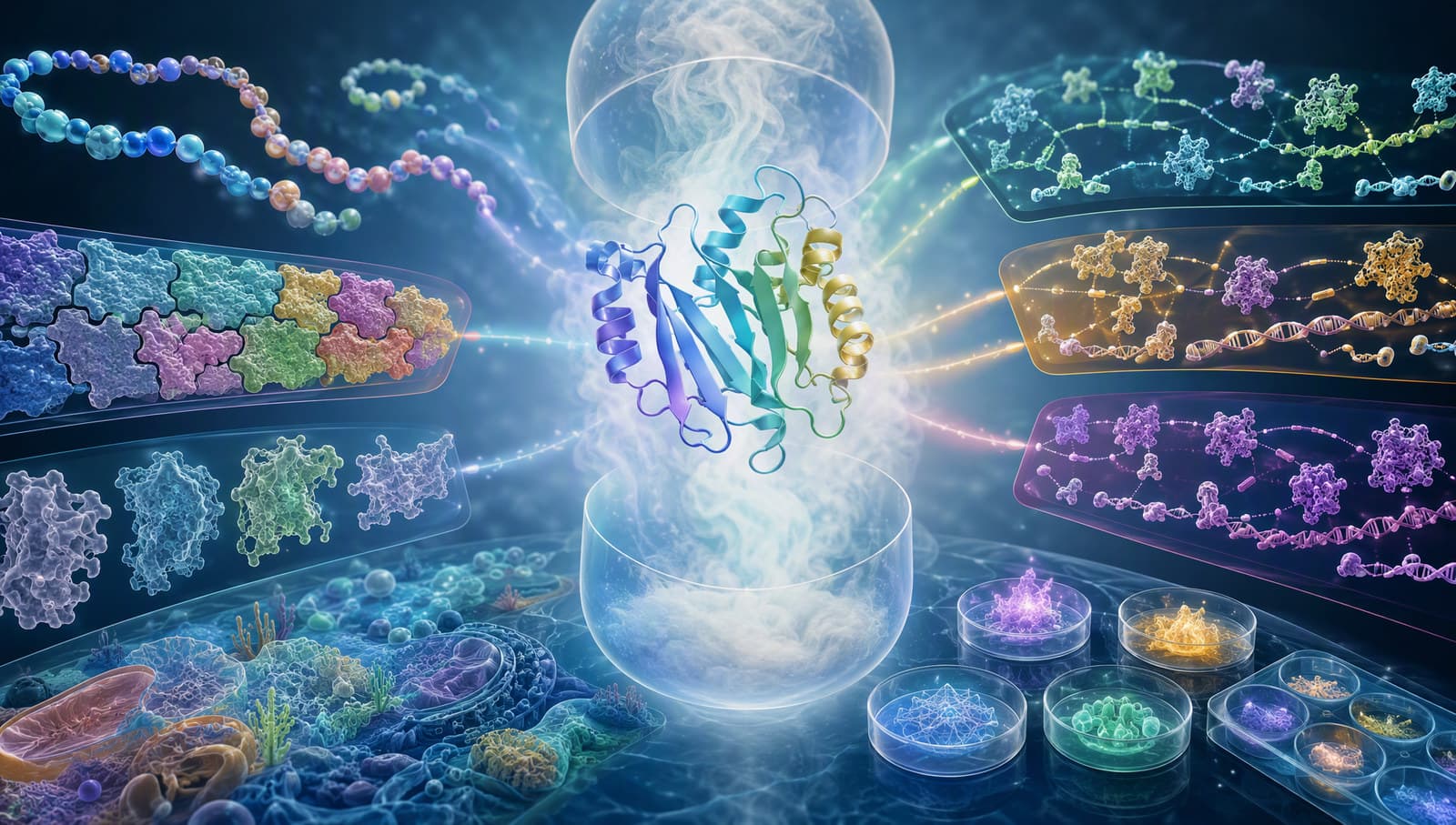
Diverse clues form several plausible paths around an unfamiliar protein
Category: Protein bioinformatics / Functional annotation / AI-assisted research
The most common mistake in unknown protein function prediction is to treat “unknown” as an empty field waiting for a model to fill. An unfamiliar sequence may be missing annotation, truncated, remotely related to known families, or assembled from recognizable domains in a new combination. A dependable strategy does not rush toward one answer. It asks which explanations can be excluded, which clues reinforce one another, and which competing hypotheses deserve experimental priority.
Why Unknown Protein Function Prediction Cannot Be a One-Step Task
Protein function may refer to a catalytic reaction, molecular binding, cellular location, biological process, or regulatory role. Each question requires different evidence. A family match does not prove that every activity has been retained. A structure resembling a known protein does not establish that the same task is performed in a cell. Critical residues, domain combinations, organismal background, and expression context can all change the interpretation.
“Unknown” also has degrees. Some proteins have close homologs but no direct experiment. Others reveal only a broad domain. Still others lack informative sequence, structure, and neighborhood signals. Unless the source of uncertainty is diagnosed first, choosing a method becomes difficult and low-resolution clues are easily overstated.
Unknown protein function prediction is therefore best understood as uncertainty reduction. Each independent evidence layer removes incompatible explanations. When the available evidence remains insufficient, the correct state is Unknown—not a forced label.
Start by Asking Whether the Sequence Is Interpretable
Before functional analysis, confirm the input object. Is the sequence complete? Are its boundaries plausible? Does it contain low-complexity regions, long disordered segments, signal peptides, or transmembrane helices? Could it represent a mistaken gene model, a fusion, or only one domain? These basic checks determine whether later homology searches, structure prediction, and site analysis can be trusted.
For a bare sequence, identification should come before functional interpretation. MatwingsVenus®(晓鹜®)follows a sequence-first principle and can organize initial checks through protein sequence analysis and database retrieval. Existing authoritative records should be examined first. An empty search does not mean “no function”; it means prediction may be considered after user confirmation.
Sequence quality also provides the first exclusion filter. A fragment lacking a complete catalytic domain should not be described as a complete enzyme. A protein with multiple transmembrane segments should prompt hypotheses compatible with a membrane environment. The objective at this stage is not naming—it is establishing a defensible input boundary.
An Evidence Funnel Narrows the Candidate Space
Homology sets the initial search radius. Close homologs can suggest families, domains, and relevant experiments. Functional transfer remains an inference, however. An experiment on the source protein is Measured for that source object; when transferred to the query protein, the claim becomes Predicted until the query itself is tested.
Domain architecture reveals available modules. Family, domain, repeat, and site entries in resources such as InterPro support different levels of inference. A domain match indicates the presence or similarity of that module. Full-length function still depends on other domains, order, boundaries, and context.
Three-dimensional structure extends the search to remote relationships. When sequence similarity is weak, folds, pockets, and spatial residue patterns may reveal distant candidates. Structure prediction makes this step more accessible, but one static model cannot fully represent conformational dynamics, complex environments, or cellular context. Structural similarity should not be written as a settled mechanism.
Functional sites test whether a hypothesis has the necessary machinery. If a catalytic proposal requires a specific set of residues and geometry, those conditions can be checked. Missing essential features can help reject a hypothesis. Preserved features mean “worth testing,” not “activity proven.”
Biological context calibrates the remaining options. Genomic neighborhood, co-expression, organismal ecology, cellular environment, and interaction records can show whether a candidate role fits its setting. These clues are directional and should be interpreted alongside molecular evidence and experiments.

Successive evidence layers compress a broad set of functional possibilities
How MatwingsVenus®(protein design agent)Organizes the Prediction Workflow
MatwingsVenus®(晓鹜®)uses conversational interaction to connect protein identification, database retrieval, sequence analysis, and structure prediction. It can help turn “What does this protein do?” into an ordered set of questions: search existing records, inspect domains and homologs, and then decide whether structural or functional-site computation is needed.
Capability boundaries remain important. GO annotation, EC numbers, subcellular location, interactions, pathways, and functional summaries are database retrieval targets; they should not be presented as direct model predictions. The platform can predict active, binding, and evolutionarily conserved sites as well as selected protein-level properties. These compute-intensive tasks require HITL confirmation, return Predicted results, and should lead to wet-lab validation suggestions.
This routing is particularly useful for unknown protein function prediction because running another model does not necessarily resolve the most important uncertainty. MatwingsVenus®(晓鹜®)can first identify the missing link in the evidence chain, then direct the user toward a tool that addresses that gap. If the evidence supports only a broad family, the conclusion should remain broad. If signals conflict, the conflict itself belongs in the result.
A Useful Output Is More Than a Function Name
A decision-ready result should identify the query object, candidate functions, supporting evidence, opposing evidence, evidence level, scope, and next experiment. Measured, Predicted, and Unknown should remain separate so that database records, homology-based transfer, and model outputs are not mistaken for the same kind of fact.
Ranking candidates does not require naming a single winner. A stronger report presents a small set of competing hypotheses and identifies observations that would distinguish them. If two candidates both imply binding but only one requires a particular catalytic arrangement, site-directed mutation and substrate-conversion assays may be more informative than accumulating additional similarity scores.
Unknown should also be made specific. Is there no credible homolog, low structural confidence, a missing key site, or insufficient biological context? Different gaps call for different next steps. Decomposing uncertainty helps control experimental cost.
Discriminating Experiments Make Predictions Converge
Validation should not end with the generic phrase “further experiments are needed.” The experiment should distinguish competing explanations. A binding hypothesis suggests binding and competition assays. A catalytic hypothesis suggests substrates, negative controls, and key-residue mutants. If the candidates mainly differ by localization, cellular or subcellular observation becomes the more informative test.
The workflow should also anticipate feedback. A positive result strengthens one candidate. A negative result may reject a path, or it may expose an expression, folding, or assay-condition problem. Experiment and computation form an iterative conversation rather than a one-way handoff.

Competing hypotheses receive decisive feedback from tailored experiments
The Goal Is to Turn “Completely Unknown” into “Next Step Known”
The success of unknown protein function prediction is not defined by producing a precise name every time. It is defined by structuring uncertainty: what has been excluded, what remains plausible, which evidence is missing, and which experiment has the greatest discriminatory value. That output can guide sample preparation, experimental priority, and resource allocation.
By connecting retrieval, sequence, structure, functional sites, and validation planning, MatwingsVenus®(晓鹜®)helps researchers avoid treating one match or model score as the endpoint. Unknown status may not disappear in a single inference, but it can be compressed layer by layer until the remaining question is testable, reviewable, and ready to move forward.