Novel Enzyme Discovery Methods: Efficient Mining via Sequence, Structure and AI
Published on October 22, 2026
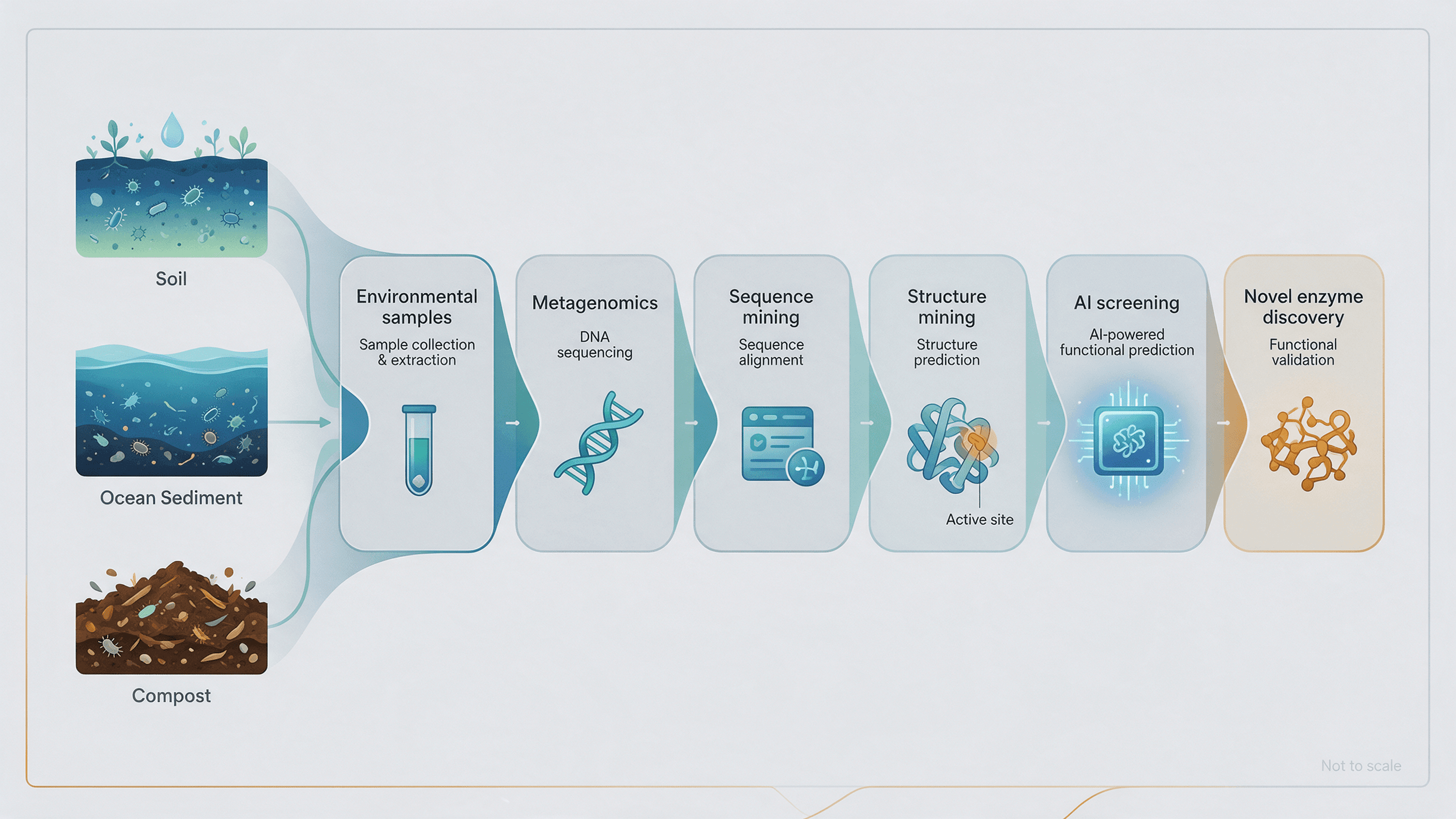
Enzymes are the workhorses of biocatalysis. Industry needs enzymes that are "just right" in activity, thermostability, substrate range and reaction conditions—yet the natural enzymes we can cultivate and use directly are only the tip of the iceberg. That is why "discovering novel enzymes" is a persistent goal in enzyme engineering and synthetic biology. In the past, people relied on "cultivating microbes + functional screening" and hoped for the best. Today, metagenomics, sequence and structure mining, and AI-driven functional prediction are turning discovery into a predictable, scalable engineering discipline. This article maps the method landscape and shows how it moves toward industrial application.
Background/Mechanism — Why systematically "discover" new enzymes instead of relying on known enzyme libraries?
Only a tiny fraction of environmental microbes can be cultivated, so a vast reservoir of enzyme-encoding genes is unreachable through traditional plate-based screening. Meanwhile, industrial reactions often require enzymes with specific thermostability, solvent tolerance, or substrate specificity—properties that are hard to obtain perfectly by "tweaking a known enzyme." Researchers therefore turn to metagenomics, extracting DNA directly from environmental samples and bypassing cultivation. Combined with public databases and predictive models, the "discovery space" for enzymes expands from the laboratory petri dish to almost the entire data space of life. The direct payoff is a far larger candidate pool, which raises the expected chance of finding an "almost-right" enzyme.【Measured/Predicted: these methods are public consensus; hit rates and costs vary by project.】
Principle/Structure — The three technical routes of novel enzyme discovery: sequence mining, structure mining, and AI functional prediction

Three discovery routes: sequence, structure and AI (schematic)
(1) Sequence mining: find by "looking alike." Starting from the amino-acid sequence of a known enzyme, homology search (BLAST), hidden Markov models (e.g., Pfam) and sequence similarity networks hunt for new sequences that carry conserved active-site motifs. It is fast and cheap—the preferred "broad net"—but is easily bounded by sequence identity and tends to miss distant homologs that are functionally similar yet sequence-divergent.
(2) Structure mining: find by "folding alike." Using structure prediction and structural alignment (e.g., Foldseek-style structural comparison) bypasses sequence-similarity limits to find candidates that are "different in sequence but similar in fold and binding pocket." It emphasizes spatial consistency of the catalytic pocket and binding pocket, often capturing distant homologs that sequence mining overlooks.
(3) AI functional prediction: find by "semantics/energy." Protein language models, function-annotation models and active learning are used to score large candidate sets and estimate activity trends via a fitness landscape. It is worth distinguishing that AI is used both for "discovery" (picking under-appreciated enzymes from existing data) and for "design" (generating entirely new scaffolds); this article focuses on the former. The three routes complement each other and are typically combined in practice to converge a candidate pool to a lab-verifiable scale.
Assay or Selection — How to validate candidate enzyme activity and stability, and pick the target that is truly usable?
Computation says "might be useful"; the wet lab says "actually useful." Candidates are typically cloned into an expression host (E. coli, yeast/fungi, Pichia, etc.) for heterologous expression to check soluble yield; then a substrate-profile assay confirms activity on the target substrate (kcat/KM); next, thermostability (e.g., T50, half-life) and solvent/pH tolerance are evaluated. The choices that really get adopted often involve engineering trade-offs between "high activity but hard to express" and "stable but low activity." At this stage, clearly separate 【Measured】 data (values obtained in this project) from 【Predicted】 data (model estimates).【Unknown: the optimal expression host and assay system for a given enzyme must be determined by project measurements.】
Conditions/Process — From candidate enzyme to scale-up: how are expression, purification and reaction conditions determined?

End-to-end enzyme discovery closed loop (schematic)
Once an expressible candidate is in hand, engineering work centers on converting activity into capacity. On the expression side, determine host, induction temperature and inducer concentration (e.g., IPTG), and fermentation time; on the purification side, choose affinity or ion-exchange based on tag and charge properties; on the reaction side, systematically optimize pH, temperature, buffer and substrate concentration, and consider cofactor dependence (e.g., NAD(P)H) and product inhibition. Scale-up also requires computing the enzyme/substrate ratio and unit cost. These conditions are often coupled and typically require iterative experimental rounds; feeding each wet-lab result back into the model is exactly the value of the "dry-wet closed loop."
How MatwingsVenus®(晓鹜®)Participates — Accelerating novel enzyme discovery with a dry-wet closed loop
For discovery methods to create real value, "compute" and "do" must close the loop. MatwingsVenus®(晓鹜®)'s dry-wet closed-loop platform links the computational side (structure mining, functional prediction, candidate ranking) with the wet-lab side (expression, activity assay, stability assessment) into an iterative data pathway: each measured value feeds back into the model, and active learning adjusts the next round of candidates—this is one way to turn "novel enzyme discovery methods" into reliable productivity. For the specific capabilities and delivery scope of each product line, please refer to the latest official website.
FAQ — Common questions about novel enzyme discovery methods
Q1: How do novel enzyme discovery methods differ from traditional "cultivate + screen"?
Traditional methods must cultivate microbes before screening, often covering only cultivable species; novel enzyme discovery methods bypass cultivation via metagenomics and computational mining, extending the search to nearly the entire environmental genome and data space.
Q2: What role does metagenomics play in novel enzyme discovery?
Metagenomics extracts total DNA directly from environmental samples, skipping microbial cultivation, thereby giving researchers access to enzyme genes carried by many "uncultivable" microbes and greatly widening the candidate source for novel enzyme discovery.
Q3: What is the difference between sequence mining and structure mining? Which is better?
Sequence mining finds enzymes by "amino-acid similarity," fast and cheap; structure mining finds them by "fold and binding-pocket similarity," capturing distant homologs but at higher cost; the two are complementary, with no absolute winner, and are usually combined according to the project.
Q4: Can AI directly "invent" a completely new enzyme?
AI is used for both "discovery" (picking under-appreciated enzymes from existing data) and "design" (generating entirely new scaffolds), which are different goals; this article's novel enzyme discovery methods focus on "discovery," while design outputs need separate evaluation.
Q5: After finding a candidate enzyme, how long until industrial application?
Moving from candidate to industrial application typically requires multiple iterative rounds of expression, activity validation, stability assessment and process scale-up, ranging from weeks to months, depending on enzyme complexity, substrate system and scale-up difficulty.
Q6: How do you judge whether a new enzyme is truly "new"?
Judging novelty first requires comparison against public sequence/structure databases to confirm low sequence similarity and absence from known functional families, then experimental confirmation that its activity profile differs from known enzymes; specific cut-off thresholds depend on database version and family definitions.
Q7: What are the cost and success rate of novel enzyme discovery?
Cost and success rate depend heavily on method combination and the target enzyme family; computational mining can sharply lower the cost of "broad screening," but actual hits still need wet-lab verification, and the success rate is best assessed per project.
Summary
Novel enzyme discovery has evolved from opportunistic screening of cultivable microbes into a systematic, closed-loop engineering method that sequences metagenomics, sequence/structure mining and AI functional prediction together; its value is supplying industrially applicable catalysts faster, more broadly, and more controllably. Making discovery a closed loop is the key to turning enzyme engineering from "luck" into "engineering." Whether this is your first encounter with enzyme discovery, or you are looking for a better catalyst for your line, understanding these methods and validation paths is the most important step before starting.