Natural Product Synthase Mining: How to Systematically Search Genomes for "Drug Factories"
Published on October 22, 2026
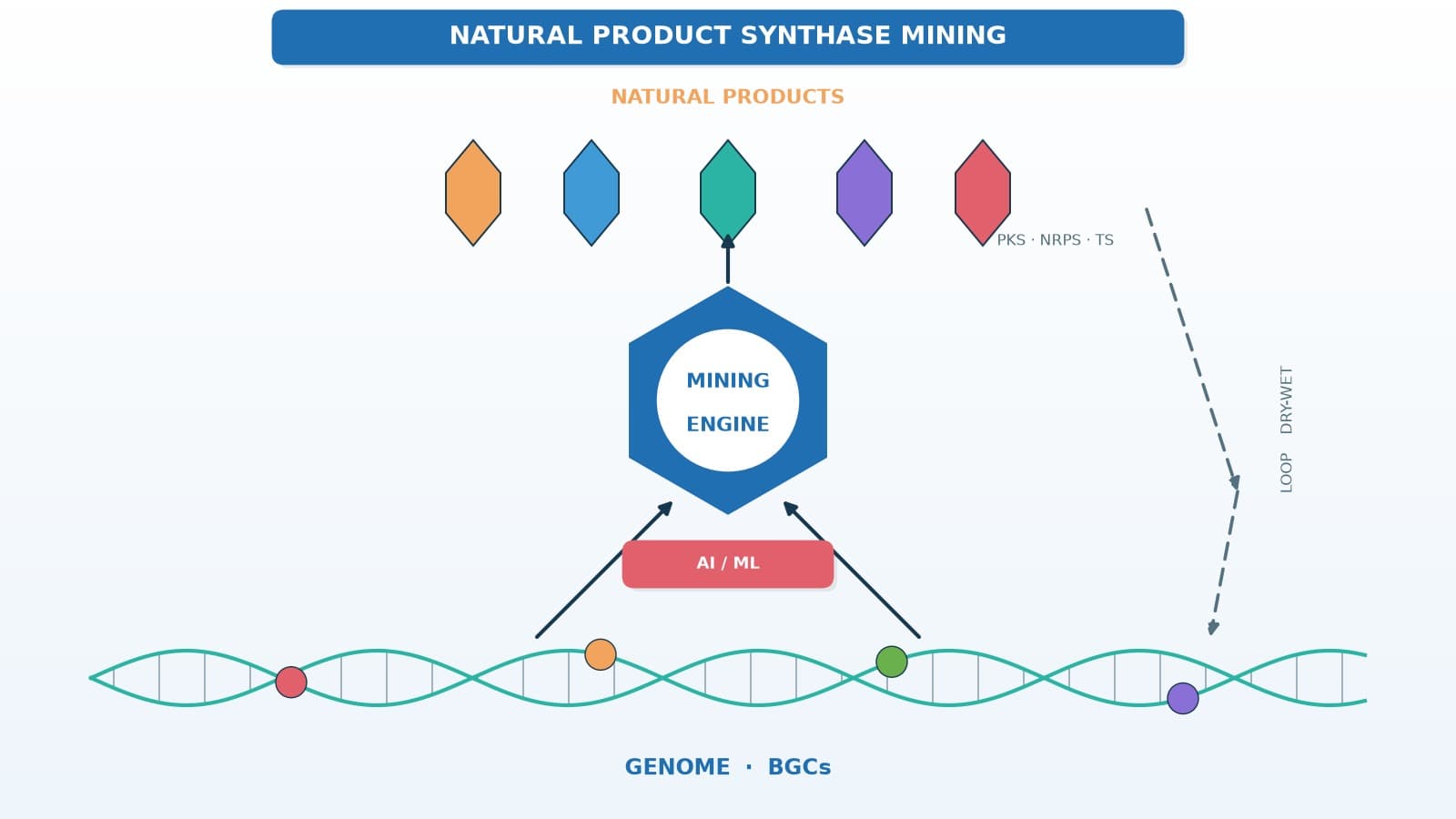
Figure 1 | Concept overview: from genome to natural product, with AI/ML + dry-wet closed loop
Introduction
The millions of microorganisms, fungi, and plants on Earth each run their own "molecular assembly line." At the heart of these lines is a class of biomolecules collectively called natural product synthases — they stitch simple metabolic precursors into molecules with complex structures and diverse activities. Many antibiotics, anticancer drugs, and immunosuppressants trace their origins to these enzymes. "Natural product synthase mining" is the practice of using genomics and AI to systematically locate, identify, and "awaken" these sleeping synthases in the genome.
Why Is Natural Product Synthase Mining Worth It?
Natural product synthase mining is worth the investment because natural products remain a major source of new drug discovery — one analysis shows that natural products and their derivatives account for more than one-third of FDA-approved new molecular entities (NMEs), with even higher proportions in the antibacterial and anticancer areas.
· Abundant sources: microbial genomes harbor a vast number of undiscovered biosynthetic gene clusters (BGCs), most of which can only be recognized by gene sequence rather than by cultured products.
· Novel structures: traditional culture and isolation can only find molecules "already expressed"; genome mining can reach silent gene clusters and deliver candidates with novel scaffolds.
· Industrial value: a synthase is both a "catalyst" and a "design template" for a natural product; mining a new enzyme means obtaining the key to a new molecule, serving pharma, agrochemicals, food, and biomanufacturing.
· Practical constraints: not every gene cluster can be efficiently expressed in its native host, so activation, heterologous expression, and enzyme engineering are still required.
Look at it from another angle: genome mining essentially "re-examines" existing sequencing data. Many strains were sequenced long ago, yet their natural-product biosynthetic capacity has never been systematically interpreted. With AI-assisted automated mining, teams can first lock onto the clusters "most likely to yield new molecules" without relying on large-scale culture, then concentrate resources on validation. This is precisely the efficiency that distinguishes synthase mining from traditional random screening.
How Do Natural Product Synthases Work?
Most natural product synthases use a modular assembly-line strategy: polyketide synthases (PKS) and non-ribosomal peptide synthetases (NRPS) assemble and extend a molecular chain through multiple functional modules, while terpene synthases cyclize isoprenoid precursors into scaffolds.
· PKS (polyketide synthase): type I PKS is modular; a typical module contains ketosynthase (KS), acyltransferase (AT), and acyl carrier protein (ACP) domains that extend the carbon chain round by round.
· NRPS (non-ribosomal peptide synthetase): modules contain condensation (C), adenylation (A), and thiolation (T) domains that assemble amino acid units into non-ribosomal peptides.
· Terpene synthase: uses isoprenyl diphosphate precursors as substrates and initiates cyclization in the active-site pocket to generate the monoterpene, sesquiterpene, and diterpene families.
· Domains as identity tags: these conserved domains are the recognition features used in mining — one can judge from sequence features alone whether a gene cluster encodes a PKS/NRPS.
Notably, most modular synthases follow a "colinearity" rule — the order of domains or modules in the gene corresponds to the assembly steps of the product. This lets researchers predict the assembly order and rough scaffold from the gene sequence alone, which is a key basis for mining and engineering. In addition, the substrate specificity of different modules (e.g., AT toward extender units, A domains toward amino acids) sets the boundary of product diversity.

Figure 2 | Modular assembly (PKS/NRPS) and terpene cyclization
How to Evaluate and Select Candidate Synthases?
Not every mined candidate synthase is worth further investment; evaluation and selection should consider sequence/structure features, predicted product novelty, controllable-expression feasibility, and eventual application value.
· Novelty: compare against known enzymes and known products, prioritizing clusters that differ greatly from known molecules.
· Completeness: whether the cluster contains complete initiation, extension, and release (e.g., thioesterase TE) modules directly determines whether a complete molecule can be produced.
· Expressibility: the expression and folding potential of a candidate in a heterologous host is key to moving from "sequence" to "product."
· Engineerability: whether there are engineerable domain boundaries and existing templates determines the room for later directed evolution.
· Risk flags: flag potential toxicity, low solubility, or difficult purification early, and distinguish【measured】from【predicted】.
In practice these dimensions are often quantified into comparable scores, with each dimension tagged by evidence level: experimental results are【measured】, alignment- or model-derived ones are【predicted】, and those lacking evidence are clearly marked【unknown】. This accelerates decisions without mistaking inference for fact.
The Standard Workflow of Genome Mining
Mature genome mining usually follows a closed loop of "sample → sequencing → gene-cluster prediction → homology/structure comparison → candidate ranking and validation → scale-up," in which AI models handle prediction and ranking while wet-lab work provides final confirmation.
1. Sample and sequencing: perform whole-genome or metagenomic sequencing on microbial/fungal/plant samples.
2. Gene-cluster prediction: annotate BGCs and their core enzyme types with tools such as antiSMASH.
3. Homology mining: run BLAST homology comparison on unknown sequences, or use structure comparison to find remote homologs.
4. Candidate ranking: score and rank candidates by novelty, completeness, expressibility, and other metrics.
5. Validation and scale-up: heterologous expression, activity and structure identification (LC–MS, NMR), then fermentation scale-up.
6. AI closed loop: each round of wet-lab data flows back into the model for active learning, progressively improving the next round's mining accuracy.
The key to the whole workflow is "dry-wet integration": dry-lab work narrows candidates while wet-lab work provides real feedback. Missing either side often leads to "accurate prediction but hard to implement" or "a needle in a haystack at high cost."

Figure 3 | Standard genome-to-product workflow
How Does MatwingsVenus®(晓鹜®) Participate?
MatwingsVenus®(晓鹜®) links "AI-driven sequence/structure mining" with "wet-lab validation and engineering results" into a closed loop, helping teams move from genome to producible novel natural products faster.
· Dry-lab mining: perform functional annotation, structure, and property screening of candidate synthases using sequence homology (BLAST) and structure mining (VenusMine).
· Structure prediction and design: use protein-structure prediction and AI design tools to quickly assess a candidate's foldability and engineerable sites.
· Wet-lab closed loop: validate candidates through heterologous expression, purification, activity, and stability characterization, then feed results back into the model to form a "dry → wet → dry" cycle.
Related products/services (deep links)
· Wet-lab services (expression, purification, characterization): Wet-lab platform
· Expert and custom services: Expert center
· AI dry-wet closed-loop platform: Dry-wet closed-loop platform
FAQ
How does natural product synthase mining differ from traditional natural product isolation?
Traditional isolation relies on molecules a microbe "already expresses," whereas mining can discover silent synthases and gene clusters at the genomic level, reaching far more unknown structures.
What is the difference between PKS and NRPS?
PKS (polyketide synthase) assembles acyl/malonyl units, while NRPS (non-ribosomal peptide synthetase) assembles amino acid units; both are built by multiple modular domains on an assembly line.
Does having a biosynthetic gene cluster guarantee producing the target molecule?
Not necessarily. Completeness and effective expression are prerequisites: the cluster must have complete assembly and release modules and be expressed effectively in a host; otherwise heterologous expression or activation is required.
What data and tools does genome mining require?
Typically genome/metagenome sequencing data, BGC prediction tools (such as antiSMASH), sequence and structure homology comparison, and candidate scoring and validation workflows.
How do you judge whether a mined synthase is valuable?
Look at novelty, cluster completeness, expressibility, engineerability, and application value, and distinguish【measured】from【predicted】results.
What role does AI play in natural product synthase mining?
AI handles gene-cluster/enzyme function prediction, candidate ranking, structure prediction, and active-learning optimization, quickly narrowing "many candidates" to "a few worth validating."
What kind of support can MatwingsVenus provide?
It can provide dry-lab mining/annotation/structure prediction, wet-lab expression and purification characterization, and integrated services on the dry-wet closed-loop platform (scope subject to official confirmation).
Summary
Natural product synthase mining systematically turns "the synthetic capability hidden in genomes" into verifiable, producible molecule and enzyme resources. From sequencing and gene-cluster prediction to homology and structure mining, then candidate validation and scale-up, every step requires close coordination between AI and wet-lab work. If you hit bottlenecks in candidate synthase mining, heterologous expression, or scale-up, welcome to get selection advice or submit a sample: phone 13061973951, email info@matwings.com.
Explore MatwingsVenus®(晓鹜®): to learn more about AI protein and enzyme-engineering capabilities, browse our products and services. For more technical articles and cases, follow the company news center.