How Does Phytase Unlock the Phosphorus Locked in Feed Phytate? From Mechanism to Process to Selection
Published on October 22, 2026
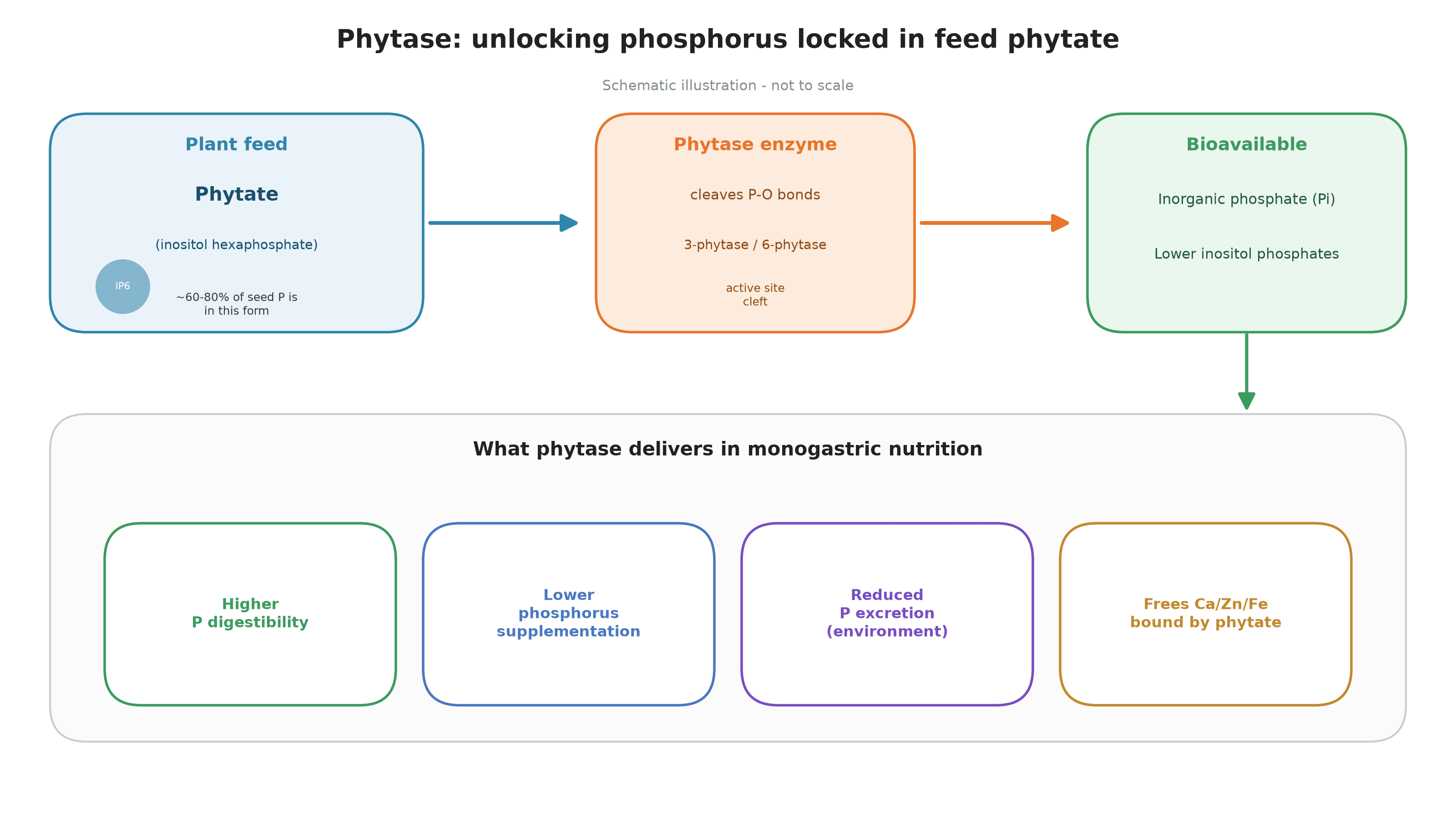
Fig. 1 Phytase concept overview phytate (inositol hexaphosphate) in feed is progressively hydrolyzed by phytase, releasing inorganic phosphorus available to monogastric animals while reducing dietary phosphorus supplementation and phosphorus excretion. Schematic illustration, not to scale.
About 60%–80% of the phosphorus in feed ingredients exists as phytate, which monogastric animals can barely use. Phytase is the key enzyme that releases this "locked" phosphorus. By cleaving the phosphate ester bonds of phytate, it converts otherwise unavailable phytate phosphorus into absorbable inorganic phosphorus, while also freeing calcium, zinc and iron that phytate chelates — improving animal performance while cutting dietary phosphorus addition and phosphorus excretion.
Why Do We Need Phytase? Background and Problem
Phytate is the main storage form of phosphorus in plant feed, but pigs and poultry lack sufficient phytase, so roughly 60%–80% of phytate phosphorus is poorly available; adding exogenous phytase is therefore a routine strategy to raise phosphorus utilization, cut costs and reduce environmental phosphorus loss.
Much of the phosphorus in plant-based feed ingredients is stored as phytate (inositol hexaphosphate, IP6). The International Union of Biochemistry (IUB) recognizes phytase as the only enzyme able to initiate release of phosphate from phytin. For pigs, the digestibility of phytate-bound phosphorus is typically only 20%–30%, so animals must be supplemented with inorganic phosphorus to meet requirements — costly and burdened with phosphorus excretion. Phytate is also an anti-nutritional factor, binding protein and minerals such as calcium, zinc and iron and lowering their availability.
How Phytase Works: Mechanism and Structural Classes
Phytases are classified by first-cleavage position into 3-phytase (EC 3.1.3.8), 6-phytase (EC 3.1.3.26) and 5-phytase (EC 3.1.3.72), and by catalytic mechanism into histidine acid phosphatase (HAP), beta-propeller phytase (BPP), purple acid phosphatase (PAP) and cysteine phytase.
Phytase is a phosphatase that hydrolyzes the phosphate ester bonds of phytate. It cleaves the phosphate groups of phytate one by one to form lower inositol phosphates such as IP5, IP4 and IP3, and the end products are inositol and inorganic phosphate (Pi). Phytases from different sources differ in first-attack position and catalytic machinery.
By first-attack position, there are 3-phytases, 6-phytases (also historically described as 4-phytases) and 5-phytases; fungal and most bacterial phytases are typically 3-phytases, while plant and E. coli phytases are usually 6-phytases. By catalytic domain, four classes of phytase use unrelated protein scaffolds: histidine acid phosphatase (HAP), beta-propeller alkaline phytase (BPP), purple acid phosphatase (PAP) and cysteine phytase (CP). Most phytases used as feed supplements are microbial histidine acid phosphatases.

Fig. 2 ·Phytase application/process flow:Phytase key mechanism/structure: using Aspergillus fumigatus phytase (PDB 1QWO, 1.5 Å), the active site of a histidine acid phosphatase is shown. The phosphorylated histidine His59 acts as a nucleophile to form a phospho-histidine intermediate; Asp339 nearby acts as the catalytic acid in hydrolysis. Real experimental structure, not to scale.
The "two-step" mechanism of histidine acid phosphatase: HAP phytases share a conserved active-site sequence motif (Arg-His-Gly-X-Arg-X-Pro). The key catalytic histidine (here His59 in 1QWO) acts as a nucleophile, attacking the phytate phosphate to form a phospho-histidine intermediate; an activated water molecule then attacks this intermediate with the aid of the catalytic acid (such as Asp339), releasing inorganic phosphate and regenerating the active site. Because this process can be "frozen" at the intermediate state crystallographically, we can observe and validate it directly in three dimensions.
How Phytase Is Measured and Selected
Phytase activity is measured as the amount of inorganic phosphorus released per minute (in units such as FTU), and selection must weigh activity, optimal pH and temperature, thermostability, phytate specificity, and fit to different diets and animal types.
Activity assays usually use sodium phytate as substrate at a defined pH and temperature and measure released inorganic phosphorus colorimetrically; common units include FTU (Phytase Units). But an activity number is not the same as real-world effect, because feed pelleting and the conditions in the animal digestive tract strongly affect how the enzyme performs.
When selecting, four dimensions typically matter:
· Activity and efficiency: release capacity per unit of activity, and whether it stays active at the low pH of the stomach.
· Thermostability: feed pelleting usually involves conditioning at 75–90 °C; the enzyme must survive high temperature or recover activity after cooling.
· pH and temperature profile: acid phytases are usually most active between pH 2.0 and 6.0; different strains often show distinct two-peak pH behaviors.
· Specificity and substrate type: the degradation path (first cleaving at position 3 or 6) and susceptibility to chelation by phytate and metal ions.
Application Conditions and Process Control
Applying phytase is a process loop spanning formulation, pelleting and feeding; the key levers are dosage, addition method, conditioning temperature and water activity, and a mismatch at any step can markedly weaken the final effect.
Phytase value is only realized through sound processing. In feed production, one must consider enzyme dosage, timing of addition (before or after conditioning), conditioning temperature and residence time, and the retained activity after pelleting. Phytases with poor thermostability lose much activity under high-temperature conditioning, which is why heat-stable or coated product forms exist. Inside the digestive tract, phytase must remain active across the different pH zones of the stomach and intestine to contact and hydrolyze the phytate in the digesta.

Fig. 3 the upper track is feed manufacturing (ingredient mixing → dosing phytase and conditioning → pelleting); the lower track is hydrolysis and phosphorus absorption in the monogastric gut, along with outcomes such as increased phosphorus absorption, less inorganic phosphorus in the diet, less phosphorus in manure, and release of mineral elements. Schematic, not to scale.
Key process control points include conditioning temperature (about 75–90 °C, requiring enzyme thermostability), uniform enzyme mixing, the release profile of the enzyme in the gut, and matching with dietary phytate and calcium levels. In practice, phytase benefit follows a curve of diminishing returns: most of the benefit is obtained within the dose needed to destroy 30%–40% of dietary phytate, so more is not necessarily better.
How MatwingsVenus®(晓鹜®)Can Support Phytase R&D
MatwingsVenus®(晓鹜®)links sequence mining, AI protein design, structure and activity prediction, and wet-lab validation through its dry-wet closed-loop platform, helping customers iterate faster from candidates to production-ready strains in phytase and other industrial enzyme projects.
Developing a phytase is essentially a protein-engineering problem of balancing manufacturability against performance: raising catalytic efficiency and thermostability while keeping expression, secretion and storage stability. MatwingsVenus®(晓鹜®)offers integrated capabilities spanning protein discovery, protein design, structure prediction, function prediction and a dry-wet closed loop, which can be applied to active-site optimization, thermostability engineering and substrate-specificity tuning of phytase. We support both structure- and function-guided design from sequence and handing candidates to closed-loop wet-lab validation, for fewer iterations and higher success rates.
Frequently Asked Questions (FAQ)
What class of enzyme is phytase?
Phytase is a class of phosphatase that catalyzes the hydrolysis of the phosphate ester bonds of phytate (inositol hexaphosphate); common classes include 3-phytase (EC 3.1.3.8), 6-phytase (EC 3.1.3.26) and 5-phytase (EC 3.1.3.72).
Why is phytase important for pigs and poultry?
Pigs and poultry can barely use phytate-bound phosphorus, and phytate accounts for about 60%–80% of the phosphorus in plant feed, so exogenous phytase significantly improves phosphorus utilization, lowers dietary phosphorus addition and reduces phosphorus excretion.
How does phytase catalyze the hydrolysis of phytate?
In histidine acid phosphatase, the catalytic histidine attacks the phytate phosphate nucleophilically to form a phospho-histidine intermediate; an activated water then attacks it with the aid of a catalytic acid, releasing inorganic phosphate and regenerating the active site.
What factors affect the real-world effect of phytase?
The main factors are enzyme activity, optimal pH and temperature, thermostability, dosage and addition method, conditioning temperature, and dietary phytate, calcium and mineral levels.
What is the relationship between phytase and thermostability?
Feed pelleting often requires 75–90 °C conditioning, and phytases with poor thermostability lose much activity, so heat-stable or coated phytases are better suited to high-temperature pelleting.
Is more phytase always better?
No. Phytase benefit follows diminishing returns; most of the benefit lies within the dose needed to destroy 30%–40% of dietary phytate, so higher dosing does not linearly improve the effect.
What is the environmental significance of phytase?
By raising phosphorus utilization, phytase can reduce inorganic phosphorus added to feed, thereby lowering phosphorus excreted in manure and urine and easing water eutrophication pressure.
Conclusion
Phytase releases the phosphorus that phytate "locks up" in plant feed, delivering both economic and environmental value. Its effect depends on catalytic mechanism (active site and two-step hydrolysis), enzymatic properties (pH/temperature/thermostability), and process control spanning formulation, pelleting and feeding. For industrial-enzyme R&D teams, improving activity and manufacturability under these constraints is exactly where protein engineering and a dry-wet closed loop can help.
Explore MatwingsVenus®(晓鹜®)
MatwingsVenus®(晓鹜®)is an AI-driven platform for protein R&D and industrial enzymes, offering protein discovery, protein design, structure prediction, function prediction and molecular simulation, connected to wet labs through a dry-wet closed loop. You are welcome to explore.