Extreme-Environment Enzyme Mining: Why Extreme Habitats Hold the Next Generation of Industrial Enzymes
Published on October 22, 2026
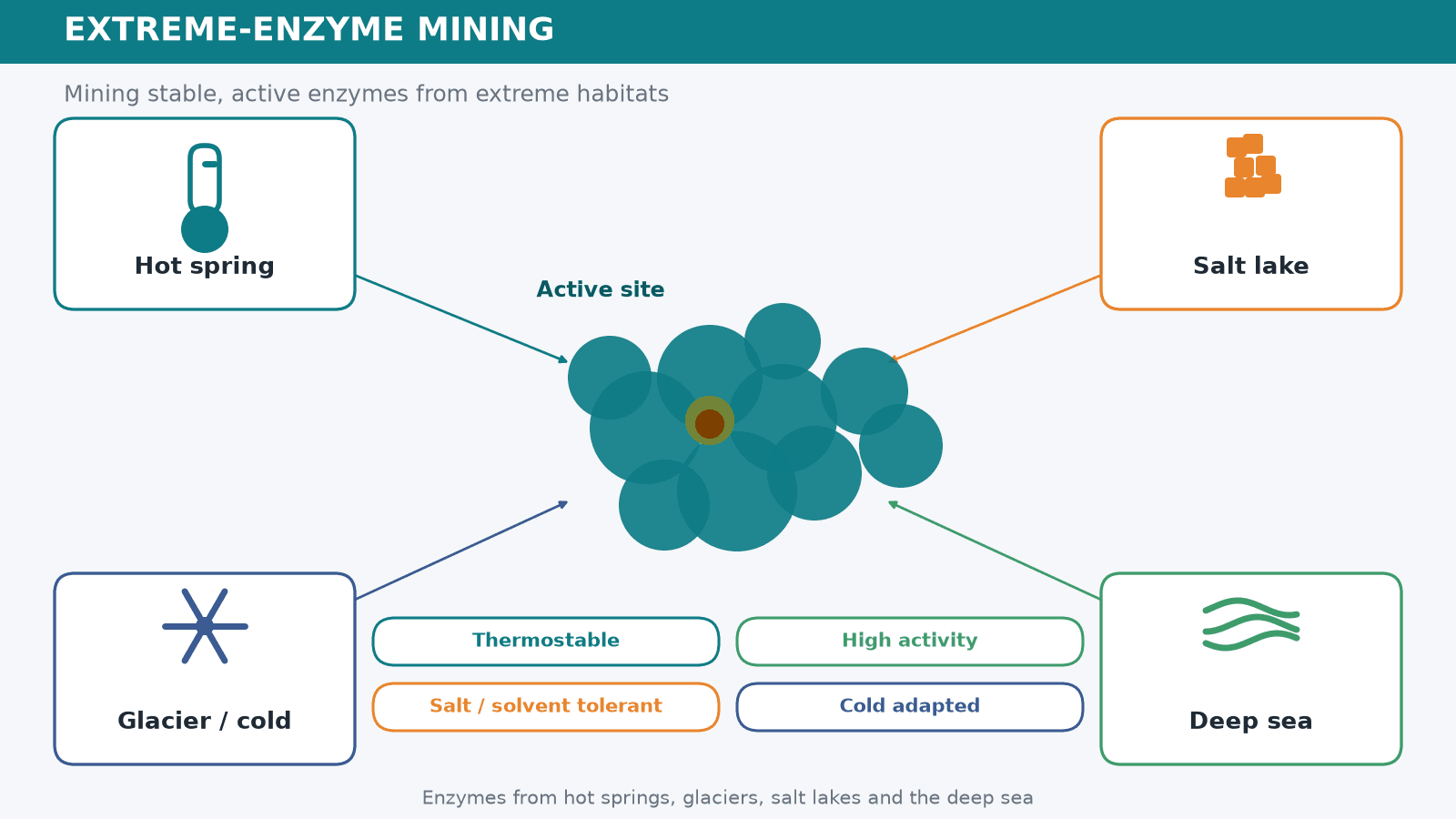
Figure 1 | Extreme-environment enzyme mining at a glance
Category C (Directed evolution / protein engineering); cross-reference: G (Application / scenario)
Enzymes are nature's built-in catalysts. Most work under mild conditions and quickly lose activity at high temperature, extreme cold, high salt or high pressure. Yet a group of organisms called extremophiles thrive precisely in these "harsh" environments. The enzymes inside them have evolved remarkable tolerance and distinctive activity — and that is exactly what extreme-environment enzyme mining is looking for. For biomanufacturing, turning this survival wisdom into a scalable industrial catalyst is often the key to cutting energy use and widening the process window.
1. Background & Mechanism: Why Extreme Habitats Produce "Super Enzymes"
Microbes that thrive in volcanically heated hot springs, glaciers, salt lakes and deep-sea vents must keep their enzymes working under punishing conditions, and in doing so evolved "extremozymes" that tolerate heat, cold and salt — making them a valuable source for industrial catalysis.
• Classified by extreme condition: thermophiles (~45–80 °C), hyperthermophiles (>80 °C), psychrophiles (<15 °C), halophiles, barophiles, plus acidophiles and alkaliphiles.
• Tolerance evolved to survive: through distinctive sequences and structures, these enzymes gain outstanding thermostability, cold adaptation, salt, pressure and organic-solvent tolerance.
• Exactly what industrial biocatalysis wants: high temperature speeds reactions and suppresses contamination; solvent tolerance broadens the substrate range; high stability lowers energy use and loss.
• Industry-facing use cases: heat-stable α-amylase for starch saccharification and biofuels; alkali-stable protease for detergents; cold-active enzymes for low-temperature food processing and cold-wash; salt/organic-solvent-tolerant enzymes for non-aqueous catalysis and saline wastewater treatment.
• A simple analogy: an ordinary enzyme is like a city car; an extremozyme is like an off-road vehicle — the first stalls on a rough road, the second keeps going.
• Classic example: the Taq DNA polymerase from a thermophile made PCR (polymerase chain reaction) possible — the best-known case of "one extremozyme changing an industry."
• An important insight: extremophily is rarely one-dimensional — the same microbe often resists heat, salt and pressure at once, giving its enzymes "combined tolerance" and offering engineers a wider process window.
2. Principles & Structure: How Extremozymes Are Both "Stable and Capable"
Extremozymes raise overall structural rigidity through ion-pair networks, a denser hydrophobic core and disulfide bonds, while preserving the flexibility their active site needs, so they stay both stable and highly active under harsh conditions.
• Thermostability mechanisms: ion-pair networks, a denser hydrophobic core, intramolecular disulfide bonds, proline residues and aromatic stacking all raise the energy needed to unfold the protein.
• A traceable residue "recipe": thermostable proteins favor Arg, Pro and aromatic residues with more compact hydrophobic packing; psychrophilic proteins use more Gly and fewer salt bridges, making the structure "looser."
• Cold adaptation: a more flexible active site, fewer salt bridges, and reshuffled surface charges and polar residues keep the enzyme active at low temperature — cold-adapted enzymes often show high activity but lower overall stability.
• Halotolerance: acidic/hydrophilic surfaces, repulsion of salt ions and replacing salt bridges with internal water molecules prevent salting-out aggregation under high salt.
• The core trade-off: the active site is the functional core; stabilization must not sacrifice its necessary mobility. Over-rigidifying can drop activity, which is the main challenge in extremozyme engineering.

Figure 2 | How extremozymes stay both stable and active
3. Assay & Selection: How to "Hunt Down" the Target Enzyme from an Extreme Environment
Discovering extremozymes relies on three complementary routes — culturable microbes, metagenomics and AI sequence/structure mining — and candidate enzymes must then be selected through activity assays, stability tests and substrate profiling.
• Route 1 · Culture-based: isolate and culture extreme microbes, then measure activity and tolerance limits. This gives real phenotypes but has limited coverage, because most extreme microbes are hard to culture.
• Route 2 · Metagenomics: mine genes directly from environmental DNA, bypassing the "unculturable" bottleneck and returning many candidate sequences at once — today's mainstream method.
• Route 3 · AI mining: screen candidates by function, sequence or structural similarity using public protein databases and AI models; after a similarity hit, verify against authoritative annotations to avoid misjudgment.
• Screening approaches: high-throughput activity screening with chromogenic/fluorescent substrates, sequence-based metagenomic binning and homology search, and structure-based virtual screening.
• Selection metrics: optimal temperature and pH, thermostability (Tm/half-life), salt and solvent tolerance, substrate profile, catalytic efficiency (kcat/Km), enantioselectivity, expressibility, purification yield and unit cost.
• Evidence boundary: prioritize actual measurement and authoritative database annotations for activity and stability; AI predictions are mainly for candidate ranking, labeled【predicted】rather than【measured】.
• A practical caveat: extremozymes are "naturally tough" but often suffer from low expression, weaker activity or narrow substrate preference, so they usually need a second round of engineering before meeting production activity and cost targets.
4. Conditions & Process: From a Candidate Enzyme to a Usable Enzyme
A candidate extremozyme must pass through heterologous expression, performance engineering, process optimization and industrial scale-up before it can be used economically and stably in production.
• Expression system choice: E. coli, yeast, fungi, Bacillus and others; extremozymes often need host support such as thermotolerant expression, secretion signals, chaperones and disulfide-bond-assisted folding.
• Performance engineering: combine directed evolution with rational design — commonly error-prone PCR, gene recombination, site-directed mutagenesis and AI-assisted design — to improve activity, stability and substrate specificity.
• Process optimization: control fermentation temperature, induction conditions, media and pH, plus substrate/enzyme dosage, salt concentration and time during reaction; combine with immobilization, solvent systems and reactor design.
• Downstream purification & immobilization: use heat/acid precipitation, chromatography, cross-linked enzyme aggregates (CLEA) or carrier immobilization to improve recovery, reusability and storage stability.
• Scale-up validation: from pilot to industrial scale, focus on activity retention, recovery, reusability, storage stability, batch consistency and unit cost.
• Full process: Sampling → Metagenomics → AI mining → Expression → Screening → Directed evolution → Scale-up → Application.

Figure 3 | From extreme habitat to industrial enzyme
5. How MatwingsVenus® ( protein design agent ) Can Help
MatwingsVenus® (晓鹜®) connects AI enzyme design, high-throughput wet experiments and industrialization services through a dry-wet closed-loop platform, helping teams discover, engineer and scale extremozymes faster and at lower cost.
• Dry-wet closed-loop platform: AI prediction/design and wet-lab validation drive each other, with experimental data flowing back to continuously improve the model, significantly shortening the iterations from "candidate" to "usable."
• Capability coverage: starting from an extreme-environment sample or a known sequence, it can run function prediction, thermostability and activity engineering, candidate screening and engineering assessment.【To be verified: specific enzyme types and case data】.
• Who it serves: research and corporate users gain Wet-Lab services, Expert Center consulting, and sequence/structure analysis plus function-prediction tools covering both the "dry" and "wet" sides.
• Related capability links: Wet-Lab Services, Expert Center, Dry-Wet Closed-Loop Platform.
• Call to action: for selection advice, sample submission or a quote, contact 13061973951 or info@matwings.com.
6. FAQ | Frequently Asked Questions
What is extreme-environment enzyme mining?
It is the process of finding natural enzymes with unusual tolerance and function in extreme habitats such as high temperature, low temperature, high salt or high pressure, then developing and engineering them.
How are extremozymes better than ordinary enzymes?
They keep their structure and activity under harsh conditions, supporting high-temperature reactions and solvent-tolerant systems while reducing contamination, which lowers energy and operating costs.
What role does metagenomics play?
Metagenomics obtains genes directly from environmental DNA, bypassing the bottleneck that most extreme microbes are unculturable, and greatly expands the enzyme sequence space available to screen.
Can AI fully replace experiments?
No. AI is used to generate and rank candidates, shrinking the search space; activity, stability and process performance still need experimental measurement and validation.
Which industries use extreme-environment enzyme mining?
Food, detergents, bioenergy, pharmaceutical intermediates, environmental treatment, materials and fine chemicals — any process needing high-temperature, salt-tolerant or solvent-tolerant catalysis.
How long does it take from finding an enzyme to using it?
【To be verified: the timeline depends on species, target enzyme and process complexity, typically assessed in "weeks—months"】.
How do I start an extreme-environment enzyme mining project?
Define the target reaction and conditions → determine the sample/sequence source → run discovery and screening → engineer and scale up. You can consult MatwingsVenus® (晓鹜®) for selection advice and a quote.
7. Summary
Extreme-environment enzyme mining turns the survival wisdom of extreme habitats into industrial catalytic capability, and with metagenomics plus an AI dry-wet closed loop it is accelerating the journey from lab to production line. For biomanufacturing, finding an enzyme that is both "stable and capable" is often more efficient than merely optimizing an existing one.
---
Explore MatwingsVenus® (晓鹜®)
MatwingsVenus® is committed to an AI + wet-lab dry-wet closed loop to advance the R&D and industrialization of enzymes, antibodies and proteins. Explore our Wet-Lab Services, Expert Center and Dry-Wet Closed-Loop Platform. For selection advice, sample submission or a quote, contact 13061973951 or info@matwings.com.