Textile Waste Recycling and Reuse Explained: From Mixed Fibers to New Materials
Published on October 9, 2026
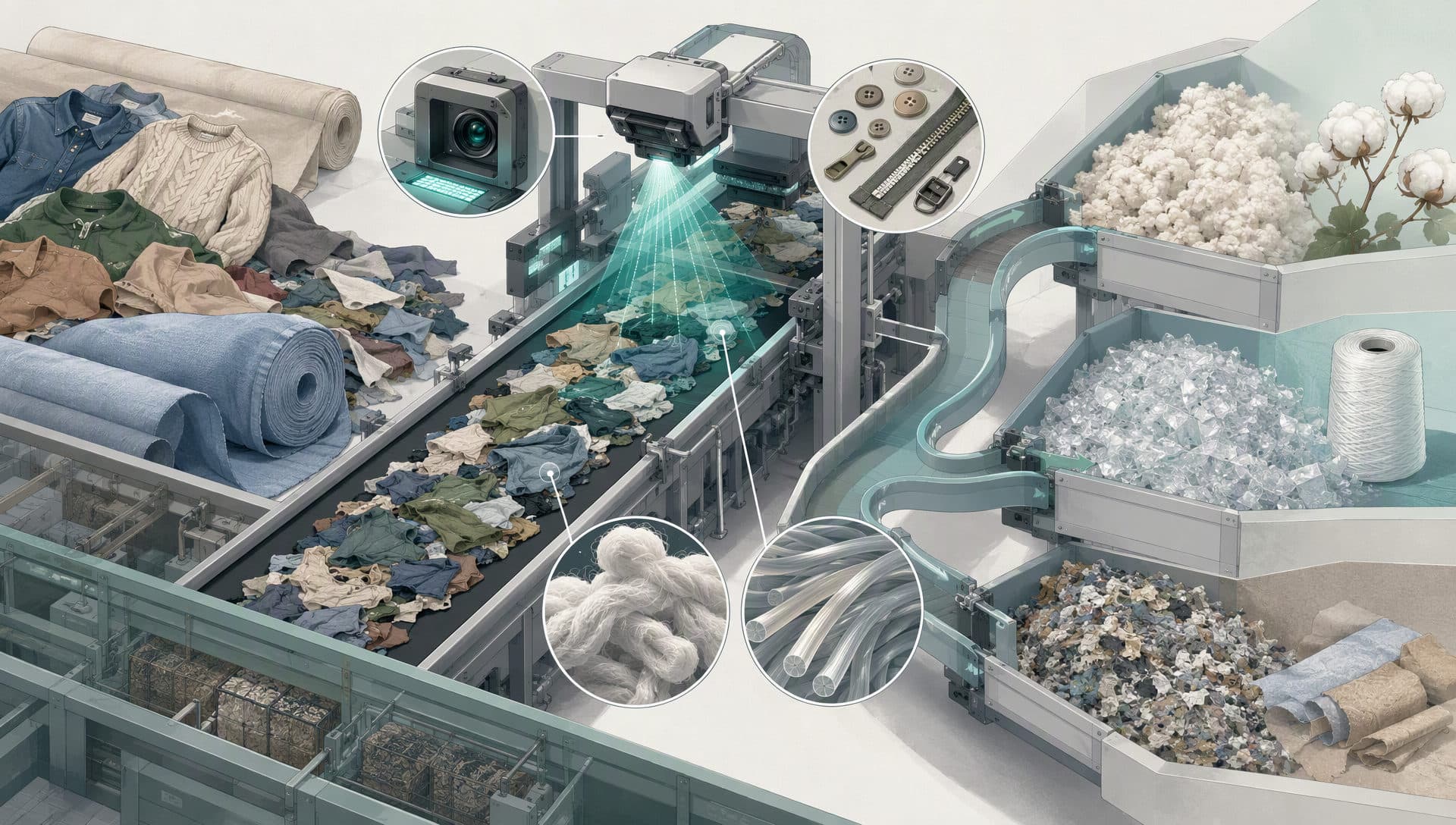
Textile waste recycling and reuse begins with blend identification
Category: Circular Textiles, Green Manufacturing, Biocatalysis, Recycled Materials
A discarded garment is rarely a single, clean material. The main fabric may combine cotton, polyester, nylon, or elastane, while dyes and finishing agents remain on the surface. Zippers, buttons, labels, sewing threads, membranes, and elastic trims introduce additional components. If these differences are ignored, shredding can damage recoverable fibers, melt processing can be disrupted by incompatible polymers, and depolymerization can inherit an avoidable purification burden.
That is why textile waste recycling and reuse is best understood as a connected material system rather than one treatment step. Collection, identification, dismantling, sorting, conversion, purification, and quality verification must work together. The objective is not merely to divert textiles from disposal. It is to preserve fiber value where possible or return polymers to suitable building blocks so that recovered material can re-enter manufacturing.
Start Textile Waste Recycling and Reuse by Defining the Feedstock
Technology selection should begin with a feedstock profile. Pre-consumer cutting scraps are often more consistent and better documented than post-consumer garments. Used clothing varies in wear, contamination, blend ratio, color, finishing, and accessory content. Uniforms, bed linens, carpets, and technical textiles may all be textile waste, but their structures and safety requirements justify different handling rules.
A useful intake record identifies the dominant fibers, minor elastane content, layered or coated construction, color and finish complexity, removable accessories, contamination, and intended output. A plant that wants reusable staple fiber will apply different acceptance criteria from a process targeting polymer chips, purified monomers, or cellulose derivatives.
This information supports an early routing decision: direct reuse, mechanical recovery, component separation, polymer depolymerization, or another managed outlet. The decision prevents clean mono-material streams from being overprocessed and keeps difficult blends away from lines designed for high-purity feedstock.
Why Post-Consumer Textile Sorting Determines Downstream Quality
The bottleneck is often located before the reactor. Care labels are helpful but cannot resolve missing labels, inaccurate declarations, coatings, or layered structures. Near-infrared sensing, hyperspectral methods, machine vision, and manual verification can work together to classify fiber type, color, and visible condition. Even then, low elastane content, dark fabrics, surface treatments, and spectrally similar materials can complicate identification.
Sorting criteria should reflect the next process. Mechanical recyclers care about color, yarn construction, wear, and retained fiber length. Melt recyclers must control incompatible polymers, metals, and certain finishes. Depolymerization routes need information about polyester content, dyes, non-polyester fractions, and compounds that may complicate reaction or purification. There is no single sorting specification for all recycling technologies.
Dismantling is equally important. If zippers, buttons, metal parts, printed films, interlinings, and sewing threads are shredded with the fabric, they become smaller and harder to remove. Separating them before size reduction can reduce equipment damage and downstream contamination. Linking composition results to batch identifiers also creates a data trail for process adjustment and quality investigation.
Match Cotton, Polyester, and Blended Textiles to Different Recovery Routes
The most advanced technology is not automatically the most suitable one. The better question is which route preserves the greatest useful value for a particular feedstock and product target.
Relatively clean mono-material cotton, wool, and some polyester streams can be opened, carded, and respun mechanically. This route keeps the polymer intact, but repeated opening and processing can shorten fibers and reduce strength. Blending with selected fibers, redesigning the yarn, or shifting to nonwoven and composite applications may be needed to match the recovered fiber quality.
Polyester streams intended for polymer or monomer recovery can follow melt processing or depolymerization. Melt recycling benefits from a clean and compatible feedstock and must manage thermal history, molecular-weight loss, and foreign matter. Chemical routes use hydrolysis, glycolysis, or other reactions to convert polyester into monomers or oligomers before purification and repolymerization. They can offer more options for contaminated material but add requirements for reagent recovery, energy management, equipment compatibility, and product purification.
Polyester-cotton, polyester-elastane, and multilayer textiles usually need component separation before each fraction is assigned a destination. Shredding without separation may convert one recoverable component into contamination for another process. Selective dissolution, selective depolymerization, and enzyme-assisted treatment are valuable because they target one fraction while seeking to preserve another.
Build Polyester-Cotton Separation Around Pretreatment and Selectivity
Polyester-cotton blends illustrate the system challenge. Cotton is cellulose, while polyester is primarily PET, yet the two materials are tightly interwoven at yarn scale. Dyes, crosslinking finishes, and elastane can cover surfaces or alter mass transfer. Simply increasing reaction severity may damage both fractions instead of improving separation.
A practical workflow starts by measuring fiber composition and secondary components. Cutting, milling, washing, decolorization, or controlled structural opening can then improve accessibility. The process selectively treats cellulose or polyester according to the desired outputs, followed by separate recovery of solid and liquid products. Mass balances are essential because a high conversion number for one fraction can hide the loss of the other into wastewater or fine particles.
Pretreatment should not be maximized without limits. Smaller particles provide more surface area but create dust and filtration challenges. Decolorization can improve recovered-product appearance but requires a plan for solvents and extracted dyes. Acid, alkali, or heat may open the structure while changing polymer properties. Separation purity, material retention, chemical recovery, and effluent load therefore belong in the same optimization framework.

Textile waste recycling uses enzyme-assisted separation for complex blends
Where Enzymatic Textile Recycling Fits into Polyester Recovery
The defining advantage of enzymes is substrate selectivity. Cellulases act on cellulose-based fibers such as cotton. Keratinases can target protein fibers, and polyester-hydrolyzing enzymes provide a route toward PET building blocks. In blended textiles, that selectivity may be used either to remove one fiber fraction or to convert a target polymer into recoverable small molecules.
Material form still governs performance. Crystalline regions, fiber orientation, surface finishes, and dyes can limit access to polyester ester bonds. Cutting, opening, or carefully modifying the surface may improve contact, but intensive pretreatment can erase the benefit of mild reaction conditions. A robust evaluation measures solid-mass change, monomers and intermediates, remaining-fiber properties, enzyme dosage, and reuse rather than relying on one conversion figure.
MATWINGS MALL presents an rPTA direction within the MatwingsVenus™(晓鹜™) product portfolio, focused on converting waste textiles into regenerated PTA through enzymatic depolymerization. Its rPET direction addresses the conversion of waste PET into regenerated PET. For a polyester textile program, these product directions illustrate a complete logic: prepare a sufficiently controlled polyester feedstock, release and purify useful building blocks, then verify repolymerization and material performance. The exact feedstock range and processing window still require sample-specific testing.
A Platform Workflow from Enzyme Discovery to Real Textile Testing
Once an enzymatic route enters development, the question shifts from whether an enzyme exists to whether a candidate works on the intended textile waste. A useful candidate must do more than convert a model substrate. It needs sufficient stability within the selected temperature and pH window, tolerance to the actual dye and additive background, and access to oriented or crystalline fiber surfaces.
MatwingsVenus™(晓鹜™) can organize protein database retrieval, natural candidate discovery, functional-site analysis, and protein engineering tasks, with a handoff to wet-lab services. A defensible workflow begins with curated sequence and measured-data retrieval, builds a diverse candidate set, proposes modifications only after functional regions are considered, and then measures product release, residual material, and stability on real textile samples. Computation narrows the experimental space; wet-lab data establishes the performance boundary.
The same MatwingsVenus™(晓鹜™) workflow can support combinations of cellulases, keratinases, and polyester hydrolases. Sequential enzymes may help process complex blends, but synergy depends on composition, addition order, and reaction conditions. Results from a simplified substrate should not be generalized directly to post-consumer garments. Connecting composition analysis, enzyme screening, and mass balance in one data chain is more informative than optimizing an isolated activity value.
Confirm Textile-to-Textile Recycling with Quality Data
Separation or depolymerization is not yet textile-to-textile closure. Mechanically recovered fibers need data on length distribution, strength, contamination, color variation, and spinnability. Recycled polyester requires appropriate monomer purity, molecular weight and distribution, color, thermal behavior, and spinning performance. Regenerated-cellulose pathways must confirm dissolution, shaping, and final fiber properties.
Post-consumer feedstock is inherently variable. Development programs should deliberately include different colors, blend ratios, wear levels, and finishing treatments rather than testing only the cleanest samples. Pilot trials should track useful product per unit of input, water and reagent consumption, residue destination, equipment load, and quality yield. These measurements reveal whether a process has improved recovery value or merely shifted the burden to washing, purification, and end treatment.

Textile-to-textile recycling verifies monomer, fiber, and fabric quality
Build Scale-Up Metrics Around Material Function
Laboratory metrics should connect early to production decisions. Feedstock metrics include fiber composition, contamination, moisture, color, and batch variability. Process metrics include sorting accuracy, target-fraction retention, reaction time, enzyme or chemical use, reuse cycles, and solid-liquid separation load. Product metrics include spinnability, monomer purity, polymer molecular weight, color, mechanical performance, and downstream processing stability.
Economic and environmental comparisons need a consistent functional unit. Two routes should be compared only when they provide products of comparable function and quality. Collection, transport, pretreatment, energy, reagent recovery, wastewater, and residue management belong within the assessment boundary. A lower reaction temperature alone does not prove a lower total burden, just as mature equipment does not compensate automatically for severe quality loss.
A realistic scale-up strategy begins with a narrow feedstock window. A team might first process traceable production scraps with stable polyester content, establish sorting and product-quality baselines, and then introduce color variation, post-consumer garments, and more complex blends. Every expansion of the acceptance window should be supported by mass balance and quality data rather than masked by harsher treatment.
FAQ
Why is a total recycling rate insufficient for project evaluation?
A total rate may combine usable fiber, off-spec material, contaminated solids, and qualified products. A stronger evaluation separates target-fraction retention, product quality yield, monomer purity, spinnability, and residue destination. The recovered output must be capable of replacing material for the intended function.
Should a polyester-cotton blend be processed by removing cotton or polyester first?
There is no universal sequence. If the goal is to preserve polyester fiber, a selective cellulose treatment may be appropriate while polyester properties are monitored. If the objective is polyester monomer recovery, cotton, dyes, and finishes must be assessed for their effects on depolymerization and purification. Product target, purity, material retention, and total process cost determine the sequence.
Is enzymatic recycling always better than chemical recycling for polyester textiles?
No. Enzymes can offer selectivity and milder reaction conditions, but crystallinity, surface accessibility, reaction rate, enzyme cost, and pretreatment can limit performance. Chemical processing may offer advantages in maturity and throughput. A fair comparison uses the same product-quality requirement and system boundary, and a hybrid route may be appropriate.
What demonstrates that a textile-to-textile loop is real?
The waste textile needs a traceable input pathway, the recovered output must pass the quality requirements of the next textile-manufacturing step, and by-products and residues need defined destinations. Material recovery into a lower-grade application can still be useful, but it should not be presented as an equivalent-quality textile loop.
Summary
Textile waste recycling and reuse does not require one universal process for every discarded garment. It requires alignment among feedstock identification, recovery technology, and product target. Clean mono-material fibers can often retain material value through direct or mechanical routes. Complex blends need separation, while polyester closure requires depolymerization, purification, repolymerization, and performance verification to operate as one chain. Enzymatic processing adds useful selectivity for blend separation and controlled depolymerization, while rPTA and rPET directions illustrate pathways from waste textiles and PET back to regenerated materials. Real batches, quality data, mass balances, and scale-up trials ultimately determine whether the loop works.