Protein Molecular Docking agent and tools
Published on October 9, 2026
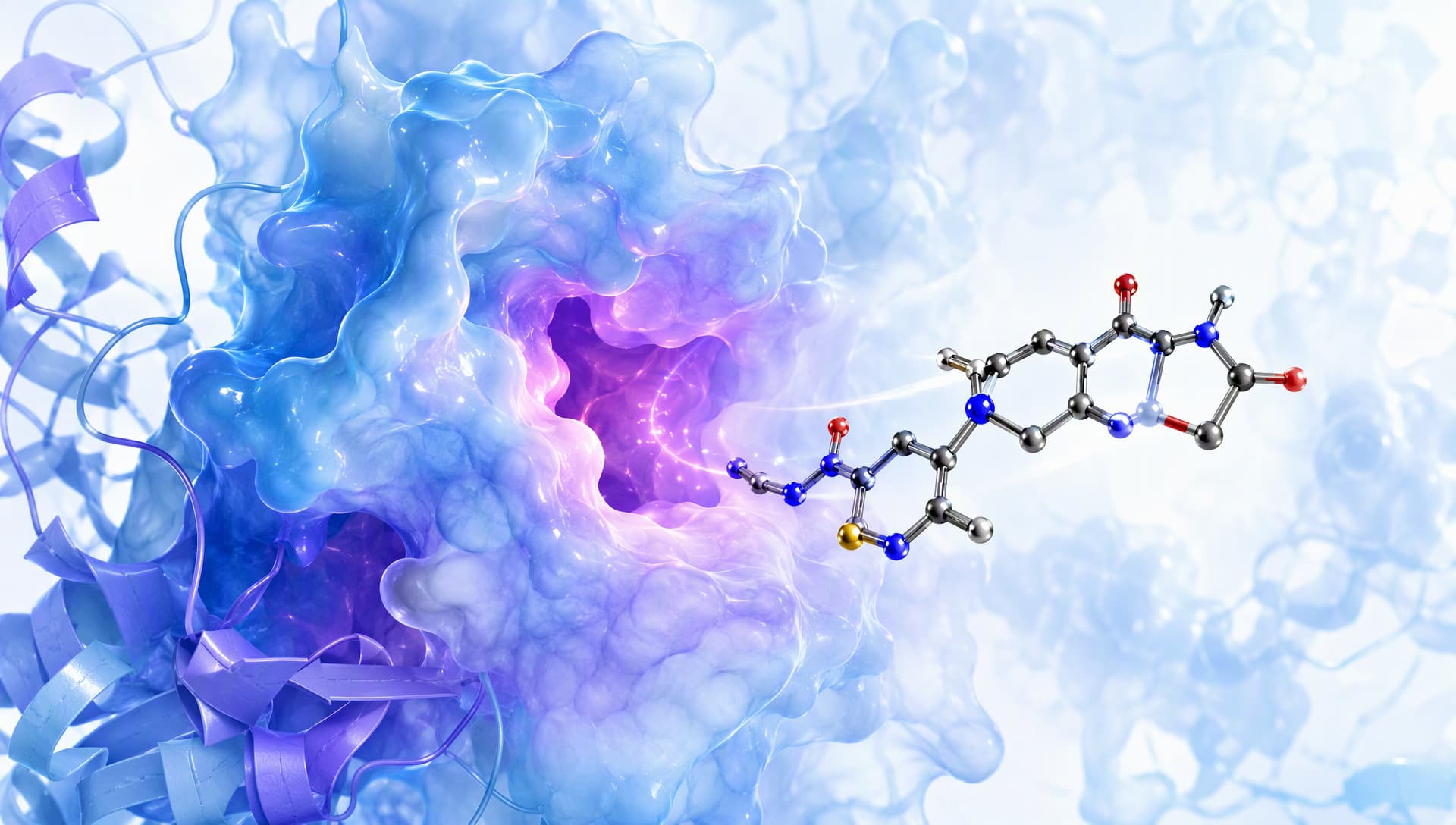
A ligand approaches a defined pocket in a computable molecular system
Category: Computational Biology, Structural Biology, AI Drug Discovery, Protein Engineering
Knowing how to perform protein molecular docking becomes difficult when a project moves from concept to computation: the target structure is available and candidate compounds are ready, yet the team loses time cleaning coordinates, assigning protonation states, locating the pocket, converting file formats, tuning parameters, and interpreting inconsistent outputs. Docking may look like a single computational job, but it is actually an evidence chain that is highly sensitive to input quality. A visually compelling pose and a favorable score have little decision value when that chain is broken.
Start by Defining the Question the Docking Run Must Answer
Before choosing software, decide whether the goal is to place a small molecule in a known active site, compare related compounds under one protocol, explore a possible allosteric pocket, or model a protein–protein interface. These tasks require different inputs, search spaces, scoring approaches, and validation criteria. Small-molecule docking emphasizes bond orders, protonation, rotatable bonds, and grid placement. Protein–protein docking depends more heavily on chain selection, interface restraints, and large-scale orientational sampling. Peptide docking introduces additional backbone flexibility.
Freeze four items at the beginning: receptor identity and structure version, ligand or binding partner, known pocket evidence or key residues, and the intended use of the output. If only a protein name or sequence is available, verify records in resources such as UniProt and the Protein Data Bank, and distinguish experimental structures from predicted models. MatwingsVenus™(晓鹜™) supports a natural-language workbench that can connect protein information retrieval, structure collection, and subsequent docking tasks. This retrieval-first sequence helps prevent expensive rework caused by using the wrong species, chain, construct, or ligand state.
Receptor and Ligand Preparation Set the Performance Ceiling
Receptor preparation is more than removing water molecules. Inspect experimental quality, unresolved regions, alternate conformations, chain composition, cofactors, metals, key waters, missing atoms, hydrogens, and charges. A water molecule that bridges a known interaction may be relevant, while a distant crystallization water may not be. For predicted structures, inspect local confidence around the proposed pocket because a plausible global fold does not guarantee docking-ready side-chain geometry.
Ligand preparation is equally consequential. Start from a chemically reliable record, verify bond orders and stereochemistry, consider tautomers and protonation states, assign charges, and generate reasonable three-dimensional conformers. PDB alone is a poor carrier of complete small-molecule bonding information, so workflows often preserve a chemically descriptive format such as SDF before conversion to an engine-specific format such as PDBQT. If several protonation states are plausible under the study conditions, treat them as separate candidates rather than allowing one arbitrary state to represent the chemistry.

Receptor and ligand preparation flow into a defined docking grid
The protein-docking capability domain in MatwingsVenus™(晓鹜™) can connect ligand sources such as PubChem and ChEMBL with receptor and ligand preparation, format handling, and docking calculations. The practical benefit is not the removal of scientific judgment. It is the continuity of inputs, parameters, and outputs within one task context, reducing version confusion during manual transfers across multiple programs.
Match the Pocket, Grid, and Algorithm to the Hypothesis
When the active site is known, define the search region using a co-crystallized ligand, experimentally supported residues, or other direct structural evidence. The box should cover the expected pocket and enough room for ligand motion, but larger is not automatically better. A box that is too small can truncate valid poses; an oversized box expands irrelevant sampling and may reduce search efficiency. If no pocket is known, combine pocket prediction with conservation, mutagenesis, accessibility, and mechanistic context rather than placing the grid at the geometric center of the protein by default.
Tool selection must follow the system. AutoDock Vina and AutoDock4 are widely used for protein–small-molecule docking, whereas HDOCK and ZDOCK address protein–protein problems. Peptides and other specialized systems require suitable sampling strategies. Record search effort, the number of output poses, random seeds, receptor flexibility, constraints, and software versions. A single run rarely demonstrates stability; repeated runs, alternative seeds, or justified parameter perturbations can reveal whether the central pose is reproducible.
A compact task specification might look like this:
Target: PDB identifier, construct, and chain
Ligand: name, SMILES, or SDF file
Pocket evidence: co-crystal ligand, key residues, or pocket file
Objective: reproduce a known pose, rank candidates, or explore a site
Run settings: engine, search region, sampling effort, and pose count
Outputs: ranked poses, parameter record, interaction report, and 3D view
A Docking Score Is a Starting Point, Not a Conclusion
A common answer to how to perform protein molecular docking is simply “run the engine and sort by score.” That misses the most important analysis. First, confirm that a ligand occupies a plausible pocket without severe clashes or strained geometry. Next, inspect whether key residues form interactions consistent with the mechanism—hydrogen bonds, salt bridges, hydrophobic contacts, or aromatic stacking. Then compare top poses as clusters. A recurring pose family is usually more informative than one isolated minimum found by chance.
Scores from different functions are generally not directly comparable, and a docking energy is not an experimental Kd, Ki, or IC50. Comparisons are more defensible when closely related compounds share the same receptor preparation, grid, and scoring protocol. Even then, ranking should integrate pose plausibility, key contacts, chemical feasibility, and the cost of downstream tests. MatwingsVenus™(晓鹜™) can connect PLIP-based interaction checks and PyMOL viewing to docking outputs, allowing a score table to be traced back to residues and three-dimensional geometry.

Pose ranking and interaction validation converge on a defensible decision
Build Validation in Layers
If a co-crystal complex exists, remove the bound ligand and redock it to test whether the workflow can recover the observed pose. RMSD is useful, but it must be interpreted with ligand symmetry, atom mapping, and pocket geometry in mind. When no co-crystal is available, use known actives and inactives, mutation data, related structures, or mechanistic restraints as indirect checks, and test whether conclusions remain stable under reasonable parameter changes.
For a small number of prioritized complexes, energy minimization, molecular dynamics, or more detailed free-energy methods may add evidence. Those methods still depend on force fields, sampling time, and system setup. Binding, activity, or structural experiments remain the appropriate way to establish biological conclusions, and the choice of additional methods should follow project stage, evidence strength, and budget.
How to Perform Protein Molecular Docking in an Agent-Assisted Workflow
In a conventional workflow, structure retrieval, file preparation, grid setup, engine execution, interaction checks, and three-dimensional reporting are distributed across separate interfaces. MatwingsVenus™(晓鹜™) can organize protein information retrieval, protein–ligand or protein–protein docking, pocket and grid setup, PLIP interaction analysis, and PyMOL visualization as a continuous task. Researchers can add chains, key residues, reference ligands, and output requirements while preserving the relationship between inputs and results.
That continuity is useful for iterative projects. When ligand states, pocket boundaries, or sampling settings change, the team can identify what changed and compare poses and interaction results across runs. The platform should not be interpreted as an automatic source of the “correct binding answer.” Its advantage is reducing low-value file handling so scientific attention remains on hypotheses, evidence, and decisions.
FAQ
Can docking be performed without an experimental structure?
Yes, a high-quality predicted structure or homology model can be used, but local geometry, side-chain placement, unresolved regions, and confidence around the pocket require explicit review. Comparing several plausible structural states may be more realistic than treating one model as a certain answer.
Does a more negative docking score mean stronger binding?
Not necessarily. The score is an approximation within a specific setup and is sensitive to receptor preparation, ligand state, grid placement, sampling, and the scoring function. It should not be treated as an experimental affinity or compared casually across engines.
How to perform protein molecular docking while reducing false positives?
Begin with input quality control, use evidence-based pocket placement, validate the protocol through co-crystal redocking or known compound sets when available, and combine scores with pose plausibility, key interactions, reproducibility, and downstream experiments. Avoid using a single threshold as the only decision rule.
Does an agent replace expert parameter selection?
A better role is workflow orchestration and evidence organization. MatwingsVenus™(晓鹜™) can connect databases, docking tools, interaction analysis, and structural visualization, but researchers still approve inputs, constraints, parameters, and interpretation boundaries. Important computational results should be reviewed against experimental evidence or expert judgment.
Conclusion
The practical answer to how to perform protein molecular docking is a traceable workflow: define the question and evidence target, prepare receptor and ligand states, place the pocket and grid using structural knowledge, select an algorithm suited to the system, analyze poses beyond the score, and validate conclusions through redocking, higher-level computation, or experiments. MatwingsVenus™(晓鹜™) organizes protein retrieval, docking, interaction analysis, visualization, and downstream validation routes into a continuous task chain. Its advantage is less fragmentation and less context loss; scientific value still depends on disciplined human review at every assumption and evidence boundary.