How Protein Binding Site Prediction Finds Key Residues
Published on October 8, 2026
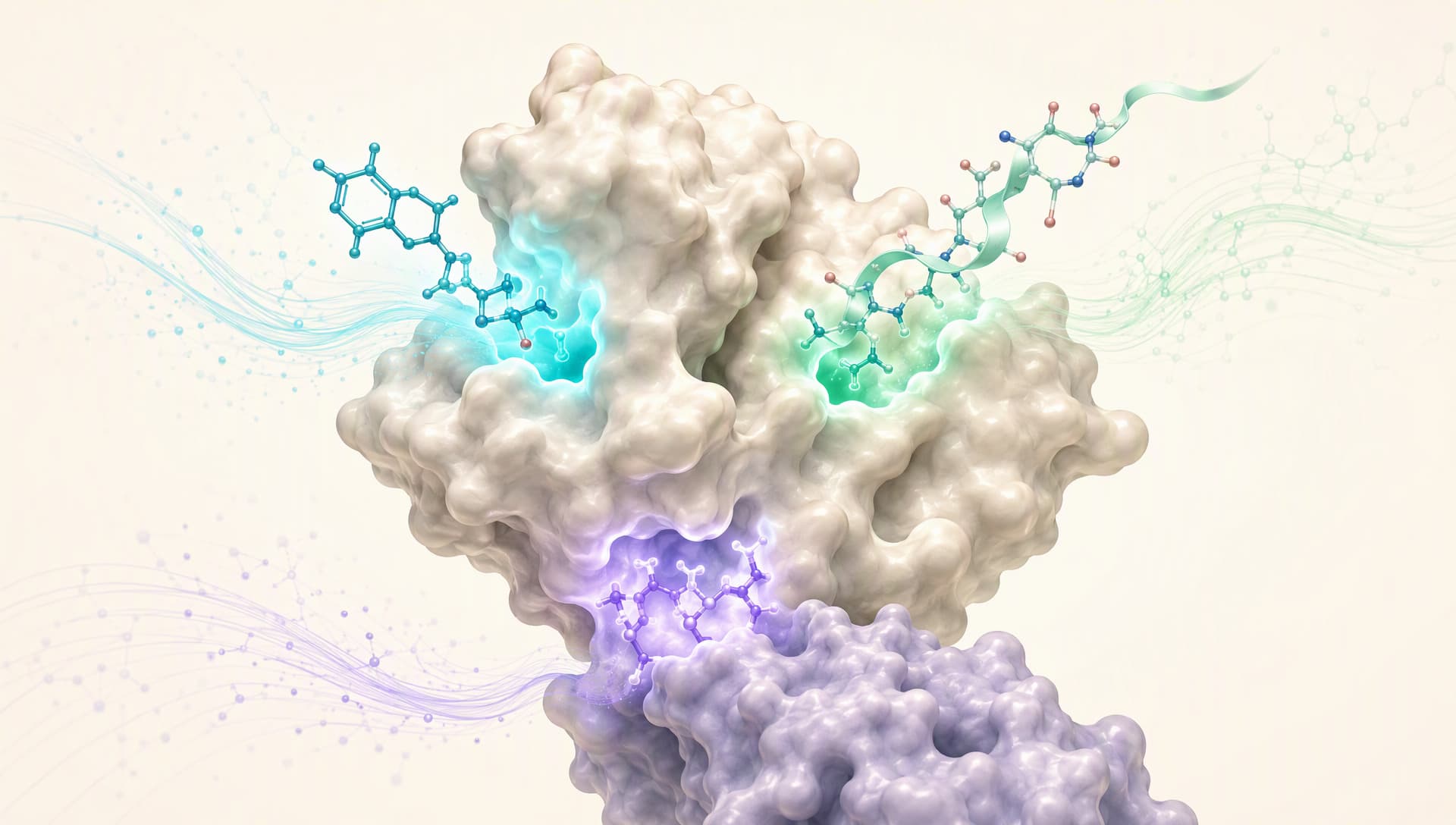
Different partners activate different combinations of key residues
Category: Protein Function Analysis / Computational Biology / Protein Engineering
A single protein surface may recognize small molecules, metal ions, nucleic acids, peptides, or another protein chain. A region that can physically accommodate contact is not necessarily the region that determines binding. Protein binding site prediction is most useful when it identifies residues or regions worth testing for a defined partner and explains whether each candidate comes from curated knowledge, sequence patterns, structural context, or computational inference.
Protein binding site prediction begins with “binding to what?”
The same protein can participate in more than one interaction. For a small molecule, the relevant question may concern residues that contact the ligand directly. For a protein complex, the focus shifts toward a distributed network across an interface. Metal ions and nucleic acids introduce still other chemical, geometric, and electrostatic requirements. Without a defined partner, a high-scoring “site” is difficult to convert into a clear experiment.
The input should therefore extend beyond a sequence. A more interpretable task usually includes protein identity, the possible partner, available structural or homolog information, experimental conditions, and the intended use of the result. That final point matters: mechanistic validation, mutation design, protection of essential residues, and candidate screening require different levels of resolution.
This is also why a binding site should not be treated as a synonym for a binding pocket. A pocket describes geometry, while a functional binding site may consist of individual residues, a continuous segment, or a broad molecular interface. It may lie inside a cavity or across a relatively flat surface. Partner context is what turns spatial proximity into a testable functional hypothesis.
Retrieve observed binding evidence before making a prediction
Authoritative databases and public structures may already record experimentally observed ligand contacts, protein-interaction residues, or curated functional annotations. Retrieving those records first avoids presenting known information as a new prediction and may reveal whether different experimental conditions implicate the same region.
When the input is an unannotated sequence, identity should be established before site analysis. A mistaken identity can distort annotation transfer, structural mapping, and every downstream residue assignment. Once the protein has been identified, homologs, conserved positions, and available structures can be examined before deciding whether prediction is necessary.
An empty database result does not mean that no site exists; it means that public evidence is currently insufficient. At that point, protein binding site prediction can be introduced as a source of testable candidates rather than blended with measured facts.
Protein binding site prediction works best when evidence converges
Sequence evidence asks which residues remain conserved through evolution. Structural evidence asks whether those residues are exposed, spatially connected, and chemically plausible. Curated annotations indicate whether experimental or expert support already exists. Partner information helps determine whether shape and chemical complementarity fit the interaction under study. One signal is rarely decisive; confidence increases when independent signals converge.
Conformation is another critical variable. Some binding residues become accessible only in a particular state, while others reorient when a partner approaches. A static structure is an important starting point, not a universal portrait of the protein under all conditions. Missing segments, flexible loops, and low-confidence regions should retain explicit uncertainty and receive a more cautious validation plan.
Docking can explore plausible poses for a specified partner, but a docking pose or score is not a reliable binding-affinity measurement and cannot replace biochemical testing. The productive use of docking is to combine it with residue prediction and structural interpretation for prioritization, then let experiments determine whether binding occurs, how strong it is, and whether it changes function.

Converging evidence narrows the set of residues worth testing
A candidate residue should carry its evidence into the experiment
A useful output is more than a list of residue numbers. Each candidate should include its location, evidence type, structural availability, relationship to known function, and a suitable validation route. This allows researchers to distinguish residues supported by databases, residues strongly inferred by models, and residues for which evidence remains sparse.
Evidence status can remain explicit throughout the project. Database measurements and published experiments can be labeled Measured, algorithmic outputs Predicted, and unresolved gaps Unknown. This distinction guides resource allocation: teams can prioritize high-value candidates with manageable uncertainty while avoiding changes to regions that may carry essential functions.
The experiment must also match the claim. A mutation that reduces activity may disrupt binding, but it may instead impair folding, expression, or stability. Functional assays often need to be paired with expression, purification, structural-integrity checks, or suitable negative controls. In a protein-engineering project, high-confidence binding residues can also be defined as protected regions so that optimization avoids unacceptable functional risk.
MatwingsVenus™(protein agent)connects residue decisions to an R&D workflow
MatwingsVenus™(晓鹜™) publicly provides capabilities related to database retrieval, protein sequence analysis, structure prediction, functional reasoning, and protein engineering, organized through conversational biological workflows. For a binding-site question, this organization supports a logical sequence: clarify protein identity and the partner, retrieve known annotations and structural evidence, and only then decide whether computation should fill a genuine evidence gap.
When authoritative retrieval is insufficient and the user explicitly chooses to proceed, VenusX in MatwingsVenus™(晓鹜™) can perform residue-level functional-site prediction, including binding-site tasks. The output is presented as Predicted and can be accompanied by validation recommendations rather than being described as an experimental observation.
Protein binding site prediction can then inform downstream decisions. Candidate residues may guide site-directed mutation and mechanistic interpretation, or serve as protected “do-not-touch” regions during protein engineering. MatwingsVenus™(晓鹜™) thus extends the task from “mark a site” to a continuous chain: explain the evidence, plan validation, and use the result in engineering.
Three questions determine whether a prediction deserves an experiment
First, does the candidate correspond to a defined partner and research task? A generic score without an interaction context rarely specifies experimental conditions.
Second, is the candidate supported by multiple evidence types? Agreement among sequence, structure, annotation, and partner context creates a clearer priority. When evidence conflicts, that disagreement should become part of the validation design.
Third, does the result produce a falsifiable experiment? A useful prediction should help decide which residues to mutate, which controls to retain, and which readout will answer the question—not merely place attractive markers on a 3D model.

Experimental feedback makes the next site decision more reliable
Conclusion: good prediction creates a clearer validation choice
The value of protein binding site prediction is not measured by how many residues it highlights. It comes from organizing partner identity, prior evidence, computational signals, and experimental objectives into an interpretable priority list. MatwingsVenus™(晓鹜™) combines retrieval-first reasoning, explicit evidence status, and residue-level functional-site prediction to connect candidate sites with validation and protein-engineering decisions. The most productive starting point is to define the protein, its intended partner, and the claim to be tested—then require every candidate residue to carry both its rationale and its next experiment.