Protein Docking Agent: Protein molecular docking tool online
Published on October 9, 2026
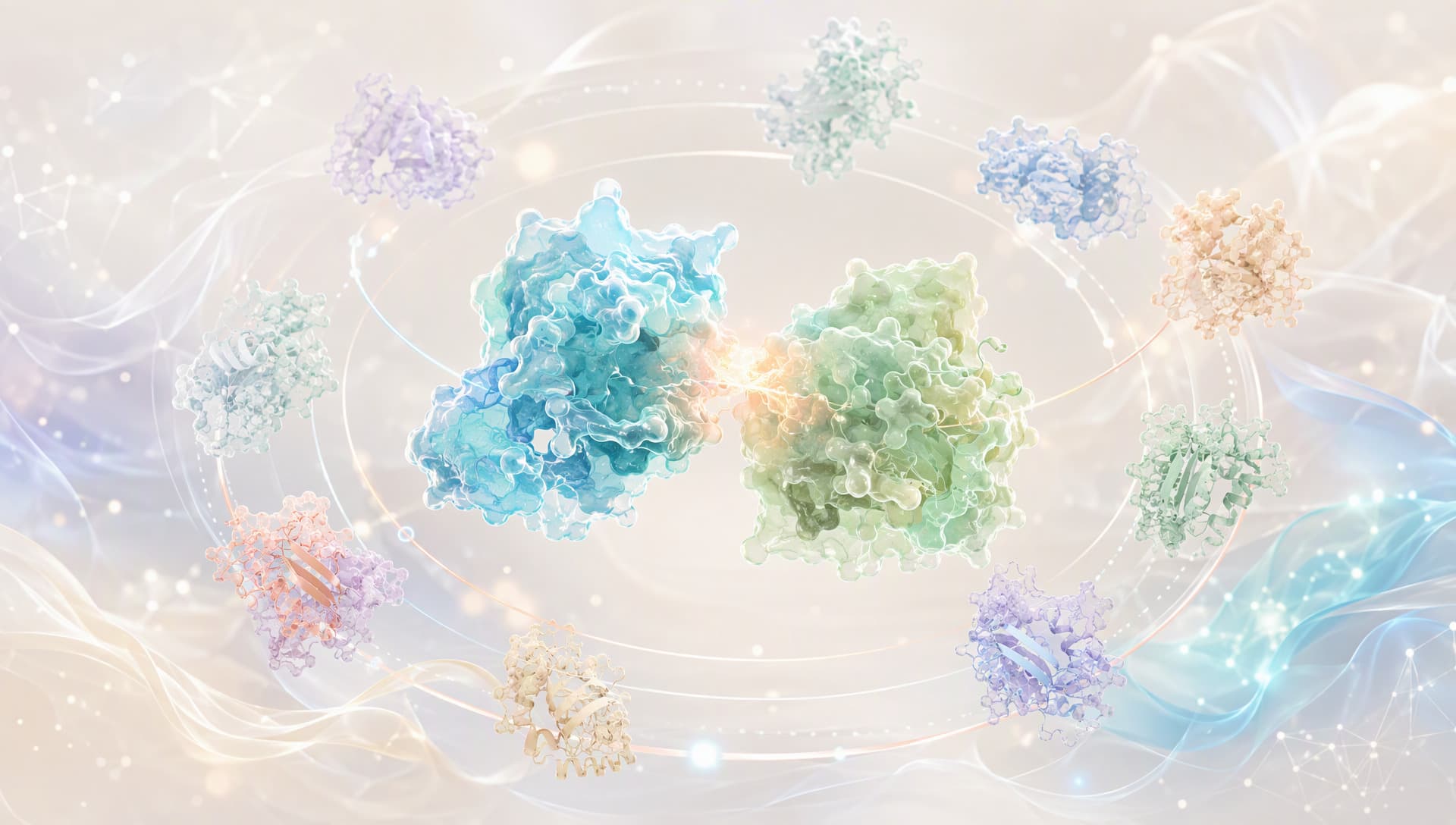
Candidate binding poses require sampling, scoring, and validation
Category: Computational Biology / Structural Biology / Protein Engineering
A protein docking agent solves more than a one-click task
Docking is often reduced to three actions: upload a structure, run a calculation, and inspect the lowest score. In practice, the workflow branches before computation begins. The system may involve a protein and small molecule, two proteins, a protein and peptide, or metal coordination. The binding site may be known or may first require evidence from structures, annotations, and functional residues. The receptor may be represented by one conformation or an ensemble.
A protein docking agent is useful when it turns a natural-language objective into a dependency-aware task plan. It should ask who is docking, where the interaction may occur, which components are flexible, which constraints are justified, and how the result will be tested. Without those decisions, a generated pose has little interpretive foundation.
Molecular docking explores a large configurational space to generate and rank plausible binding modes. It can produce hypotheses about molecular recognition, but it does not replace an experimental complex structure, binding constant, or functional assay. The more automated the workflow becomes, the more clearly this boundary must remain visible.
Four docking classes need different routes
Protein–small-molecule docking depends on pocket definition, ligand conformers, protonation states, and local receptor flexibility. It is frequently used to propose binding poses or prioritize compounds. Ignoring a critical water, metal, or cofactor can distort pocket chemistry.
Protein–protein docking involves larger interfaces and many relative orientations. Experimental constraints, known interface residues, mutational evidence, and biological assembly context often become central. A globally searched complex can make geometric contact without being biologically meaningful.
Protein–peptide docking must account for substantial peptide flexibility. Starting conformation, length, modification state, and anchor residues can all reshape the search space.
Metal-associated docking requires explicit treatment of coordination geometry, atom types, charge state, and surrounding residues. Treating the metal as an ordinary sphere may yield a favorable score but implausible chemistry.
A credible protein docking agent should route the task before choosing preparation steps, sampling scope, and validation criteria.
Input preparation can matter more than another run
Docking failure is often blamed on the algorithm or score even when the problem entered through the input. Does the receptor represent the intended state? Is a missing loop near the interface? Are side-chain orientations, disulfides, and protonation states reasonable? Does the ligand include the relevant tautomer and charge? Should waters, ions, and cofactors be retained?

Preparation determines whether the search space and interface chemistry are credible
A protein docking agent can convert these questions into explicit checkpoints:
1. Confirm protein identity, sequence version, chains, and biological assembly.
2. Record structure provenance and label evidence as Measured, Predicted, or Unknown.
3. Inspect missing regions, clashes, alternate conformations, and nonstandard residues near the site.
4. Prepare the ligand, peptide, metal, cofactors, and essential waters for the system type.
5. Present inputs, constraints, and expected outputs for confirmation before heavy computation.
The objective is not to make the coordinates look cleaner. It is to align the computational object with the scientific question. If a critical interface lacks credible coordinates, obtaining better structural evidence is preferable to hiding uncertainty behind broader sampling.
Why the lowest score may not be the best experimental candidate
Scoring functions approximate the differences among candidate poses while simplifying a real molecular system. Protein flexibility, ligand sampling, entropy, desolvation, and water-mediated interactions can all alter ranking. Different strategies weight these effects differently, so a small numerical difference should not be presented as a measured affinity gap.
A stronger triage process uses an evidence funnel. Remove severe clashes and implausible coordination first. Then assess key interactions, interface burial, known-site constraints, and pose clustering. Compare whether similar conclusions emerge across preparation choices or receptor states. A candidate that survives multiple evidence layers is usually more useful than an isolated minimum from one run.
Validation should match the question. Local refinement or short relaxation can probe geometric stability. Higher-cost physical simulation can be reserved for a small set. Mutational, binding, or activity experiments can then test the central interface hypothesis. The protein docking agent narrows the set and records the rationale; experiments determine whether the hypothesis holds.
Organizing a protein docking agent workflow in MatwingsVenus™(protein agent)
MatwingsVenus™(protein docking agent)uses a conversational interface to organize database retrieval, sequence analysis, structure prediction, functional analysis, protein engineering, and de novo design. Its approved capability scope also includes protein–ligand, protein–protein, peptide, and metal docking with associated preparation workflows. Docking can therefore remain connected to the wider R&D chain instead of becoming an isolated computation.

Multiple evidence layers reduce many poses to a bounded validation set
A defensible route in MatwingsVenus™(protein docking agent)is to identify the target and retrieve PDB records, functional sites, and known interaction evidence; determine whether the structure is suitable; define the docking class, active region, flexibility scope, and constraints; obtain user confirmation before computation; and finally stratify candidates by geometry, chemistry, functional evidence, and testability.
This preserves why a structure was chosen, why a pose survived, and which evidence remains missing. If a docking result will guide mutation design, functional no-touch regions and evolutionary conservation should be reviewed before converting an interface into an engineering proposal. Tool availability, input formats, and parameter scope should still be confirmed in the current platform interface and approval step.
Five checks for a trustworthy protein docking agent
Reliability is not defined by speed or a low score. It is defined by five questions: Was the task class routed correctly? Is input preparation traceable? Do sampling and constraints match the question? Is uncertainty preserved during scoring? Does each candidate connect to a validation plan?
A system that returns one pose and one score gives the researcher little ability to locate failure. A protein docking agent that presents input choices, pose families, triage reasons, and stop conditions is more useful as a decision assistant. Its job is not to declare successful binding, but to deliver the most defensible hypotheses to the next stage.
Conclusion: the agent is the task chain, not the automatic click
The main contribution of a protein docking agent is workflow organization. It connects identity resolution, structure retrieval, input preparation, task routing, pose generation, evidence-based triage, and validation planning so every result has provenance, boundaries, and a next action.
MatwingsVenus™(protein docking agent)provides a continuous conversational entry point for this type of work. A team can begin with a concrete question: what is being docked, what evidence already exists, and which experiment will decide whether the result matters. That question-driven route is more valuable than pursuing a lower score without a plan to interpret or test it.