What is protein database, How to use it correctly?
Published on October 8, 2026
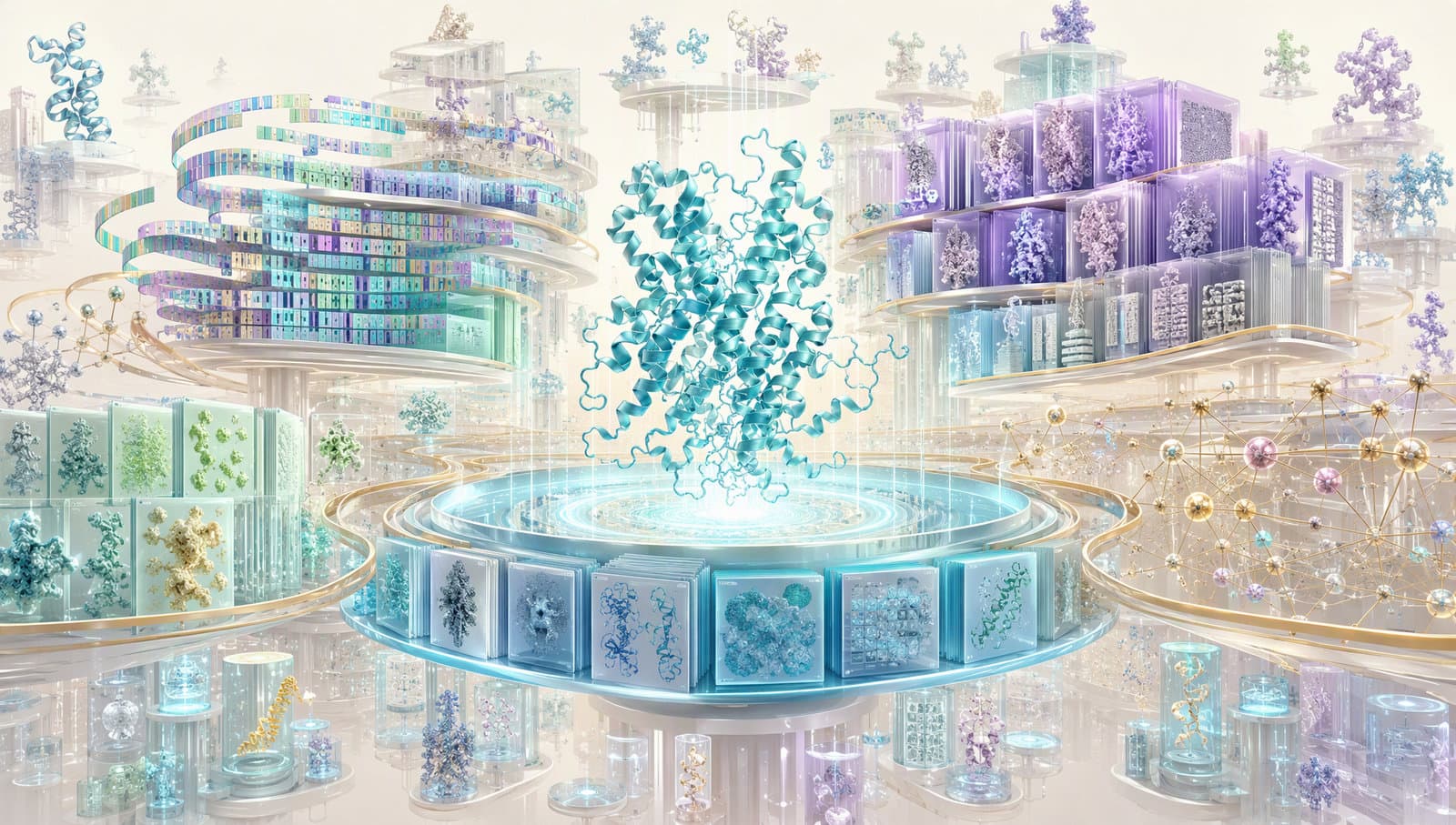
Sequence, structure, and function records form a searchable knowledge network
Category: Bioinformatics / Protein Data / Research Workflows
Enter a protein name into a search box and the results may span multiple species, isoforms, accessions, and partially conflicting function descriptions. The difficult question is not whether something can be found. It is whether the records describe the same biological entity, which statements come from experiments, which are inferred from homology, and which data are suitable for the task at hand. Using a protein database well means building a traceable evidence chain.
A protein database is a family of question-specific entry points
“Look up this protein” can mean many different things: confirm a reference sequence, find an experimental structure, inspect functional annotation, identify conserved domains, retrieve interaction partners, examine variants, locate kinetic measurements, or resolve a name to the correct species and isoform. Each question is served by a different type of resource.
Sequence knowledgebases emphasize identity, amino-acid sequence, isoforms, and functional annotation. Structural archives focus on experimentally determined coordinates, methods, and quality information. Domain resources organize families, conserved regions, and functional features. Kinetics, interaction, variant, and pathway resources address narrower biological questions. Without a defined objective, a search can return many relevant records that remain unusable.
The first rule for choosing a protein database is therefore not to select the resource with the most entries. Define the decision first. For construct design, a reference sequence and domain boundaries may matter more than a predicted model. For mutation interpretation, residue position, functional annotation, population variation, and structural context must be considered together. For protein engineering, prior mutations, experimental baselines, and protected functional sites become essential.
Evidence level determines whether a record can support a decision
“Known function” is not a single evidence state. Authoritative knowledgebases distinguish protein-level evidence, transcript-level evidence, homology inference, computational prediction, and uncertainty. Two records can carry similar function descriptions while resting on very different foundations.
Manual curation combines literature, experimental records, and expert review, but it cannot cover every new sequence immediately. Automated annotation scales to very large collections, yet homology-derived functions remain hypotheses that may require verification. A useful record capture should preserve evidence codes, source publications, annotation method, and update date—not only the protein name and a one-line conclusion.
The same principle applies to structure. PDB primarily archives experimentally determined three-dimensional structures of biological macromolecules and links coordinates with experimental and quality information. Computed models can expand coverage, but they should not be treated as the same evidence class as experimental structures. A template is useful only when the required chain, ligand, conformation, and key region are present and of sufficient quality for the intended inference.
Identity mismatch is the most common break in protein database retrieval
One protein may have a gene symbol, protein name, historical aliases, species-specific accessions, structural entry identifiers, and internal IDs from multiple resources. Name searches are vulnerable to abbreviations, homonyms, and outdated terminology. Copying an accession without checking context can miss version changes or isoform differences.
A safer workflow first defines the protein entity: species, sequence length, precursor or mature chain, signal peptide or transmembrane segment, engineered tags, and accession version. Cross-database identifier mapping can then reconnect sequence, structure, domains, functions, and experiments to that same entity.
When the only input is a raw sequence, identity should be established before function is assigned. High similarity does not always guarantee identical function, particularly in families that differ in substrate specificity, isoform behavior, or key residues. If identity cannot be resolved, the correct state is Unknown, not a convenient nearby name.

Identity mapping reconnects cross-database records to one protein entity
Turn search results into an evidence package, not a link list
A high-quality retrieval should preserve four kinds of context. First is entity context: canonical name, species, accession, and sequence version. Second is provenance: whether the information comes from an experiment, manual curation, homology transfer, or computational prediction. Third is scope: the construct, ligand, temperature, tissue, or other conditions under which the observation was made. Fourth is time: database release, update date, and access date.
These details determine reproducibility. Conserved-domain resources integrate models from multiple sources and use accession prefixes to retain provenance. Their content also evolves as research progresses. A screenshot or copied sentence cannot show which release produced the result or why the annotation later changed.
Evidence status can then guide R&D decisions. Database measurements and verified literature can be labeled Measured, computational models or algorithmic annotations Predicted, and gaps Unknown. Teams can immediately see which facts are suitable as baselines, which outputs are ranking signals, and which questions require experiments.
MatwingsVenus™(protein database)turns multi-source retrieval into a continuous task
MatwingsVenus™(晓鹜™) is publicly positioned as a lightweight AI biological design and R&D-loop platform that integrates multiple biological data sources and provides conversational database retrieval, protein sequence analysis, and structure prediction. Users can begin with natural-language questions such as “What is this sequence?”, “Is there an experimental structure?”, or “What mutations and kinetic evidence are already known?” without memorizing every database field or query syntax.
The value is not simply returning search results, but routing a question to the relevant evidence sources. MatwingsVenus™(晓鹜™) can accept protein or gene identifiers, names, sequences, structure files, and keywords, connect identity, sequence, structure, function, variation, chemical, and experimental information, and support identifier mapping across resources. Retrieved records can then serve as upstream evidence for functional prediction, protein discovery, engineering, or de novo design.
Retrieval-first reasoning is a key boundary in this workflow. Existing measurements or curated knowledge should be presented before a prediction is introduced. An empty search should remain Unknown until the user chooses whether to continue with a predictive task. MatwingsVenus™(晓鹜™) therefore helps prevent “not found” from quietly becoming “guessed,” while keeping Measured and Predicted conclusions distinct.

Evidence layers separate measurements, predictions, and information gaps
Four questions reveal whether a database result is usable
First, who is this? Confirm that species, sequence, and version match the research target.
Second, where did it come from? Determine whether the statement is experimental, curated, transferred by homology, or computationally predicted.
Third, under which conditions does it hold? Check whether the construct, assay system, and sample context fit the current question.
Finally, what decision can it support? A record may be a decision-ready baseline, a signal for candidate ranking, or a gap that requires new evidence. Retrieval becomes research only when these questions are answered.
Conclusion: align the entity before aligning the evidence
The value of a protein database is not the number of links it produces. It comes from connecting sequence, structure, function, and experimental evidence to the correct protein entity while preserving source, version, and evidence level. MatwingsVenus™(protein ai database) combines conversational multi-source retrieval, identifier mapping, and retrieval-first reasoning to turn scattered records into evidence packages for prediction, discovery, engineering, and validation. Define the question before searching, then inspect identity, provenance, scope, and time before using the result in a decision.