Protein Catalytic Function Annotation: Reading Enzyme Reaction Logic
Published on October 12, 2026
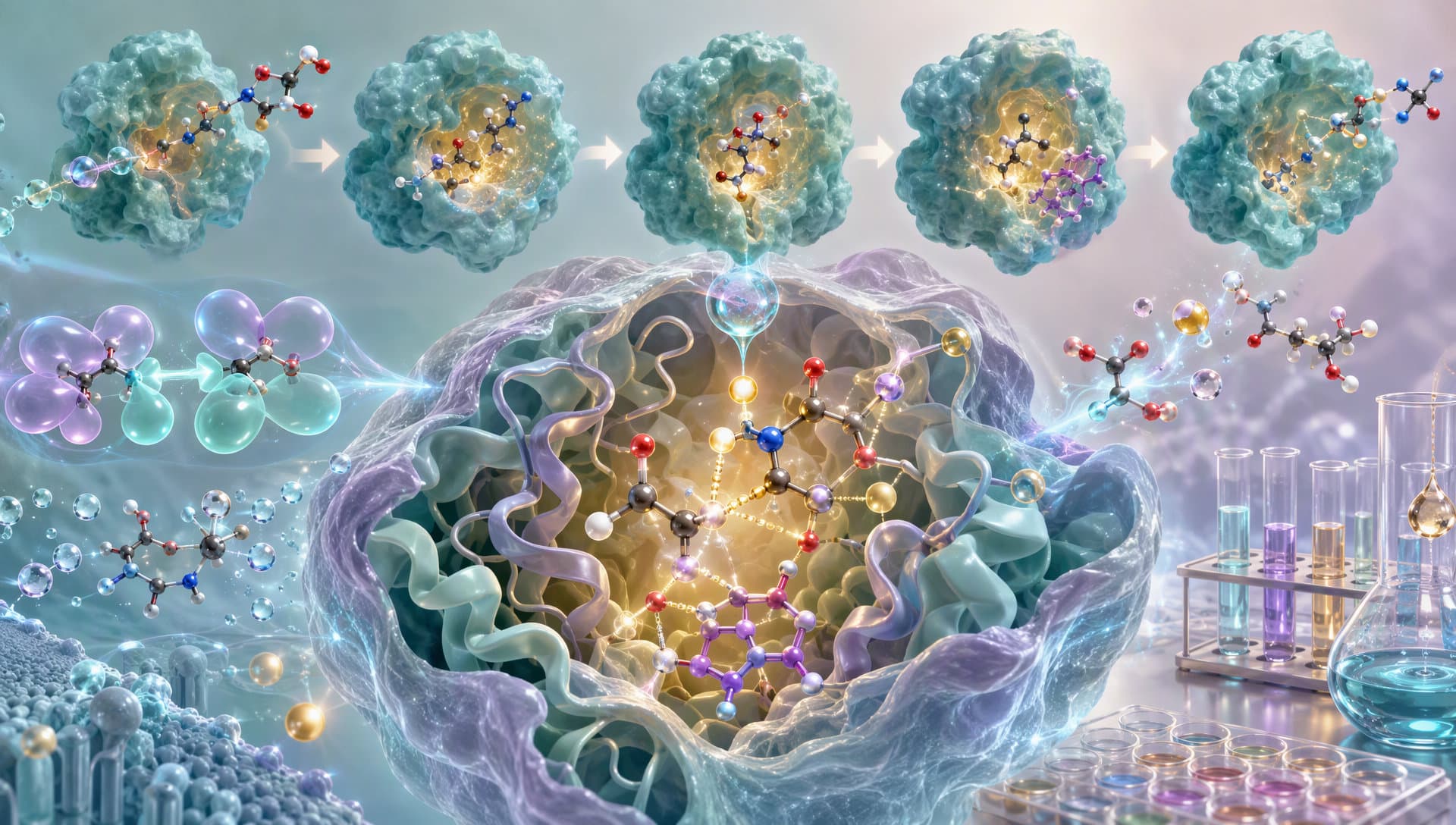
Catalytic function is defined jointly by the reaction, key residues, and chemical steps
Category: Enzymology / Protein Science / Bioinformatics
What Does Protein Catalytic Function Annotation Actually Describe?
“What class does this enzyme belong to?” and “How does it perform the reaction?” are different questions. A functional name or EC classification can locate an overall transformation, but it cannot by itself identify the residue that transfers a proton, the group that stabilizes an intermediate, the role of a metal ion, or the way a substrate is oriented in the pocket. Decision-ready annotation has to connect the macroscopic reaction to microscopic chemistry.
The result can be organized into three layers. The reaction layer defines substrates, products, bond changes, direction, and necessary conditions. The catalytic-component layer identifies residues, metal ions, and other cofactors that participate directly or indirectly. The mechanism layer, when evidence permits, describes the chemical steps and the role of each component.
These layers are not interchangeable. Knowing the overall reaction does not mean the stepwise mechanism is known. Finding an active-site pocket does not make every nearby residue catalytic. Reduced activity in a variant may arise from altered folding, expression, or substrate binding rather than direct loss of chemistry. Protein catalytic function annotation prevents “association” from being rewritten as “causation.”
Catalytic Residues Do More Than Directly Perform Chemistry
Direct catalytic roles are intuitive. A residue may participate in covalent catalysis, electron transfer, or general acid-base chemistry. Enzyme catalysis also depends on residues whose chemical structures do not change during the reaction but whose contributions are still essential.
These indirect roles can shift the pKa of a neighboring group or water molecule, stabilize a transition state or intermediate, control stereo- or regioselectivity, or coordinate a catalytically important metal. Together, they arrange charge, orientation, and distance so that the reactants can reach a productive state.
Physical proximity to a ligand is therefore not enough to define a catalytic residue. A residue used only for ligand binding, one required for global folding, and one involved directly or indirectly in a chemical step should be interpreted separately. Resources may draw different boundaries between an active site and a catalytic residue, so a public result should preserve the annotation convention and its evidence conditions.

Direct and indirect catalytic roles maintain the microenvironment required for reaction
What Evidence Builds a Credible Catalytic Causal Chain?
The first requirement is object consistency. Sequence version, organism, construct, mature-protein range, and structure numbering must align. Signal-peptide cleavage, missing segments, or tagged constructs can shift coordinates and place a correct literature residue at the wrong position in the query.
The second is reaction identity. An EC number is a hierarchical classification, not a substitute for substrates, products, and bond changes. Homologous enzymes with similar folds and partly conserved pockets may act on different substrates. One protein may also have several reactions or alternative mechanism proposals. Annotation should state which reaction each conclusion addresses.
The third is structural and chemical context. Does the representative structure contain a relevant substrate, product analogue, metal, or cofactor? Does a residue use its side chain or backbone for function? Are pocket distance and geometry compatible with the hypothesis? Structure strengthens interpretation, but a static conformation does not automatically become a complete reaction movie.
The fourth is experimental and literature strength. Direct reaction assays, site-directed mutation, binding experiments, and structural observations answer different questions. A full mechanism usually requires several evidence classes to agree. If the evidence identifies only key catalytic components, the conclusion should remain at the catalytic-site level rather than inventing unsupported electron flow.
Why Homology Transfer Requires Extra Care
Enzyme-family members often preserve part of a catalytic framework, making homology a useful starting point. Sequence similarity, however, does not guarantee an identical reaction, substrate range, cofactor requirement, or kinetic behavior. A transferable hypothesis becomes stronger when reaction identity matches, catalytic residues are conserved, and the local structural environment remains compatible.
A careful workflow begins with an experimentally supported or expert-curated representative. Candidate sequences are aligned to its catalytic residues, while insertions, deletions, local conservation, and pocket substitutions are examined. A missing key residue should lower confidence. Conserved residues with an altered substrate pocket may support a shared core chemistry while leaving substrate scope Unknown.
This is what distinguishes protein catalytic function annotation from an ordinary similarity search. It asks not only “What does this resemble?” but also “Is the reaction the same, is the catalytic geometry retained, and how far can the evidence support the claim?”
Why a Prediction Score Cannot Replace a Catalytic Mechanism
Models can predict active sites, binding sites, conserved residues, or protein-level properties such as kcat, but these outputs address different questions. A site prediction locates a potentially important region. A kcat prediction estimates a kinetic property under a defined context. Neither proves the overall reaction or reconstructs a stepwise mechanism on its own.
To keep conclusions interpretable, direct experimental records on the target protein can be labeled Measured. Automated database transfer, homology inference, and model outputs remain Predicted. Missing or conflicting information is Unknown. This does not diminish computation; it assigns prediction to the task it performs best—narrowing the search space, prioritizing validation, and exposing unresolved claims.
Experiments should follow the hypothesis. A putative acid-base residue can be tested with targeted variants and a relevant reaction readout while expression and folding are monitored. A metal-dependent hypothesis calls for controlled metal conditions. A substrate-specificity claim requires comparable assays across substrates. Only when controls and conditions are explicit does an activity change support mechanistic interpretation.
How MatwingsVenus®(晓鹜®)Connects Reaction Evidence and Design
MatwingsVenus®(晓鹜®)publicly describes capabilities including conversational assistance, protein sequence analysis, database retrieval, structure prediction, protein function prediction, enzyme discovery, and mutation design. For protein catalytic function annotation, its appropriate role is to organize a retrieval-first, gap-filling, validation-oriented task chain rather than generate an unsourced mechanism conclusion.
A task can begin with a protein name, accession, or sequence. A raw sequence is identified before downstream analysis. Existing records for function, EC classification, structure, catalytic residues, reaction, and cofactors are then retrieved. Direct experimental information on the target protein belongs in the Measured layer; automated transfer and model inference remain Predicted; unanswered questions stay Unknown.
When existing annotation is insufficient and the user confirms the computational task, VenusX can predict active, binding, or evolutionarily conserved sites. Candidates can then be mapped into a structural pocket to inspect local context. VenusG may provide a predictive lead for protein-level properties such as kcat, but a property estimate is not a mechanism proof. If work progresses to mutation design, the catalytic core can become a protected zone and the surrounding network a caution zone requiring validation.

Align evidence first, then prioritize prediction, experiment, and engineering
The value of MatwingsVenus®(晓鹜®)lies in placing retrieval, prediction, structural interpretation, and design constraints in one conversational workflow. It can help formulate more focused catalytic hypotheses, but it does not guarantee a correct mechanism, higher kinetics, or experimental success.
Turning Protein Catalytic Function Annotation into the Next Action
An actionable result should resemble a reaction passport. It records the research object, overall transformation, substrates and products, cofactors, catalytic residues and their proposed roles, structural context, evidence level, and unresolved questions. Each uncertainty points to an action: resolve sequence mapping when numbering differs; test substrate range when reaction identity is unclear; build a minimal validation set when a site is prediction-only; or choose a discriminating assay when several mechanisms remain plausible.
Keeping Unknown fields does not make an annotation incomplete. It tells a project where design is justified, where a claim remains hypothetical, and where an experiment should come first. In enzyme discovery, this helps reject candidates that merely look similar but lack a plausible catalytic framework. In protein engineering, it protects the reaction core while stability or expression is optimized.
Conclusion: Good Catalytic Annotation Is a Testable Causal Chain
Protein catalytic function annotation should end with more than a label. It links reaction, catalytic components, structural microenvironment, evidence strength, and validation plan. A mechanism should be described only as far as the evidence reaches. Computational support remains Predicted, and unresolved questions remain Unknown until an appropriate experiment addresses them.
With MatwingsVenus®(晓鹜®), researchers can connect prior-evidence retrieval, site and property prediction, structural interpretation, and mutation constraints in one task chain. Computation navigates; experiments confirm. That is how a protein moves from “possibly an enzyme” to a clear, testable account of what it catalyzes, why, and what should be verified next.