How Can protein Pfam family analysis Reveal Functional Clues?
Published on October 14, 2026
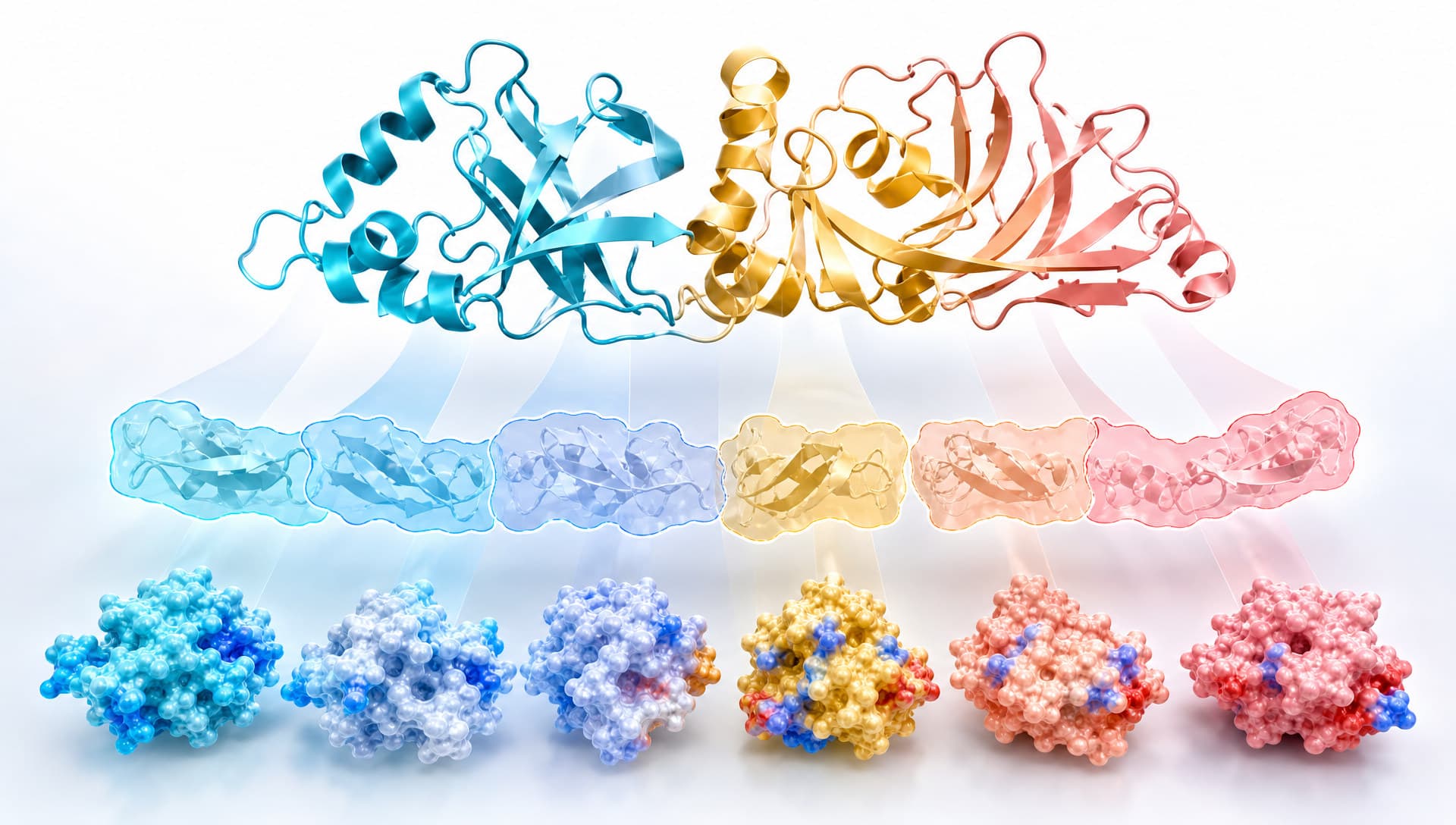
A luminous protein reveals its domain composition and potential functional clues
Category: Computational Biology | Protein Function Annotation | Bioinformatics Workflows
Genome annotation, enzyme discovery, and protein engineering projects often begin with the same practical problem: the sequence is available, but its name is vague, its closest homologs are distant, or several functional modules appear to coexist in one protein. The greatest risk is not the absence of an answer. It is mistaking a local resemblance for a complete biological function. protein Pfam family analysis addresses that risk by first asking which regions are compatible with established families or domains and only then asking what functional claims those regions can support.
protein Pfam family analysis starts with architecture, not a final function label
Pfam is not simply a catalogue of keywords. A classical Pfam family is built from a representative seed alignment that is used to create a profile hidden Markov model, or profile HMM. The model captures family-level patterns of conservation, insertion, and deletion. When a query sequence is compared with that model, the output can describe the family accession, matching coordinates, score, statistical significance, and position within a broader domain architecture.
This model-based approach is useful because it summarizes signals across a family rather than comparing the query with only one reference sequence. It can therefore detect homologous regions that have accumulated substantial sequence divergence. HMMER provides the underlying methods commonly used to scan a sequence against a profile database such as Pfam, while complementary search modes can start from a sequence or a custom profile when the research question requires a different direction of comparison.
A Pfam match, however, is not direct experimental proof of function. It indicates that a region of the sequence is compatible with a family model. Substrate specificity, catalytic rate, cellular localization, interaction partners, and physiological role may still depend on a few decisive residues, the surrounding structure, partner domains, or the organismal context. A rigorous interpretation therefore treats a family match as an evidence-backed starting point rather than a finished annotation.
Pfam content is now integrated into the InterPro environment, where family assignments can be interpreted alongside other member-database signatures and protein records. In practice, this shifts the objective from “finding a PF accession” to reconstructing a coherent domain architecture and checking whether independent annotation signals support the same biological explanation.
Input quality sets the ceiling for every downstream match
A reliable workflow begins with sequence verification. For an accession-based input, the analyst should confirm the organism, sequence version, and expected length. For a raw protein sequence, useful checks include invalid characters, suspicious truncation, start and stop boundaries, low-complexity segments, and unusually long ambiguous regions. Gene-prediction errors deserve particular attention because a missing exon or premature stop can remove enough residues to weaken or fragment a genuine domain match.
After quality control, HMMER’s hmmscan can compare the protein with the Pfam profile database. Interpreting the output requires more than choosing the smallest E-value. Family-specific gathering thresholds, domain scores, alignment coverage, and boundary completeness all affect confidence. A strong match that spans the expected model is usually easier to interpret than a short, borderline match. Weak regions should be checked for overlap with repeats, transmembrane helices, coiled coils, or low-complexity segments and then reviewed in the context of conserved residues and neighboring domains.

A protein sequence passes through probabilistic models and resolves into clear domains
What an integrated analysis workflow should preserve
MatwingsVenus®(晓鹜®) provides one example of an integrated analysis environment that can keep identifier resolution, sequence verification, InterPro/Pfam retrieval, and structured output within one task.
The complete domain architecture is often more informative than the top hit
Many proteins are not defined by one family alone. Signal peptides, transmembrane segments, catalytic domains, binding modules, and regulatory domains can occur in a specific order, and changes in copy number can alter interactions or localization. For these proteins, protein Pfam family analysis should prioritize a map from the N terminus to the C terminus. The analyst can then inspect overlaps, unexpected gaps, partial domains, and the presence or absence of modules required by the proposed mechanism.
Overlapping model matches should not be accepted mechanically. Their significance, coverage, model hierarchy, and InterPro integration need to be compared. Two signatures may describe the same region at different levels of a superfamily, or they may represent a legitimate nested relationship. Likewise, a missing expected domain should first trigger checks for incomplete sequence data and shifted boundaries before it is interpreted as evolutionary loss or functional divergence.
Architecture comparisons become especially useful in batch projects. Proteins may share a conserved catalytic core while carrying different accessory modules. That pattern can motivate hypotheses about substrate range, localization, regulation, or interaction strategy. Yet these remain hypotheses until tested. Separating database-supported annotation, computational inference, and unknown information helps prevent predictions from being presented as measurements and makes candidate prioritization more transparent.
Turn family matches into decisions that can be tested
A useful deliverable should go beyond a table of hits. For one protein, the next step may be to inspect conserved motifs, known catalytic residues, or experimentally determined structures associated with the family and map those features back to the query. Domain boundaries can also guide construct design by suggesting where an isolated module might begin and end, although flexible linkers and structural context still require careful consideration.
For enzyme discovery, candidates can be stratified by the completeness of the core catalytic domain, accessory-domain composition, and conservation of essential residues rather than ranked by E-value alone. For protein engineering, highly conserved functional regions can be designated as cautious-editing zones before structural modeling or experimental evidence is used to identify more permissive positions.

Sequence data becomes an interpretable domain architecture and tiered evidence trail
This is where protein Pfam family analysis connects to a broader research workflow. Family annotation generates testable hypotheses. Homology searches expand the candidate set. Structure prediction tests whether the proposed architecture is spatially plausible. Residue-level analysis narrows the experimental search space. Biochemical or cellular experiments then determine whether the proposed activity is real. A unified platform can preserve the sequence, database records, prediction outputs, and exports in a shared context, making the analytical chain easier to reproduce without turning predicted evidence into experimental fact.
Three interpretation errors are particularly common. First, a significant match to one generic binding domain is used to assign a complete protein name. Second, a difference in E-value is treated as a difference in biological activity, even though it primarily describes match significance under the model. Third, an absent domain in a truncated sequence is interpreted as a meaningful biological deletion. All three errors can be reduced by reviewing coordinates, coverage, domain combinations, evidence levels, and plausible validation routes together.
Interpretable conclusions require thresholds, boundaries, and evidence tiers
A decision-ready report should record the input sequence version, Pfam accession and family name, match coordinates, domain score and significance, applied threshold, complete architecture, treatment of conflicting hits, and recommended validation. Batch analyses should also preserve database versions and execution parameters so that results can be rerun and compared after resource updates.
The central contribution of protein Pfam family analysis is not merely faster annotation. It is a more interpretable path from sequence to research decision. The workflow clarifies which statements come from curated database models, which are computational inferences, and which remain unknown. For novel proteins, remote homologs, and complex multi-domain candidates, that transparent boundary between evidence and hypothesis is often more valuable than an automatic label that appears certain but cannot be audited.