Which Protein GO Functional Annotation Methods Produce More Reliable Results?
Published on October 13, 2026
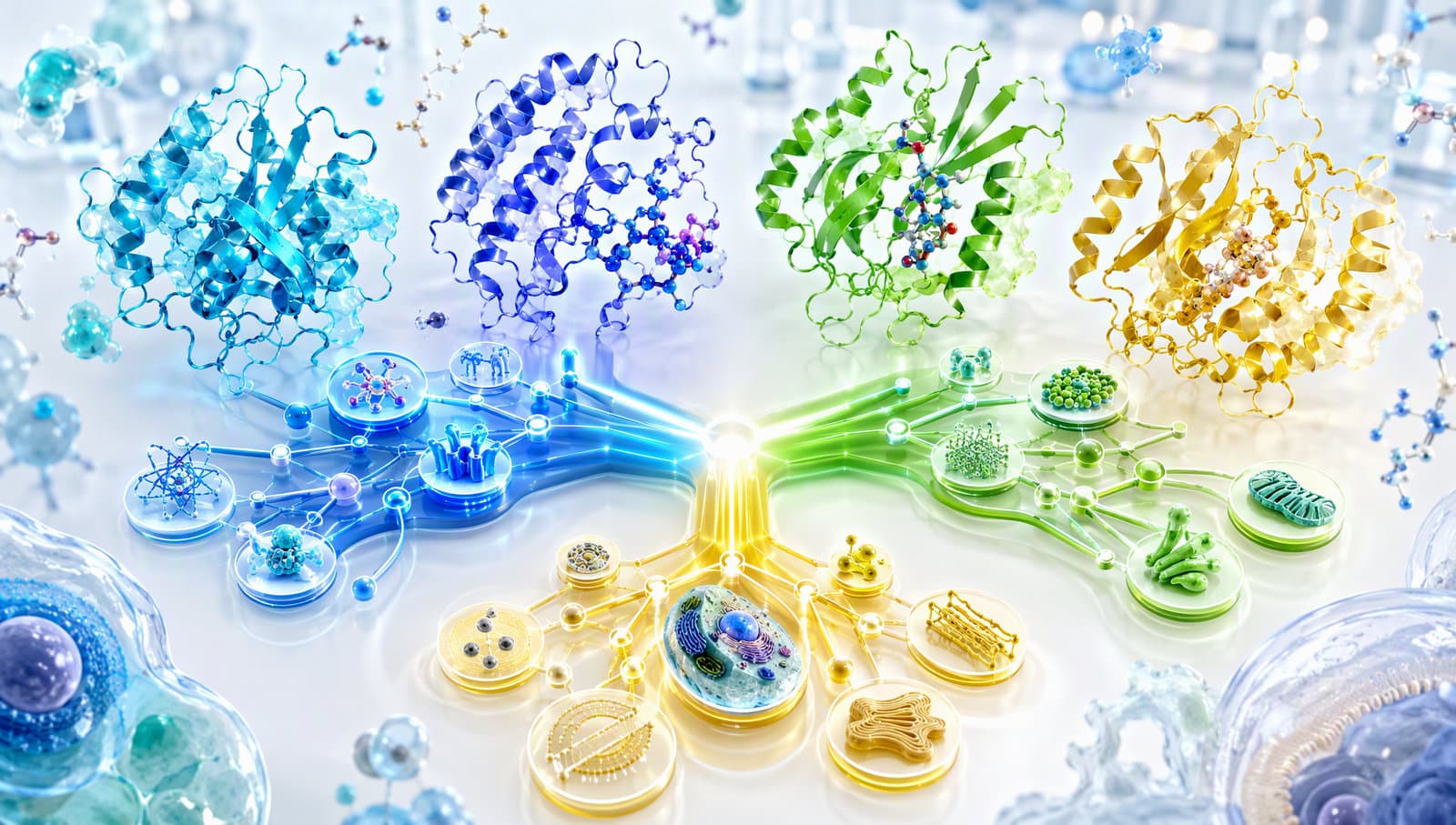
Protein structures and the three GO aspects form a shared framework for functional interpretation
Category: Bioinformatics / Protein Function Analysis / Research Methods
Proteomics, new-species genome projects, metagenomics, and early target-discovery studies often face the same bottleneck. Sequence data accumulate rapidly, while manual interpretation does not scale. Protein GO functional annotation methods may return a tidy table of GO terms within hours, yet the table alone does not explain where each term came from, whether it describes an activity, a broader process, or a cellular location, and how strongly the available evidence supports it. Without that context, an uncertain clue can easily look like a settled conclusion.
Start with What a GO Annotation Actually Says
Gene Ontology does not simply assign a convenient name to a protein. It organizes biological knowledge into three complementary aspects. Molecular Function describes the molecular activity a gene product performs, such as catalysis or binding. Biological Process places that activity within a larger biological program. Cellular Component describes where the product acts or has been detected. One protein can legitimately receive several terms because it may perform multiple activities or participate in different processes and locations.
The practical goal of protein GO functional annotation methods is therefore to create traceable connections among a protein, a defined relation, a GO term, and supporting evidence. The absence of an annotation does not prove the absence of a function; the information may not yet have been captured. Likewise, association with a process should not automatically be rewritten as direct execution of that process. Keeping these distinctions clear prevents downstream enrichment, candidate selection, and experimental planning from being built on semantic shortcuts.
Different Methods Answer Different Questions
Sequence similarity is the most common entry point. A query protein is compared with database sequences, and annotations from strong matches are considered as possible clues. The method is intuitive and scalable, but similarity alone does not guarantee identical function. Short local matches, low-complexity regions, paralogs, and multidomain architectures can all produce impressive scores that lack functional specificity. A careful workflow considers alignment coverage, identity, conserved residues, and the evidence behind the reference record rather than copying the top hit.
Domain and protein-family methods focus on recognizable functional modules. InterPro integrates multiple signature resources, and curated InterPro-to-GO mappings can provide automated annotation clues when a sequence significantly matches an appropriate signature. This route is useful for large datasets, but a domain-level signal usually represents a shared property of a family or module. In a multidomain protein, one local feature may not explain the biological role of the complete protein, so domain boundaries and combinations remain important.
Orthology and phylogenetic approaches ask whether a query and a characterized protein are likely to have inherited the same function. Distinguishing orthologs from paralogs, while considering functional gain or loss along a gene tree, can reduce inappropriate transfer compared with raw similarity alone. However, these conclusions depend on the quality of the tree, species relationships, reference annotations, and sequence completeness. Rapidly evolving families and lineage-specific expansions require additional caution.
A Protein GO Functional Annotation Methods Workflow Built on Multiple Evidence Types
The most practical protein GO functional annotation methods assign different roles to different analyses. Similarity searches identify candidate homologs. Domain detection confirms functional modules. Orthology or phylogenetic analysis tests whether function is likely to transfer across species. Features such as localization signals and transmembrane regions help assess biological consistency. The evidence can then be mapped to GO terms at a level of specificity that the data actually support.

Sequence, domain, and homology evidence converge into a structured GO annotation workflow
A reproducible workflow begins with sequence quality control, including checks for abnormal length, duplication, fragmentation, low complexity, and possible contamination. Similarity and domain searches follow, with orthology analysis added for high-priority proteins. GO terms are then consolidated while preserving their source, evidence code, database version, and mapping route. Rule-based checks can flag conflicts, biologically implausible combinations, and terms that are more specific than the supporting evidence allows. The value of an analysis platform or pipeline is not that it automatically declares the answer, but that it connects inputs, rules, intermediate evidence, and outputs in an auditable chain.
When independent lines of evidence agree, an annotation can receive higher priority. When they conflict, simple majority voting is rarely enough. The discrepancy may arise from database versions, family divergence, unusual domain architecture, or the sample itself. For poorly characterized proteins, a broader and more conservative GO term can be more useful than a highly specific label that cannot be defended.
Evidence Codes Explain How Results Should Be Used
Every GO annotation includes an evidence code describing how the association was supported. Experimental codes cover evidence such as direct assays, physical interactions, mutant phenotypes, and expression patterns. Phylogenetic codes reflect evolutionary inference. Computational-analysis codes can represent sequence or structural similarity, orthology, sequence models, or genomic context. IEA identifies electronically generated annotations that were not individually reviewed by a curator.
This does not mean that every experimental annotation is universally correct or that every electronic annotation is weak. Experiments often apply to particular conditions, while automated rules may undergo extensive evaluation. Evidence codes are better treated as instructions for use. A project selecting candidates for validation may prioritize direct evidence and conserved key residues. A large exploratory survey may use automated annotations while keeping uncertainty visible. A GO enrichment analysis should apply consistent species scope, background sets, database versions, and evidence filters.
For this reason, protein GO functional annotation methods should output more than a GO identifier and term name. The result should retain the evidence category, annotation source, reference record, relation type, and database version. These fields make it possible to understand why a result changes when databases or thresholds are updated.
Quality Control Prevents Annotation Inflation
One frequent failure is over-transfer: a local match leads to all functions of a reference protein being copied to the query. Another is redundancy. GO is hierarchical, so a specific term is connected to broader parent concepts; without hierarchy-aware handling, summaries can be overwhelmed by repeated information. A third problem is incorrect interpretation of absence and negation. Missing annotation does not mean biological absence, while an explicit NOT statement is not equivalent to a failed search.

Evidence ranking and conflict filtering make annotation outputs clearer and more actionable
A useful quality-control checklist covers sequence completeness, alignment coverage, domain boundaries, orthology, term hierarchy, evidence code, taxonomic scope, and database version. Proteins central to the research question should be checked against original experimental or high-quality curated records. Protein GO functional annotation methods generate testable functional hypotheses rather than final substitutes for wet-lab validation. Clear high-, medium-, and low-priority categories are often more honest and actionable than a falsely precise score.
Turn Annotation Tables into Research Decisions
After annotation, results can be summarized across Molecular Function, Biological Process, and Cellular Component, compared across samples, or used in GO enrichment analysis. Enrichment indicates concentration relative to a selected background; it does not by itself prove a mechanism. Background composition, protein-selection thresholds, annotation coverage, and dependencies among GO terms can all shape the output. Expression, phenotype, structural information, and other omics evidence should therefore be interpreted alongside the GO result.
For enzyme discovery, domains and conserved catalytic residues can narrow candidates before molecular-function terms are used for ranking. In pathogen research, cellular-location clues can be combined with secretion signals and biological processes. For newly sequenced species, distant similarity should carry less weight, while orthology and lineage-specific checks become more important. These use cases differ, but all of them work best when protein GO functional annotation methods serve a defined biological question rather than maximizing the number of assigned terms.
Conclusion
Reliable protein GO functional annotation methods are evidence-organization systems. They begin with the meaning of the three GO aspects, combine similarity, domains, orthology, and phylogeny, and then apply evidence-aware and hierarchy-aware quality control. Automation improves coverage and consistency in large projects, while manual review and experiments remain essential for conclusions that drive major decisions. Treating every annotation as a traceable, updateable, and testable hypothesis is what turns large protein collections into useful biological knowledge.