PET Depolymerization Close the Loop from Hydrolases to rPTA and rPET?
Published on October 8, 2026
Category: Biocatalysis, Polymer Engineering, Plastics Circularity, Protein Engineering
When a piece of discarded PET enters a circular process, the central question is not simply whether an enzyme can cleave an ester bond. The material must be accessible to the enzyme, hydrolysis must continue beyond the initial surface, intermediates must be managed, monomers must be separated, and repolymerized material must meet its intended specification.
This explains the shift occurring in PET depolymerization research. Early work emphasized discovering PET-active enzymes. The next phase focused on activity and stability. Current development increasingly connects material pretreatment, enzyme cooperation, reaction engineering, monomer purification, and product validation. A high-performing enzyme remains important, but it is one node in a larger system.
PET Depolymerization Begins at the Polymer Surface
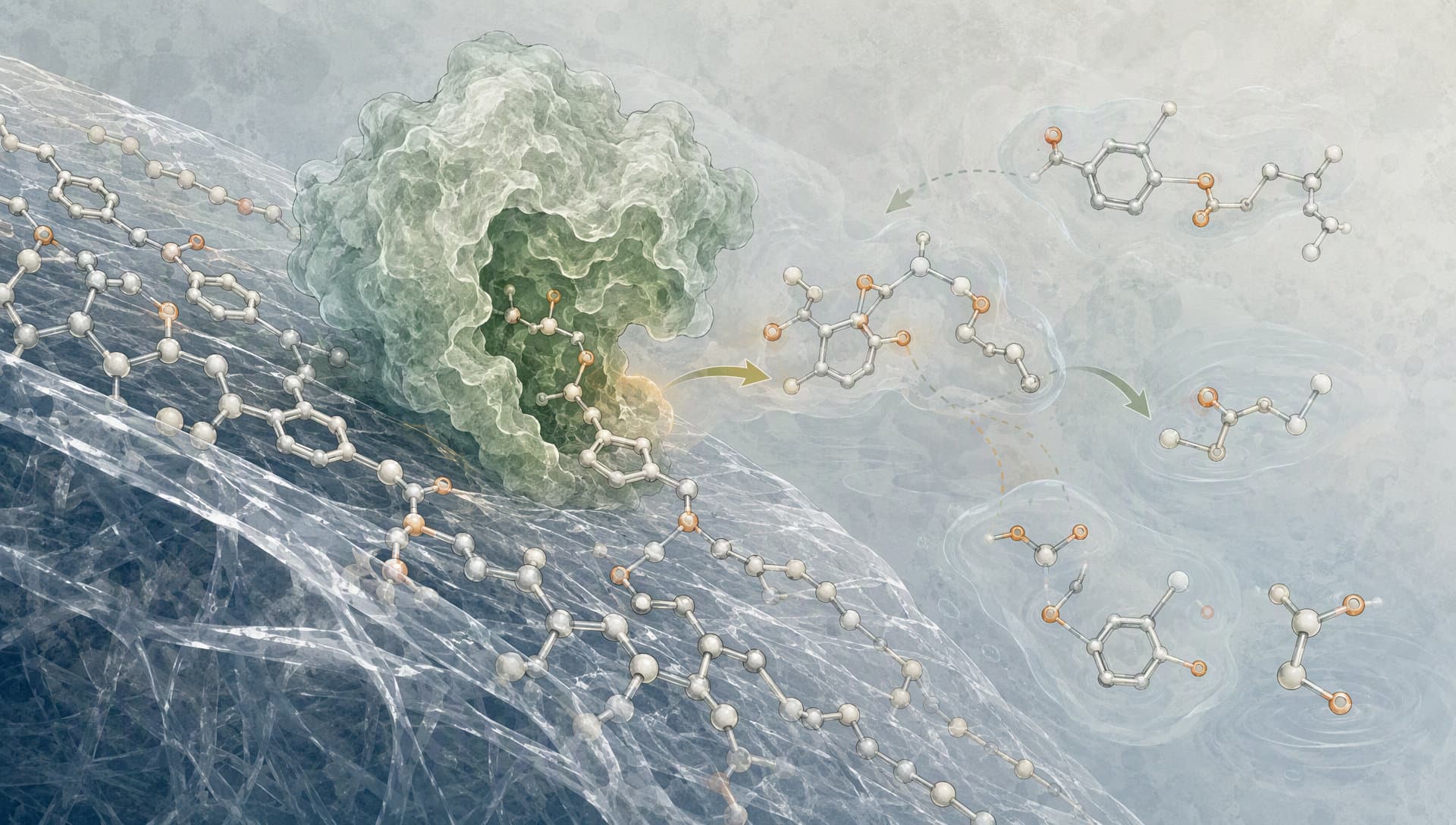
PET is a polyester built from terephthalate-related structures and ethylene glycol units. A hydrolase must approach the solid surface, bind a sufficiently mobile polymer segment in its active-site groove, and catalyze ester-bond hydrolysis. The process can release terephthalic acid, ethylene glycol, and soluble intermediates such as MHET. Their relative amounts depend on the enzyme, material state, and reaction progress.
PETase is often used to illustrate primary polymer-chain hydrolysis, while MHETase can process MHET further. In a defined amorphous PET film system, the two enzymes have shown strong cooperation. This result suggests that polymer mass loss alone is not an adequate process indicator. Intermediate accumulation should also be measured because it can limit continued conversion and reduce the completeness of monomer recovery.
A two-enzyme system is not a universal recipe for every PET waste stream. Bottle flakes, films, fibers, and multilayer packaging differ in crystallinity, surface area, molecular orientation, and additives. The polymer segments available to enzymes therefore differ as well. Mechanistic results must remain tied to the material that was actually tested.
Why PET Crystallinity Has Become a Central Process Variable
PET is not a uniform solid. Polymer chains in amorphous regions have greater mobility and are generally more accessible to enzymatic attack. Crystalline regions are more ordered, with restricted chain motion, and are commonly more difficult to hydrolyze. Materials with the same chemical composition can have different crystallinity because of their manufacturing and thermal history.
Bottles undergo stretching and thermal processing. Textile fibers can be highly oriented. Films, trays, and recycled grades may experience other processing cycles. Textiles may also contain dyes, finishes, blended fibers, and coatings. A label that identifies PET does not mean that these materials can share one pretreatment and enzyme condition.
Feedstock characterization should therefore record material form, particle size or thickness, surface area, crystallinity, color, fillers, blends, and contamination. Without this information, a change in hydrolysis may be assigned incorrectly to the protein. Material characterization is part of enzyme interpretation, not a separate downstream activity.
How PET Depolymerization Pretreatment Changes Enzyme Access
Pretreatment aims to make polymer regions more accessible to enzymes. Size reduction can increase specific surface area. Thermal or physical treatments may change amorphous content and chain mobility. Washing and sorting reduce contaminants and incompatible materials. Each option also changes energy demand, equipment requirements, material loss, and downstream separation.
A smaller particle is not automatically better for the full process. Finer material can complicate handling and solid-liquid separation or increase slurry viscosity. Raising amorphous content may improve enzyme access but adds a pretreatment burden that must be counted. Pretreatment should be designed together with enzyme temperature range, mixing, and monomer recovery.

PET depolymerization pretreatment shows crystallinity effects
The engineering target is also changing. Thermal stability remains valuable, yet it must be balanced with active-site groove flexibility and access to the polymer. Higher temperatures can increase the mobility of some PET chain segments, but protein stability, material form, and reactor limits must all remain compatible. One optimum temperature cannot be interpreted outside this system.
From PETase to Enzyme Cooperation, Metrics Are Changing
Mass loss alone does not reveal what the polymer became. Surface erosion, oligomer release, and complete monomer formation represent different conversion depths. A stronger evaluation tracks terephthalic acid, ethylene glycol, MHET, and other soluble products and closes a material balance where possible.
Initial rate and sustained conversion should also be separated. Some candidates release products quickly at first but slow because of deactivation, adsorption, or intermediate accumulation. Other candidates may have a moderate initial rate and remain active longer. For a recycling process, final monomer recovery, enzyme dose, reaction time, and downstream burden all matter.
An enzyme system may combine a primary PET hydrolase with an intermediate-processing enzyme and, in some designs, proteins that influence contact with a hydrophobic surface. Greater complexity also increases expression, purification, ratio control, and reuse challenges. Cooperation should be tested on the same PET substrate and total enzyme basis, with both intermediates and final products measured.
PET Hydrolase Protein Engineering Is Moving Beyond Heat Resistance
Thermal stability became an early engineering priority because greater chain mobility can improve access to PET. The design question is now broader. Can the active-site groove accommodate the target chain segment? Is surface interaction suitable? How long does the enzyme remain active at process temperature? Do products inhibit conversion? Can expression and secretion support the intended scale?
Research on specific engineered PET hydrolases has shown that structural analysis, mutation screening, and process matching can substantially improve depolymerization in a defined PET system and can connect recovered monomers to repolymerization tests. Those results depend on the enzyme, material pretreatment, enzyme loading, and reaction conditions. They should not be treated as a performance guarantee for a different feedstock.
A continuing challenge is performance on crystalline regions and complex waste. Packaging PET and textile PET differ in orientation, blends, and finishing chemicals. One high-activity candidate may not serve both. Protein engineering should progress alongside sorting, pretreatment, and reactor strategy rather than waiting until enzyme optimization is complete.
PET Monomer Recovery Determines the Quality of the Circular Route
Depolymerization is not the end of recycling. Terephthalic acid and ethylene glycol must be separated from intermediates, salts, enzyme protein, dyes, and other impurities. Textile waste and multilayer packaging also introduce non-PET components. Monomer purity, recovery, and compatibility with polymerization together determine whether a circular route is viable.
Relevant recycled-material product directions include rPTA connected to enzymatic depolymerization of discarded textiles and rPET connected to the conversion of waste PET into regenerated material streams. These directions shift the development endpoint beyond enzyme activity toward recoverable monomers and validated material output.

PET depolymerization connects recovery and regeneration
A complete validation chain has at least four levels. The polymer is hydrolyzed. Intermediates continue toward monomers. Monomers can be isolated and purified. Repolymerized material can be tested for its intended use. When only the first two levels are demonstrated, the work is more accurately described as depolymerization research rather than a mature recycling process.
Connecting PET Hydrolases and Material Processing with MatwingsVenus™(晓鹜™)
PET projects cross protein science, polymer characterization, reaction engineering, and materials testing. MatwingsVenus™(晓鹜™) is positioned as a conversational platform connecting dry-lab and wet-lab protein research. Protein database retrieval, natural-candidate organization, variant planning, and experimental handoff can be arranged as connected tasks.
The input should extend beyond a sequence. It can include PET form, crystallinity, pretreatment, target temperature, intermediate profile, monomer-purification requirements, and final material use. The team can then retrieve relevant hydrolase families, compare known structures and functions, propose candidates with explicit uncertainty, and define controls for expression, enzymology, material hydrolysis, and product analysis.
MatwingsVenus™(晓鹜™) can help preserve why results changed. If a variant is faster on a soluble model substrate but does not improve bottle-flake conversion, the next round should examine surface binding and crystallinity. If PET hydrolysis accelerates while MHET accumulates, intermediate processing becomes the next design task. MatwingsVenus™(晓鹜™) supports research organization and experimental handoff; performance still requires confirmation with the actual material and process.
The PET Depolymerization Trend Is to Connect Process Boundaries
The next competitive advantage is unlikely to come only from a faster enzyme. It will depend on connecting sorting, lower-burden pretreatment, sustained hydrolysis, intermediate management, monomer purification, and repolymerization. The best choice in one operation may change the next, so local performance gains need to be checked against the complete material flow.
Packaging waste, textile PET, and mixed waste may require different routes. Crystalline bottle flakes need stronger material adaptation. Textiles add dyes, finishes, and blended fibers. Multilayer packaging first presents sorting and separation challenges. Development is therefore moving toward enzyme and process combinations designed for a defined waste stream rather than one condition intended for every material.
Metrics are also expanding beyond a single activity value. Material state, monomer released per enzyme dose, sustained reaction, pretreatment burden, product purification, and repolymerized-material performance provide a more complete picture. Enzymatic circularity becomes easier to judge when these boundaries are connected.
Summary
PET depolymerization is moving from enzyme discovery toward system engineering. PET hydrolases determine whether polymer chains can be cleaved. Crystallinity and surface area determine whether enzymes can reach those chains. Auxiliary enzymes and reaction conditions determine whether intermediates continue toward monomers. Separation and repolymerization determine whether the circular route can be completed.
A reliable development sequence starts with waste characterization, selects pretreatment and enzymes according to the material and product endpoint, and then narrows uncertainty through material balance, monomer purification, and regenerated-material testing. Protein engineering can improve candidates, but the improvement gains application meaning only after it enters real PET and the full process.
FAQ
Why Can PETase Work on Amorphous Film but Fail to Perform the Same Way on Bottle Flakes?
The materials differ in crystallinity, molecular orientation, thickness, and surface area. Amorphous film usually offers more mobile chain segments, while bottle flakes require separate evaluation of pretreatment, contact, and temperature conditions.
What Does MHET Accumulation Indicate During PET Depolymerization?
It can indicate a mismatch between primary polymer hydrolysis and downstream intermediate conversion. PET hydrolase activity, MHET processing, product inhibition, and reaction time should be evaluated together rather than increasing the main enzyme alone.
Why Might Better PET Hydrolase Thermostability Fail to Increase Monomer Recovery?
Recovery also depends on crystallinity, surface area, adsorption, intermediate conversion, mixing, and purification. Thermal stability contributes only when it matches polymer-chain mobility, active-site behavior, and reactor conditions.
When Has an Enzymatic PET Route Formed a Recycling Loop?
Beyond polymer hydrolysis, the route should demonstrate intermediate conversion, monomer separation and purification, and the performance of repolymerized material. Without the final stages, the process remains at depolymerization or monomer-recovery validation.