How Are Peptide Drugs Manufactured? Chemical, Recombinant, and Enzyme-Assisted Routes
Published on October 12, 2026
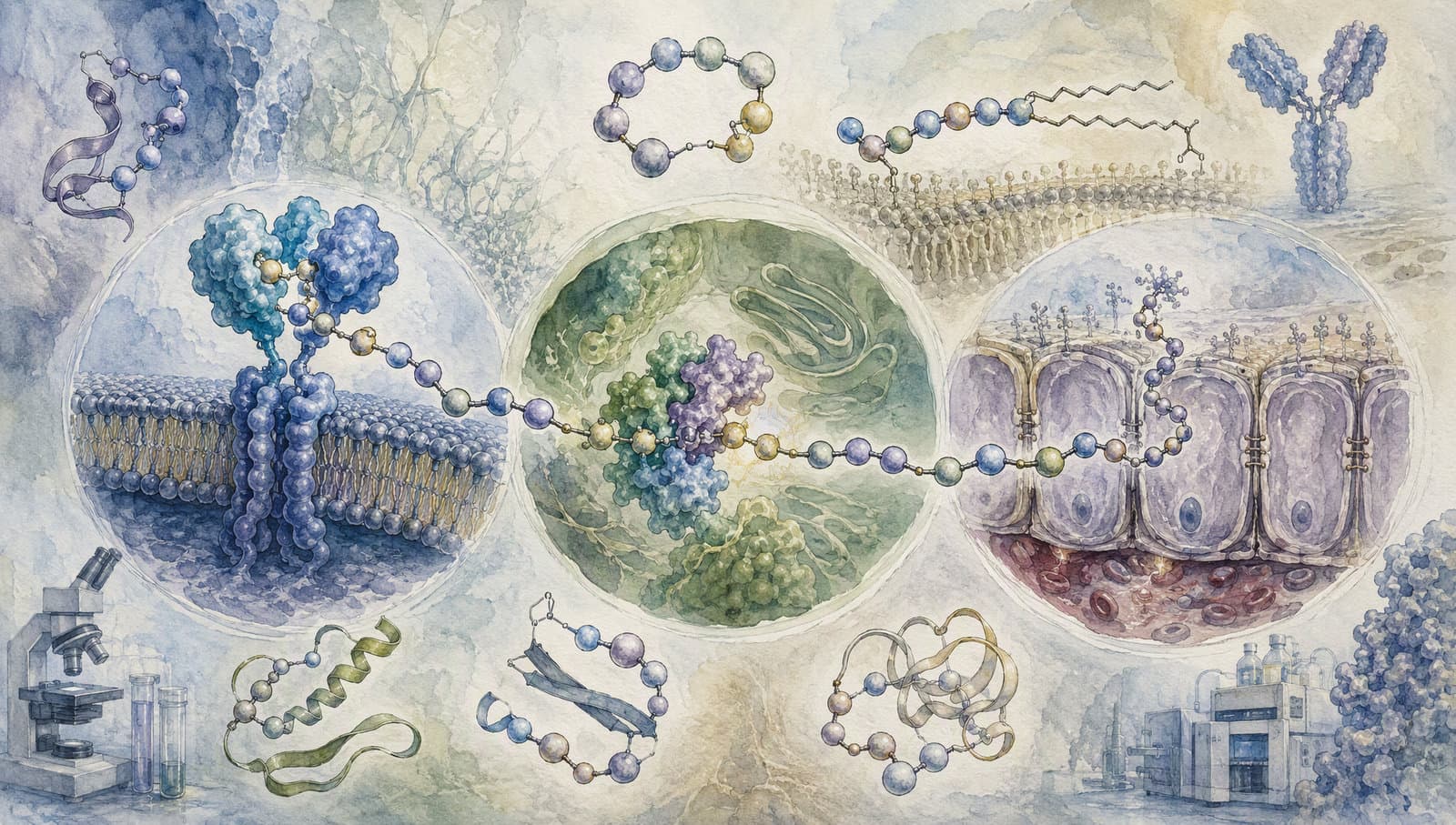
Peptide drugs across molecular types and interaction surfaces
Category: Biopharmaceuticals; Peptide development; Bioprocess engineering
What are peptide drugs, and why are they not simply smaller proteins?
A defined amino-acid sequence forms the molecular core of a therapeutic peptide. Compared with many conventional small molecules, peptides can create larger and more selective biological interaction surfaces. Compared with large proteins, they are often more accessible to sequence editing and chemical modification. Their identity therefore comes not from being shortened proteins, but from using a limited sequence to program charge, hydrophobicity, conformational preference, and target-facing residues.
That programmability has two sides. A development team can explore many sequence and modification options, yet every substitution, cyclization, lipid chain, or terminal change may simultaneously alter activity, solubility, aggregation, protease sensitivity, and purification behavior. A candidate should not advance on potency alone. It must also be reproducibly manufactured, analytically distinguished from related species, and sufficiently stable under the conditions in which it will be formulated and used.
The modality includes linear peptides, cyclic peptides, disulfide-rich peptides, lipidated peptides, conjugates, and products released from recombinant precursors. These forms are not arranged on a simple ladder from weak to strong. They solve different interaction and exposure problems while creating different manufacturing constraints.
Why peptide drug development must connect sequence, conformation, and exposure
Sequence defines chemical composition, but it does not fully determine the state of a peptide in solution or in a biological environment. A flexible linear chain may sample multiple conformations and adopt an effective binding pose only near its target. Cyclization or local conformational constraints may reduce unproductive states, but excessive rigidity can remove adaptability needed for binding. The useful design question is not whether a peptide is more rigid, but whether its conformational freedom matches its interaction mechanism.
Exposure conditions matter just as much. A peptide may encounter proteases, hydrolysis, oxidation, interface adsorption, and aggregation. Molecular size, charge, and hydrophilicity may limit membrane passage or tissue access. A natural sequence with meaningful biology is therefore not automatically a suitable drug candidate. Activity data should be interpreted together with stability, solubility, permeability, and sample-handling behavior.
Common engineering strategies include terminal capping, backbone or side-chain cyclization, noncanonical amino acids, local conformational constraints, lipid chains, hydrophilic moieties, and carrier or formulation systems. Each strategy changes a specific property. Some reduce proteolysis, some shift conformational populations, some alter albumin association or exposure, and others improve formulation behavior. They are not interchangeable enhancement modules and should not be stacked without evidence.
How peptide stability engineering avoids solving only one problem
A modification that improves resistance to one protease may also weaken target binding, increase hydrophobic aggregation, or complicate purification. Stability work is therefore a multi-objective exercise. The team should first identify the dominant failure mechanism, introduce the smallest justified change, and then verify that activity, structure, impurity profile, and manufacturability remain balanced.
Cyclization may reduce terminal degradation and constrain a binding conformation, but ring size and connection site can change epitope presentation. A noncanonical residue may reduce cleavage at one position while altering coupling efficiency and analytical response. Lipidation can substantially change exposure-related properties, yet it also changes solubility, chromatographic retention, and association behavior. A meaningful development record explains why a change was made, what attribute it was intended to alter, and which experiments support the decision.
At candidate-selection stage, a practical minimum dataset often brings together activity, selectivity, physicochemical stability, stability in relevant biological matrices, solubility, aggregation risk, and preliminary manufacturability. This approach identifies sequences that perform well in a narrow assay but are likely to create severe downstream problems.

Cyclization and lipidation for peptide stability engineering
How peptide drug synthesis changes with sequence complexity
Chemical synthesis offers direct control over residue order, protecting groups, and many noncanonical building blocks, making it useful for short-to-medium sequences and highly modified peptides. As length, hydrophobicity, and difficult coupling sites increase, incomplete coupling, deletion sequences, epimerization, residual protecting groups, and aggregation become more likely. The response is not simply to add more reagent. Fragment condensation, protection strategy, solvent choice, and intermediate purification may all need reconsideration.
Recombinant expression is relevant when a sequence can be encoded with standard amino acids and produced as a precursor or fusion protein. It can support longer chains, but expression level, host-derived impurities, fusion-tag removal, and terminal fidelity become central. When a target contains noncanonical residues, site-specific lipidation, or specialized linkers, recombinant production may need to be combined with chemical or enzymatic processing.
Tool enzymes sit at the interface of these routes. Recombinant Kex2 Protease listed by MATWINGS MALL recognizes dibasic motifs including Arg-Arg, Lys-Arg, and Pro-Arg and is positioned for recombinant peptide preparation scenarios that include GLP-1-related peptides. This example shows why cleavage is not a simple post-expression cleanup. The recognition motif should be designed early, while substrate state, buffer, enzyme loading, reaction endpoint, and purification after cleavage must be evaluated together. Suitability for any specific precursor still requires project-level testing.
The MatwingsVenus® 晓鹜® end-to-end custom peptide development service covers molecular optimization, synthesis-process development, pilot verification, and optimization of production tool enzymes. Its relevant role in a development program is to keep sequence decisions and manufacturing constraints in one task chain rather than postponing manufacturability until candidate selection is complete.
Why the peptide manufacturing process is governed by impurity fate rather than one main peak
Many peptide impurities closely resemble the desired product. A species missing one residue, carrying one residual protecting group, containing an epimerized center, or modified at the wrong site may have similar chromatographic behavior. Main-peak area alone can hide co-elution and response differences. A stronger control strategy combines chromatographic separation, molecular-mass information, sequence-relevant data, and process knowledge.
Impurities become easier to manage when organized by the event that creates them. Coupling can generate deletion or branching products. Deprotection and cleavage can leave protected variants or introduce oxidation and side reactions. Enzymatic processing may leave uncleaved, miscleaved, or over-cleaved species. Modification steps can create unmodified, positional, or over-modified variants. Storage and buffer exchange can add hydrolysis, deamidation, aggregation, and adsorption losses. Every major risk should have both a monitoring method and a planned removal point.
Specifications should mature with the program. Early work needs broad structural confirmation and impurity discovery. Once the route has converged, critical intermediates, raw materials, and the final product can receive practical control ranges. Applying a fixed late-stage specification too early may conceal method limitations, while having no intermediate gate transfers variability into expensive purification and scale-up stages.
How a peptide drug development workflow moves from laboratory scale to manufacturing scale
Mixing, heat transfer, dissolution, filtration, hold time, and purification loading rarely remain identical when equipment size changes. Local concentration differences can affect coupling or modification reactions. Increased purification load can reduce resolution. Solvent exchange, concentration, and drying may reveal aggregation or degradation that was not obvious in a small vessel. Scale-up is therefore not proportional recipe copying; it is a test of how process variables influence product quality.
A robust transfer path starts with target quality attributes, identifies critical intermediates and reaction endpoints, and links them to sampling and analytical methods. Small-scale and pilot work then define a practical operating range. The MatwingsVenus® 晓鹜® Commercial-scale CDMO Manufacturing service supports process transfer and scale-up manufacturing for proteins or peptides within the agreed project scope. A project should enter this stage only when the route is sufficiently stable, analytical methods are fit for purpose, and major impurity fates are understood.
For programs whose route is still evolving, the MatwingsVenus® 晓鹜® service portfolio also connects molecular optimization, synthesis development, pilot verification, and production-enzyme optimization. The defensible value is not a guaranteed outcome; it is a development structure in which each stage has defined inputs, outputs, and verification criteria.

Tool enzymes connecting peptide manufacturing and process scale-up
Why peptide drug delivery must return to the properties of the molecule
A delivery strategy cannot be selected independently of sequence properties. Hydrophilicity, charge, conformation, protease sensitivity, and the required site of exposure all influence route of administration, excipient choice, and carrier design. For a peptide that must cross a biological barrier, protection from degradation is only one part of the problem. Release rate, local concentration, uptake, and tissue distribution may also matter.
Some candidates are best served by molecular modifications that prolong exposure. Others rely more heavily on formulation or a delivery platform. The approaches can be combined, but added complexity increases the need to study material compatibility, release consistency, analytical methods, and scalable manufacturing. The first task is to define the delivery problem, then assign a clear role to molecular engineering and formulation engineering.
Public communication should also avoid presenting one delivery technology as a universal answer. Sequences, intended uses, and safety boundaries differ substantially. Every route requires a complete experimental evaluation. Educational content can explain the engineering logic, but it cannot replace professional development decisions or individualized medical advice.
FAQ
How are peptides distinguished from proteins?
Both are made of amino acids, and the practical boundary varies across disciplines and product classifications. Peptides are often shorter and may rely less on stable higher-order structure, whereas proteins more commonly depend on complex folding. In development, sequence length, conformation, modifications, function, and manufacturing route are more informative than the label alone.
Why do some highly active peptide candidates remain difficult to develop?
Common reasons include rapid proteolysis, low solubility, aggregation, limited membrane passage, fast clearance, and a complex manufacturing impurity profile. Activity asks whether the molecule can produce an effect in an assay. Development also asks whether it can arrive in the right state, be manufactured repeatedly, and be controlled analytically.
How should chemical synthesis and recombinant expression be compared?
Shorter sequences with many noncanonical residues or complex chemical modifications are often evaluated first through chemical routes. Longer sequences composed mainly of standard amino acids may be candidates for recombinant expression. Purification, scale, equipment, impurity profile, and cost remain decisive, and hybrid routes are often possible.
What problems can tool enzymes solve in peptide manufacturing?
Proteases, ligases, and modification enzymes can perform precursor cleavage, fragment joining, or site-selective processing. Their value depends on recognition motif, substrate conformation, and reaction conditions. Small-scale studies should confirm selectivity, endpoint behavior, and compatibility with downstream purification.
Summary
The value of peptide drugs comes from programmable sequences, broad modification space, and well-defined biological interaction surfaces. Their development difficulty arises from the same structural features. Molecular design, stability, delivery, synthesis, tool enzymes, analytics, and scale-up should not be managed as isolated topics. A productive program begins with the intended interaction, constrains engineering choices with experimental data, connects manufacturing events to impurity fate, and uses pilot evidence to test transferability. This is how an active sequence can become a reproducibly manufactured product.