Pectinase in Practice: Matching Enzyme Function to the Process Window
Published on October 15, 2026
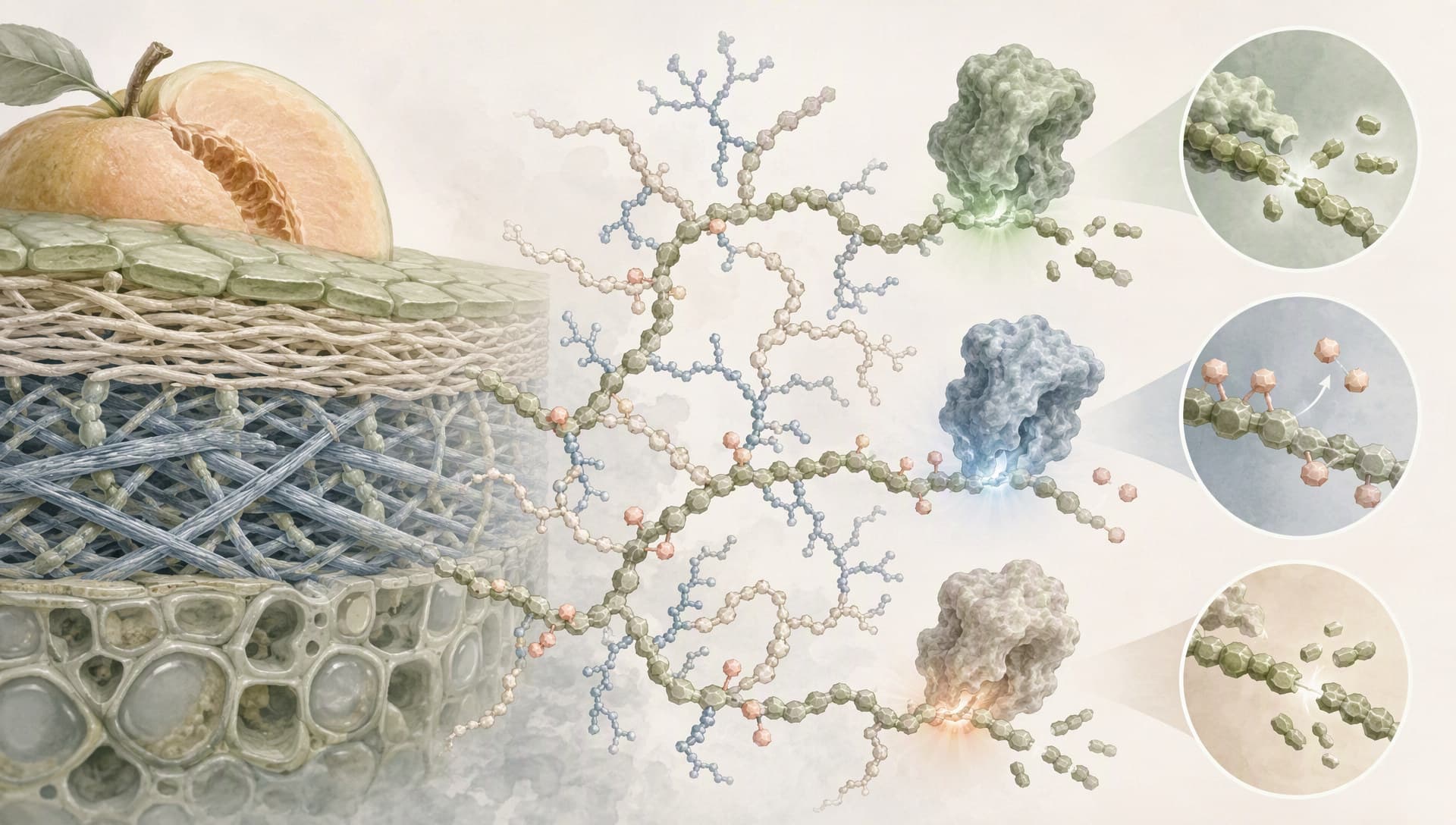
Pectinase mechanism across the plant cell wall
Category
Category: Biotechnology; Industrial Enzymes; Food Processing; Fruit and Vegetable Processing; Protein Engineering
Abstract
Abstract: Pectinase is a family of enzymes that modifies or depolymerizes pectin in plant cell walls. This article explains major enzyme functions, process effects in juice and plant-material applications, and a practical selection framework covering substrate structure, product goals, pH, temperature, residence time, downstream separation, and scale-up validation.
What pectinase means in an industrial process
Pectinase is a collective name for enzymes that modify or depolymerize pectin. Pectin is a structurally diverse polysaccharide network found in primary plant cell walls and the middle lamella between cells. Once fruit or vegetable tissue is crushed, pressed, or extracted, pectin can enter the liquid phase, increase viscosity, stabilize fine suspended particles, and influence how easily juice moves through filters or membranes.
That description immediately changes the selection question. A process developer is not simply asking whether an enzyme can “break down pectin.” The practical question is which feature of the pectin network must change, to what extent, under which processing conditions, and without compromising the desired texture, flavor, color, or storage behavior.
Several catalytic functions may contribute. Polygalacturonases cleave the galacturonic-acid-rich backbone by hydrolytic reactions. Pectin and pectate lyases cleave related backbones through eliminative reactions, while pectin methylesterase changes the degree of methyl esterification. Commercial preparations may combine these functions and may also contain cellulase or hemicellulase activities that help open a more complex plant cell-wall matrix. Activity values are therefore meaningful only when read together with the assay substrate, method, enzyme profile, and intended raw material.
Why the pectinase mechanism changes clarification, extraction, and texture
Pectin differs in degree of esterification, branching, polymer length, and association with other cell-wall components. Two raw materials with similar total pectin content can respond differently to the same enzyme preparation because their pectin is not presented in the same form. When backbone chains become shorter, viscosity may fall and filtration behavior may improve. When the middle lamella is loosened, juice and soluble compounds may be released more readily. Excessive treatment, however, may remove desirable structure or release fine particles that create a new separation burden.
The required product outcome must therefore be defined before the enzyme is chosen. A clarified juice process may prioritize viscosity, turbidity, press yield, filtration throughput, aroma retention, and storage stability. A fruit purée may need better pumpability while retaining body and particle perception. Extraction from plant material may prioritize target-compound release but also needs to control co-extraction and downstream solids removal.
Interactions among enzyme functions can also matter. De-esterification changes the accessibility and charge state of the pectin network, which can alter how other activities act on the backbone. It may also change interactions mediated by calcium. A blend can be useful when a substrate is heterogeneous, but its value cannot be inferred by adding nominal activity values. A robust development program first establishes a baseline with a defined enzyme profile, then tests whether a blend expands the usable operating window or merely makes outcomes harder to interpret.
Pectinase for juice clarification must be evaluated across the entire process
In juice processing, pectin affects pressing, viscosity, suspension stability, settling, and filtration. A suitable treatment may improve juice release and reduce resistance in selected separation operations. Yet fruit variety, maturity, particle size, prior heating, soluble solids, and native enzyme activity can all change the response. Conditions that work in a laboratory beaker cannot be transferred to production solely by multiplying the dose.
A useful trial separates the process into raw-material preparation, enzymatic reaction, reaction termination or transition, solid-liquid separation, and final product evaluation. Each stage needs measurable outcomes. During the reaction, developers can monitor viscosity, turbidity, soluble solids, and the rate of change. During separation, they can compare pressing behavior, filtration time, membrane throughput, and cake characteristics. Product evaluation should then cover color, aroma, taste, mouthfeel, storage stability, and compatibility with downstream heat treatment.
This structure prevents a single clarity reading from becoming the only definition of success. A visually clearer sample may not represent the best overall process if it loses desirable sensory attributes or creates difficulty at another unit operation.

Pectinase for juice clarification in fruit processing
Temperature and pH should be interpreted inside the real product environment. A higher temperature may accelerate catalysis while also accelerating inactivation or changing aroma and color. A longer residence time may reduce the dose required for a target conversion but place pressure on line capacity. The best process condition is often a controllable region that reliably meets product requirements, not an isolated point with the highest measured activity.
Immobilized pectinase is sometimes considered when reuse or combined reaction-separation is attractive. It is an engineering option rather than an automatically superior format. The carrier, immobilization chemistry, mass-transfer resistance, cleaning strategy, activity retention, and replacement schedule all influence performance. Stable liquid streams and frequent production cycles may justify further evaluation, whereas highly viscous or particulate feeds require careful assessment of fouling and blockage risks.
How to select pectinase using five process questions
A practical selection program can begin with five questions.
What is the substrate? Distinguish highly methyl-esterified pectin, low-methoxyl pectin, pectate, and pectin embedded with cellulose and hemicellulose. “Fruit material” is too broad a description for enzyme matching.
What must change? The goal may be lower viscosity, improved juice release, faster filtration, tissue softening, greater release of plant compounds, or controlled retention of cloud and texture. When several goals coexist, define their priority and identify attributes that must not be sacrificed.
What conditions are actually available? Record the real pH, temperature, ionic environment, solids level, shear, and residence time. A standard activity assay is useful for comparison, but it does not reproduce every production matrix. Enzyme units should always be interpreted alongside the assay substrate and method.
What happens next? Pressing, centrifugation, membrane filtration, fermentation, heating, or direct formulation will each change the preferred reaction endpoint. A reduction in viscosity at the enzyme stage does not guarantee higher total line efficiency.
How will success be judged? Build at least three layers of criteria: a direct reaction indicator, a process-efficiency indicator, and a final-product quality indicator. Progress to scale-up is more defensible when all three layers support the same decision.

How to select pectinase for a defined substrate
Trials should move from simple to representative conditions. Compare candidates under a common substrate and analytical method, then test them in the actual raw material. Screen enzyme function and approximate dose before refining pH, temperature, and time. Finally, reproduce realistic mixing, heating, holding, and separation. Changing fewer variables per round makes it easier to identify not only a promising condition but also its acceptable range and failure boundary.
Turning pectinase activity conditions into scalable parameters
Scale-up introduces mixing time, thermal gradients, addition sequence, shear, and sampling differences. High-solids plant slurries are especially prone to local nonuniformity. One region may receive insufficient treatment while another is exposed for too long. Enzyme dose should therefore be related to substrate load and reaction history rather than reactor volume alone.
A scalable development path usually has three stages. First, define the laboratory operating window for dose, pH, temperature, and time. Second, use progressively larger equipment to reproduce realistic addition, mixing, heating, and separation. Third, validate process stability across repeated batches and raw-material variation. Final-product quality remains part of every stage; a more efficient separation is not a complete success if sensory or storage performance declines.
The production of the enzyme itself has another set of constraints. Strain performance, expression, fermentation, protein stability, purification recovery, and formulation all influence cost and lot consistency. MATWINGS MALL presents a Bioprocess Development and Scale-Up service covering expression-system selection, high-expression strain construction, fermentation and purification development, and stepwise laboratory-to-pilot validation. For a pectinase program that has already identified promising candidates, these capabilities can connect laboratory activity with a repeatable manufacturing process. MatwingsVenus®(晓鹜®) can support the preceding candidate and property-assessment stages, while the service itself remains a general bioprocess capability that must be configured around the enzyme and intended application.
For mature processes, MATWINGS MALL also presents Commercial-scale CDMO Manufacturing that can include strain revival, fermentation, purification, formulation, and packaging, together with process transfer and continuing process optimization. This manufacturing service is distinct from candidate discovery, property assessment, and engineering tasks. The responsible route is not to bypass validation and move directly to volume. Critical parameter ranges, quality criteria, sampling methods, and deviation handling should first be assembled into a transferable process package.
MatwingsVenus®(protein design agent)workflow for pectinase candidate assessment and engineering
Industrial enzyme projects commonly encounter one of two challenges: natural candidates do not fully match the desired conditions, or an existing enzyme has limitations in stability, expression, temperature tolerance, or pH compatibility. MatwingsVenus®(晓鹜®) can organize natural protein discovery, functional-property assessment, and engineering of an existing protein within a retrieval-first workflow. A team can provide a functional objective, sequence, or structure; examine known candidates; estimate selected properties; and, when justified, formulate engineering hypotheses and an experimental validation plan.
The distinction between existing evidence, computational prediction, and unknown information is essential. Prediction can help narrow an experimental search space, but it does not establish industrial performance. Activity, substrate preference, and stability may trade off against one another. Functional regions should be identified before variants are proposed, and experiments should compare the parent enzyme, selected single variants, and selected combinations under the intended substrate and process conditions.
A well-organized development chain has four deliverables: a clear target product profile, reproducible laboratory activity, a bounded operating window, and transferable fermentation and purification instructions. Each deliverable should specify its inputs, decision criteria, and handoff. This structure reduces the risk of obtaining an enzyme that looks strong in an assay but is difficult to use in a real process, or a laboratory method that becomes unstable at larger scale.
FAQ
Is pectinase a single enzyme?
No. The term includes multiple catalytic functions, including backbone hydrolysis, eliminative cleavage, and de-esterification. Commercial preparations may contain supporting activities, so enzyme profile, assay method, and substrate fit should be reviewed together.
Does a higher pectinase dose always improve juice clarification?
No. Excessive dose or residence time can alter texture, release fine particles, or create undesirable effects in sensory quality and downstream separation. The operating range should be defined using combined indicators such as viscosity, filtration, yield, sensory quality, and stability.
Should pectinase be selected by its optimum temperature or the real production temperature?
Both are informative, but the real operating window governs the final decision. Reported optima usually come from a defined assay. Actual raw materials differ in pH, solids, ions, mixing, and residence time.
Is a blended pectinase preparation always better than a single activity?
Not necessarily. A blend may address heterogeneous plant tissue, but it can also cause excessive breakdown or make effects difficult to attribute. Establish a defined baseline first, then test whether the blend improves the critical outcomes.
What is commonly overlooked when scaling up a pectinase process?
Mixing and representative sampling are frequent gaps. Large, high-solids systems can develop local concentration and temperature differences. Stepwise scale-up is needed to verify parameter ranges instead of simply multiplying the enzyme dose by volume.
Conclusion
Understanding pectinase is less about finding one universal “best condition” and more about connecting pectin structure, enzyme profile, product objectives, and downstream operations. Juice clarification, fruit softening, plant extraction, and enzyme manufacturing have different endpoints. A reliable development program defines the goal, uses staged trials to establish a process window, verifies mixing and separation, protects final-product quality, and then connects fermentation, purification, and scale-up. That is how catalytic potential becomes a repeatable industrial process.