What Are Feed Enzymes? Choosing Phytase, Carbohydrases, and Protease
Published on October 13, 2026
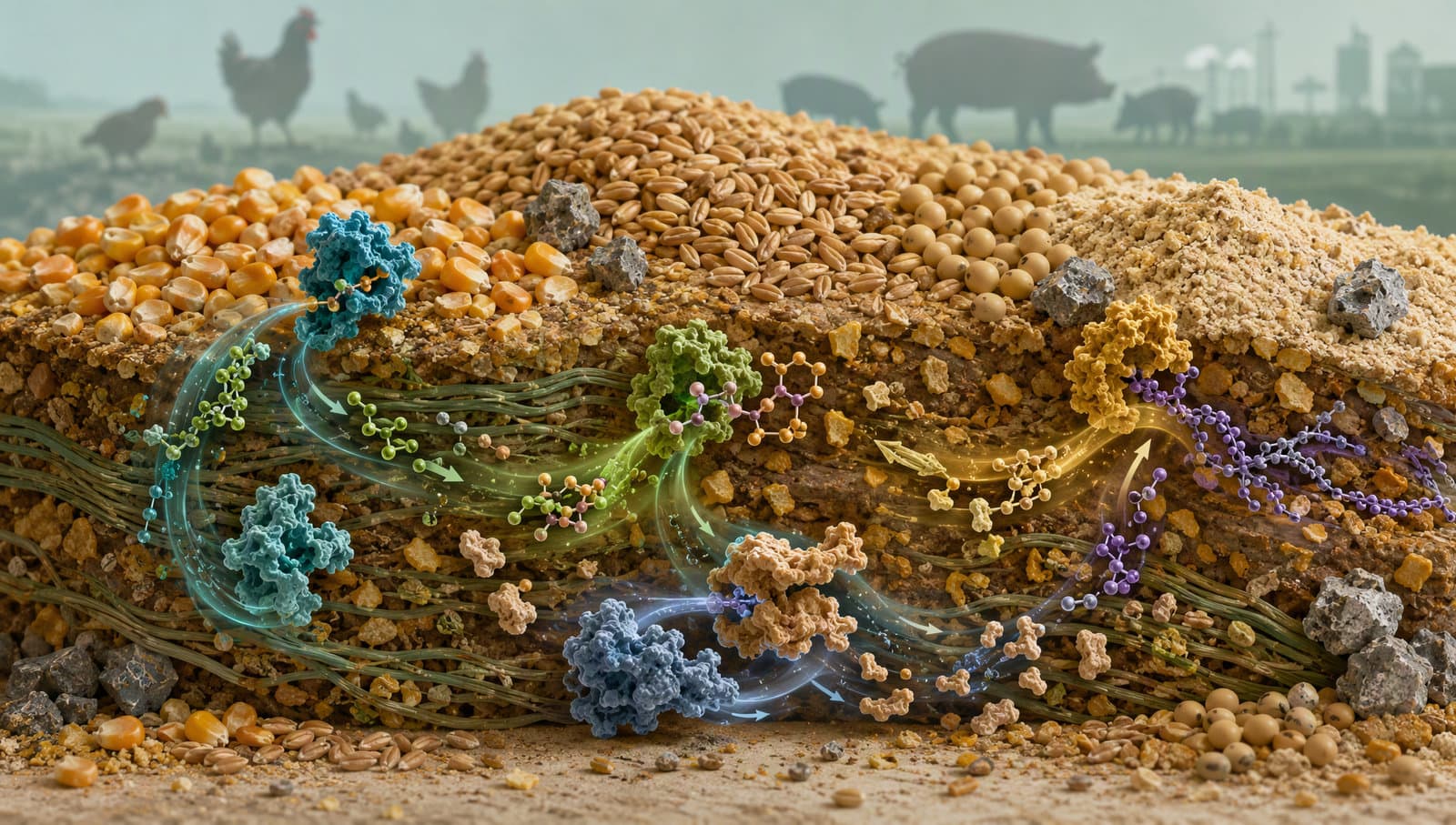
Feed enzymes mapped to phytate, fiber, and protein substrates
Category: Industrial Biotechnology, Animal Nutrition, Enzyme Engineering
A feed formula may appear to be a straightforward mixture of corn, wheat, soybean meal, minerals, and other ingredients. At the molecular level, however, it contains many potential substrates. Phytate can influence the availability of phosphorus and other nutrients. Structural carbohydrates occur in different cell-wall architectures, while proteins differ in composition, processing history, and accessibility. Feed enzymes add targeted catalytic functions to this matrix and can give formulators another way to manage defined nutritional constraints.
An enzyme name alone does not establish a result. The same class can perform differently when the diet, dose, processing conditions, product format, or animal changes. Selection should therefore answer four questions. Is the relevant substrate present? Does sufficient activity remain after manufacturing and storage? Can the enzyme function in the intended region of the gastrointestinal tract? Was the application evaluated under conditions that resemble the final use?
Types of Feed Enzymes Should Follow the Substrate Map
Phytase provides a useful example of substrate-first selection. It is used to hydrolyze phytate in the diet. In non-ruminant animals, its in vivo activity can be influenced by the phytase type, pH profile, resistance to endogenous proteolysis, dietary phytate, ingredient composition, processing, mineral conditions, animal species, and age. This makes phytase a formulation decision rather than a stand-alone dose.
Carbohydrases require another level of definition. Xylanase acts on xylan-related structures, beta-glucanase on beta-glucans, and mannanase on mannans. Wheat, barley, corn, and soybean meal do not present the same structural-carbohydrate profile. A general instruction to “add a carbohydrase” is therefore incomplete. The ingredient matrix and dominant substrate should guide the enzyme class considered for testing.
Protease is directed toward protein substrates and may be assessed as part of a strategy for dietary protein utilization. Yet feed proteins vary, and processing can change substrate accessibility. An activity result obtained with a laboratory substrate describes catalysis in that assay. It does not, by itself, establish a nutritional outcome in an animal.
Multi-enzyme products combine several catalytic directions for complex diets. Their broader composition may be useful, but it does not guarantee synergy. Each component still needs a corresponding substrate, a justified dose, and adequate activity under the same processing and gastrointestinal conditions.
Phytase in Animal Feed Is More Than a Declared Activity
Declared activity helps describe a phytase product, but it is not the entire application. Before the enzyme reaches an animal, it may pass through manufacturing, transport, and storage. After ingestion, it must encounter phytate under a sequence of gastrointestinal conditions. Phytase type, pH behavior, resistance to endogenous proteases, and the speed of action in the upper digestive tract can all shape the outcome.
The diet is equally important. When substrate conditions change, the same dose cannot be assumed to deliver the same response. Ingredient composition, dietary phytate, mineral configuration, and feed processing all belong in the decision. Species and age add further context. A dose used in one diet should not become a default for every formula without a diet-specific rationale.
This is also why two phytase products should not be compared on purchase price or one activity label alone. A useful comparison considers the activity definition, formulation type, intended use range, activity retained after relevant processing, and evidence generated under the target conditions. Any conclusion about nutrient release or reformulation should remain within the diet boundaries that were actually evaluated.
Thermostable Feed Enzymes Must Pass Processing and Storage
Thermostability matters because an enzyme may face temperature, moisture, and a chemically complex premix before it ever enters the digestive tract. Pelleting can challenge protein structure, while storage time, packaging, ambient heat, and humidity may change retained activity. These effects differ among molecules and formulations, so one universal temperature threshold cannot describe every product.
Molecular stability and formulation protection should also be separated. A protein may have intrinsic structural stability, or a formulated product may use granulation or another protective strategy. Either route requires a comparable before-and-after assessment. A short heat-challenge assay can support early screening, but it cannot reproduce every feature of commercial pelleting, including moisture, residence time, pressure, and cooling.
Storage creates a different question. Passing one thermal event does not prove stability during prolonged warehousing, premixing, transport, or climate variation. Development and procurement teams can record initial activity, post-process retention, storage-stage results, and batch consistency as distinct data. Compressing them into a single “heat stable” label removes information needed for a sound decision.
The protein-function prediction, directed-evolution, and protein-engineering areas presented by MatwingsVenus®(晓鹜®) can support analysis of functional regions and stability-related features and help prioritize variants for experimental testing. Computational ranking narrows the candidate space. It does not replace pelleting, storage, feed-matrix, or animal evaluation, and it does not imply that a finished feed-enzyme product already exists.

Thermostable feed enzymes across pelleting and digestion
Multi-Enzyme Feed Formulation Should Avoid Unexplained Stacking
A multi-enzyme plan should begin with a list of diet constraints, not with the longest possible ingredient label. Grain- and soybean-based diets may contain phytate, several structural carbohydrates, and protein substrates, but their proportions change with ingredients and batches. Defining the likely limiting substrate first makes the choice of phytase, carbohydrase, or protease easier to explain.
One transparent development sequence is to establish a base-diet control, examine selected single-enzyme candidates, and then evaluate combinations that have a clear substrate rationale. This is a project-design approach rather than a universal protocol. If development starts with a mixture containing many components, a variable result may be difficult to interpret because the contribution of each component is unknown.
Dose should remain connected to substrate and conditions. More enzyme can translate into application value only when the substrate is accessible, relevant activity survives processing, and the reaction environment is suitable. Quality control must also distinguish the components in a blend. A total-enzyme figure should not hide whether a decision-critical activity is present at the intended level.
Enzyme mining and function prediction within MatwingsVenus®(晓鹜®) can support expansion and annotation of candidate sequences. Directed evolution and protein engineering can then help propose variants for defined activity or tolerance objectives. Those candidates still require side-by-side testing under a consistent feed matrix and process.
Feed Enzyme Activity Validation Must Connect Assay and Use
The first layer of validation asks whether measurable activity remains in the sample. Teams may compare material before and after processing or at selected storage stages using a consistent method. Activity units and assay substrates differ across enzyme classes, however, so numbers should not be added or compared without understanding the method. Sampling location and sample preparation must also be controlled.
The second layer asks whether the target substrate changes under project-relevant conditions. This evaluation should reflect the intended diet and the relevant temperature and pH environment. For phytase, the digestive site of action and dietary mineral configuration matter. Other enzyme classes require endpoints tied to their own substrates and target animals.
The third layer concerns animal-level nutritional or production outcomes. High in vitro activity does not guarantee an improvement in vivo because diet, age, intake, gastrointestinal conditions, and study design can affect what is observed. Feed-additive use must also follow the applicable safety, labeling, and regulatory requirements in the target market. Early screening data are not a substitute for the complete evaluation required for a commercial decision.
Useful records include limitations as well as favorable results. Fit in one grain matrix does not establish fit in another. Retained activity after one pelleting condition does not prove unchanged activity after prolonged storage. Explicit boundaries make later reformulation and troubleshooting more reliable.

Multi-enzyme feed formulation and dose decisions
How MatwingsVenus®(protein ai agent)Can Support Feed-Enzyme R&D
In early discovery, the main challenge is often not obtaining more sequences but translating substrate, processing, and animal conditions into useful screening constraints. MatwingsVenus®(晓鹜®) can organize enzyme mining, protein-function prediction, functional-region analysis, and computational variant assessment as an early-stage support workflow. The purpose is to identify which candidates should be tested first.
Specific inputs produce more relevant rankings. The target substrate, ingredient system, pelleting route, expected pH conditions, product format, storage scenario, and non-negotiable performance attributes should be defined before variant analysis begins. A vague request to increase activity may prioritize a candidate that performs well in a simple assay yet fits poorly in the intended process.
This capability connects information organization with experimental priority setting. It does not perform diet formulation, animal trials, or regulatory assessment. Publicly presented capabilities also do not establish the availability or efficacy of a finished feed-enzyme product. The accurate role is to support candidate discovery and early enzyme-engineering decisions before empirical development confirms value.
FAQ
Do more enzyme types always produce a better feed result?
No. Each enzyme needs a relevant substrate and adequate activity after processing and under digestive conditions. A blend should be based on diet constraints and verified with appropriate controls rather than judged by the number of components.
Can one phytase dose be used across all animals and diets?
A universal dose cannot be assumed. Phytase performance can vary with the enzyme, phytate level, mineral configuration, processing, species, age, and gastrointestinal conditions. The target diet and animal must define the evaluation.
Is one high-temperature test enough for a thermostable feed enzyme?
No. A short heat challenge can support screening, but pelleting also involves moisture, residence time, and cooling. Storage, premix exposure, and transport create separate stability questions.
Does high in vitro activity guarantee an animal response?
No. In vitro activity describes catalysis under the stated assay conditions. Animal-level outcomes also depend on the diet, digestive environment, intake, age, and study design.
Can enzyme engineering replace animal evaluation?
No. Enzyme mining, function prediction, and variant design can make candidate selection more efficient, but processing stability, substrate action, diet fit, and required animal evaluation still determine application value.
Conclusion
Selecting feed enzymes is a matching exercise. Phytase, xylanase, beta-glucanase, mannanase, and protease address different substrates, while pelleting, storage, pH, ingredient composition, and animal conditions determine whether molecular activity becomes an application result. MatwingsVenus®(晓鹜®) can support candidate discovery and prioritization through enzyme mining, function prediction, directed evolution, and protein engineering. A controlled validation loop must still establish fit in the intended feed system.