Enzyme EC Number Prediction: Does Similar Sequence Mean Same Function?
Published on October 13, 2026
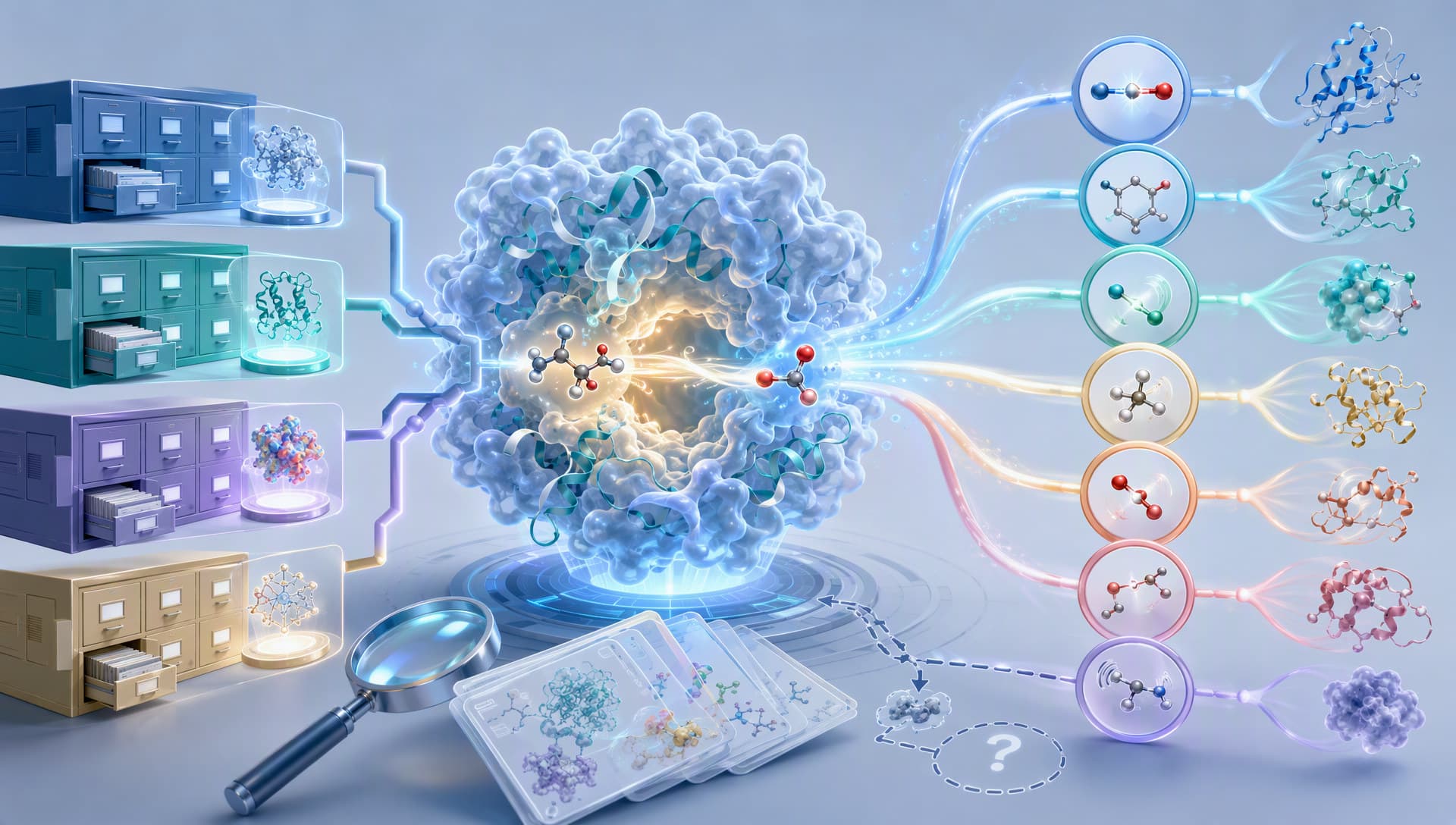
EC numbers refine enzyme function according to catalyzed reactions
Category: Enzymology and Protein Function Annotation
Enzyme EC number prediction is not sequence translation
The Enzyme Commission system classifies enzymes primarily by the reaction they catalyze—not by protein name, sequence family, or structural appearance. A complete EC number contains four hierarchical components. The first defines a broad reaction class, while subsequent levels narrow the chemistry, target, and specific reaction entry. The current top level includes oxidoreductases, transferases, hydrolases, lyases, isomerases, ligases, and translocases.
Sequence similarity is valuable evidence, but it is not a license to copy a full EC number automatically. Members of one family can diverge through a small set of catalytic residues, pocket geometry, or cofactor preferences. Conversely, unrelated sequences and folds may support similar chemistry. The annotation task must therefore move from “What does this sequence resemble?” to “Which reaction is most plausible, and why?”
ExplorEnz is the IUBMB-approved enzyme nomenclature and classification list. It provides an authoritative place to check EC entries, reaction definitions, and classification status. Computational candidates should be reconciled with this list so that provisional, obsolete, or nonexistent four-level combinations do not enter a final annotation.
A complete number is not always the most reliable answer
Many models operate hierarchically: they first separate enzymes from non-enzymes, then predict a broad class, and finally attempt a complete four-level EC number. Greater depth means greater specificity, but often fewer training examples and more ambiguity among closely related reactions. If the evidence supports only a hydrolase subclass, filling the final positions creates false precision.
Evidence-aware enzyme EC number prediction matches output resolution to evidence resolution. A result may report a partial EC category and a range of candidate reactions when confidence is strong at an upper level. A complete EC number should receive higher priority only when homology, catalytic residues, pocket structure, substrate geometry, and other evidence converge on the same reaction.
Partial classification can still support candidate grouping, database retrieval, and experimental triage. An Unknown label is also useful because it identifies which missing observation would change the decision. A transparent partial answer is more actionable than a brittle complete label.
Multifunctional enzymes make single-label output risky
One protein may catalyze more than one reaction, including a primary activity, promiscuous chemistry, or a context-dependent secondary function. Machine-learning research treats multifunctional enzymes as a multi-label problem and highlights interpretability, generalization, and class imbalance as practical challenges. Keeping only the highest-scoring label may hide another experimentally relevant activity.
A responsible prediction should present candidate EC numbers, confidence order, supporting sequence regions, nearby reaction classes, and the model’s applicability limits. If two candidates share upper-level chemistry but diverge in substrate specificity, experiments should focus on substrates, cofactors, or products that distinguish those branches.
Annotation feedback loops also require caution. An overgeneralized database label can enter a training set and then be propagated by a later model. Homology searches should prioritize experimentally supported records, and computational annotation should remain visibly separate from measured reactions.

Evidence resolution sets the publishable depth of an EC assignment
A reproducible enzyme EC number prediction workflow
A robust workflow progressively removes alternative explanations rather than generating a final code in one step.
Verify protein identity. Check sequence completeness, organism, signal peptides, transmembrane regions, domain boundaries, and possible fusion segments. A malformed input cannot be rescued by a strong classifier.
Retrieve authoritative annotation. Search resources such as UniProt, InterPro, ExplorEnz, and PDB for experimentally supported homologous functions, structures, and reactions. A Measured label belongs only to the source protein that was experimentally tested. For the query protein, homologous evidence supports a functional candidate that remains Predicted or Unknown until its own reaction is verified.
Build hierarchical candidates. Combine sequence similarity, structural fold, conserved residues, active-site geometry, and substrate information. Report either complete or partial EC candidates as appropriate. Computational output remains Predicted rather than being described as measured activity.
Design discriminating experiments. Select substrates and cofactors capable of separating candidate reactions, then detect products, reaction direction, and required conditions. Experimental results become new Measured evidence and update the annotation.
The real output is not an isolated number. It is a package of candidate reactions, supporting evidence, uncertainty, and a validation plan.
How MatwingsVenus®(晓鹜®)supports the evidence chain
The publicly described capabilities of MatwingsVenus®(晓鹜®)include intelligent dialogue, database retrieval, protein-sequence analysis, structure prediction, and protein-function prediction. These capabilities can organize identity checks, annotation retrieval, structural review, and functional-site analysis around enzyme EC number prediction. An important boundary remains: the platform’s approved capability material treats EC numbers as a database-retrieval item rather than a directly predicted protein property.
That boundary strengthens the workflow. For an unknown sequence, MatwingsVenus®(晓鹜®)can first support protein identification and retrieval of existing EC, family, and structure records. If curated evidence is insufficient, related active-site, binding-site, structural, or protein-property predictions can be considered after human-in-the-loop (HITL) confirmation, with every computational output labeled Predicted.
The platform can keep candidate classes, pocket features, conserved residues, homologous reactions, and experimental suggestions in one conversational context. It does not issue an official EC number or treat a computational label as proof of catalysis. Its role is to make evidence gaps and the next validation step easier to see.

Reaction experiments turn predictions into reliable annotation
Is the result ready for experimental testing?
An actionable annotation should answer five questions. Is the input sequence complete? Which experimentally supported record is closest? To which EC level does the evidence extend? Could the protein be multifunctional? Which experiment most efficiently separates the candidate reactions? A single number and one probability cannot answer these questions.
Structural similarity, conserved active-site residues, and pocket compatibility can all raise a candidate’s priority. None replaces substrate conversion and product detection. Reliable enzyme EC number prediction keeps Unknown visible and converts uncertainty into a testable question.
Make classification serve reaction discovery
The value of enzyme EC number prediction is not forcing every sequence into a complete label. It is the creation of credible reaction hypotheses across a large sequence space. Official classification, homologous evidence, structural context, multi-label possibilities, and experiments must work together if a precise-looking number is to correspond to reproducible function.
MatwingsVenus®(晓鹜®)provides a conversational entry point connecting database retrieval, sequence analysis, and structural or functional-site checks. When each candidate class remains traceable to evidence and points to a specific experiment, the EC system becomes a practical navigation tool for enzyme discovery and development.