Collagen from Triple-Helix Biology to Biomanufacturing
Published on October 12, 2026
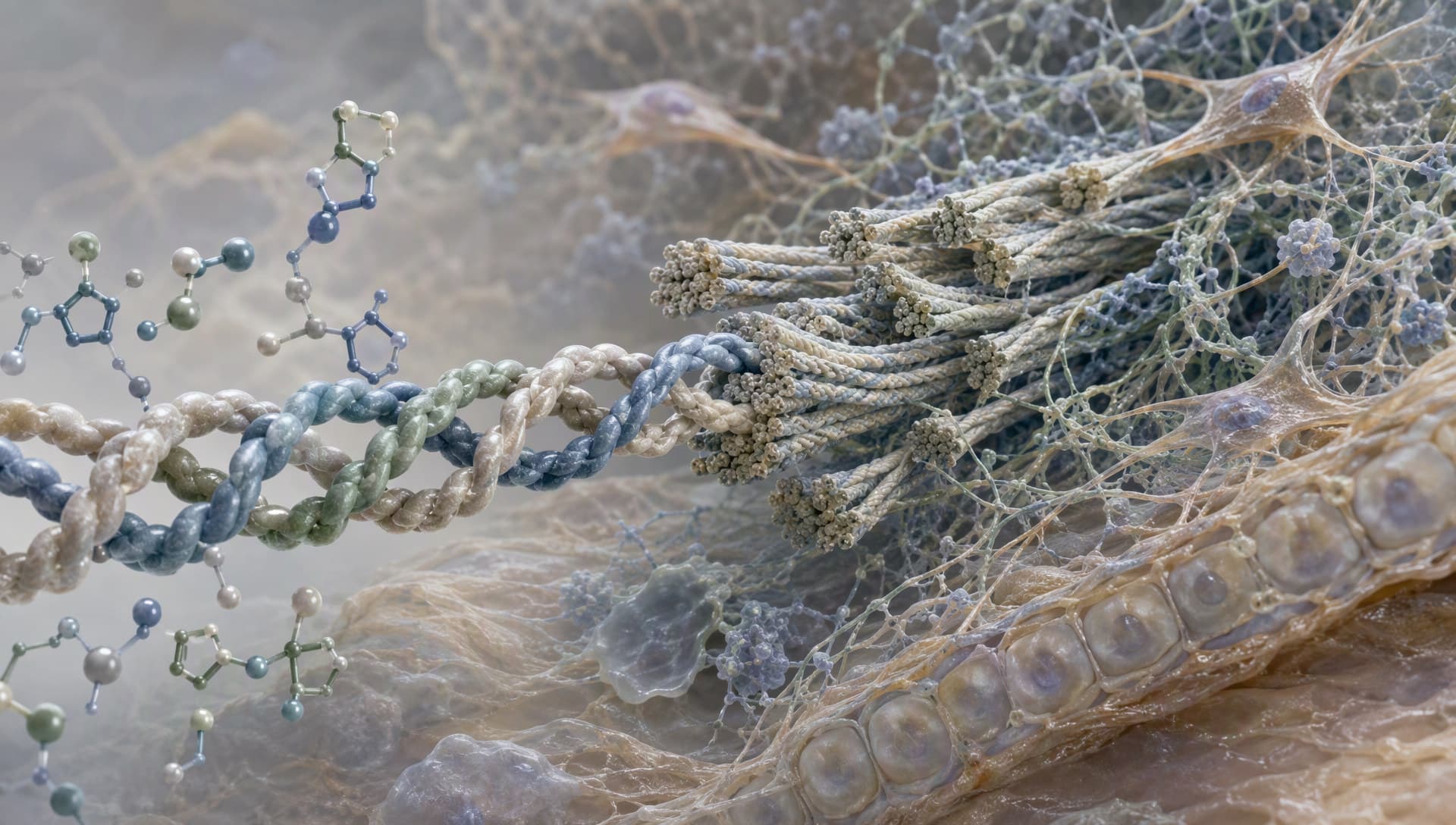
Collagen triple helix and fibril assembly hierarchy
Category: Protein science; Biomaterials; Bioprocess engineering
What is collagen, and why is one name not enough?
Collagens provide structural support within the extracellular matrix and contribute to the organization of skin, bone, cartilage, tendon, blood vessels, and many other tissue environments. Yet collagen is neither one fixed sequence nor one material state. Different family members use different chain combinations and vary in tissue distribution, molecular assembly, and structural role.
The best-known molecular feature is a triple helix formed by three polypeptide chains. Collagenous sequences often contain a Gly-X-Y repeat. Glycine is small enough to fit within the tightly packed center of the helix, while proline and hydroxyproline frequently occupy the X or Y positions and influence conformational stability. The repeated pattern is therefore not simple duplication; it is a sequence grammar that enables a particular three-dimensional architecture.
A collagen product name should prompt at least five questions. Which collagen type or collagen-like segment is present? Is the triple helix retained? Was the material extracted, hydrolyzed, or recombinantly expressed? Which processing steps were applied? Which assays establish identity, structure, and purity? Without these details, the name has limited technical value.
How does the collagen triple helix become a tissue-scale scaffold?
The triple helix is only the beginning of collagen hierarchy. After secretion, collagen molecules may undergo terminal processing, lateral association, staggered packing, and crosslinking to create fibrils, fibers, and larger networks. Tissues use different arrangements to obtain tensile strength, load distribution, cushioning, or interface support.
This hierarchy explains why identical sequence does not guarantee identical material behavior. Variations in hydroxylation, folding, terminal processing, molecular length, crosslinking, or fibril diameter can change thermal stability, protease sensitivity, solubility, and mechanical properties. Analysis should therefore extend beyond amino-acid composition to higher-order structure and assembly state.
In native biosynthesis, precursor chains are translated inside the cell and then undergo site-specific hydroxylation, partial glycosylation, chain association, and triple-helix formation before secretion and extracellular processing. Hydroxylation is not decorative; it influences helix stability and assembly. Recombinant production must therefore ask whether the selected host can support the required processing or whether additional enzymes and culture conditions are needed.
How should collagen types be selected for a structural task?
Types I, II, and III are frequently discussed because they play important roles in several connective tissues, but familiarity with a type number is not a selection strategy. Fibrillar collagens are suited to long-fiber assembly, while other collagens associate with fibril surfaces, basement membranes, or transmembrane environments. Chain composition, non-helical domains, and assembly rules determine the molecular network in which a type can participate.
For tissue research, native type and spatial localization may be the first priority. For biomaterial development, gelation, crosslinking, degradation, cell-compatible conditions, and the processing window also matter. For analytical standards or functional-segment studies, a full-length molecule may not be necessary; a well-defined collagen-like fragment may offer better control.
A purity claim cannot replace type identification. Purity asks how much of the sample is the intended component. Type identification asks what the component is. Triple-helix analysis asks whether it has acquired the expected structural state. These questions overlap, but they are not interchangeable.
What is the difference between collagen, gelatin, and collagen peptides?
Intact collagen retains long chains and a characteristic higher-order structure. Gelatin generally results from partial denaturation under heat or chemical processing, leaving chains in a more disordered state. Collagen peptides are produced through further hydrolysis and have shorter molecular lengths and different solution behavior. The three materials may share broad amino-acid composition patterns, but molecular size, conformation, assembly potential, and analytical requirements differ.
The distinction changes application decisions. Short peptides cannot simply replace intact collagen when the goal is to study triple helices, fibril assembly, or structural biomaterials. Conversely, an intact macromolecule may be unsuitable when a formulation requires a defined distribution of soluble short peptides. Similar names do not establish functional equivalence.
A material assessment can combine molecular mass or mass distribution, triple-helix signals, thermal transitions, amino-acid composition, hydroxyproline-related information, aggregation state, and lot consistency. Complex materials may also require control of residual proteins, nucleic acids, endotoxin, microbial burden, and process residues. The final analytical package should follow intended use and its applicable quality boundary.
Structural differences among intact collagen, gelatin, and collagen peptides
How does recombinant collagen production influence final structure?
Recombinant production can begin with a defined sequence and use an engineered host to build a traceable manufacturing system. Bacteria, yeast, plants, and mammalian cells are among the available hosts. They differ in expression yield, secretion, post-translational processing, protein degradation, culture cost, and scale-up behavior. No single system is universally optimal for every collagen target.
Bacterial systems can be built quickly and fermented efficiently, but they naturally lack parts of the eukaryotic processing environment. Yeast provides secretion and eukaryotic cellular machinery, yet hydroxylation patterns and host-specific modifications still require evaluation. Mammalian cells more closely reproduce complex processing but impose more demanding culture and scale-up requirements. Plant and other systems have their own tradeoffs. Route selection should work backward from target sequence, hydroxylation need, triple-helix state, intended use, and quality standard rather than expression level alone.
Structure verification should advance together with expression optimization. Higher output accompanied by misfolding, fragment accumulation, or insufficient hydroxylation may only magnify downstream purification and quality problems. A balanced development program tracks soluble expression, secretion, molecular integrity, modification state, triple-helix formation, aggregation, and purification recovery.
The MatwingsVenus®晓鹜® Bioprocess Development & Scale-Up service covers high-expression strain construction, fermentation and purification process development, and stepwise verification from laboratory to pilot scale. For a recombinant collagen program, such capabilities can support process development after host selection, while hydroxylation strategy, structural specifications, and material use still need project-specific definition.
Why collagen quality control must examine both sequence and assembly
A sample can have the expected sequence and still differ because of truncation, degradation, oxidation, incorrect modification, or incomplete assembly. Conversely, observing a fibrillar morphology does not establish sequence identity or chemical purity. Quality control therefore needs evidence spanning primary structure, higher-order structure, and material state.
At the primary level, the focus is molecular identity, chain composition, integrity, and modification sites. Higher-order assessment considers triple-helix content, thermal stability, and aggregation. Material-level tests may examine fibril formation, rheology, mechanics, degradation, or interface behavior according to intended use. Manufacturing control also addresses host-cell proteins, nucleic acids, endotoxin, medium residues, and microbial risks.
Animal-derived materials require attention to tissue origin, extraction, processing, and lot variation. Recombinant materials require control of cell banks, genetic stability, fermentation state, purification recovery, and host-derived impurities. No single metric can summarize the whole quality profile; release testing should reflect process risks.
How does a recombinant collagen development workflow reach manufacturing scale?
The variables most likely to change during scale-up include oxygen transfer, mixing, shear, temperature control, feed timing, secretion stress, and purification loading. For a protein that needs specific modifications or assembly, healthy cell growth does not guarantee correct product structure. Output and critical quality attributes must be monitored together.
The workflow input is a target sequence, structural specification, hydroxylation requirement, intended scale, and available analytical data. MatwingsVenus®晓鹜® Bioprocess Development & Scale-Up capabilities that connect high-expression strain construction, fermentation and purification process development, and stepwise verification from laboratory to pilot scale. The output should be a reusable process package containing operating ranges, sampling logic, analytical methods, deviation handling, and lot-comparison criteria rather than one successful batch.
The next step is process transfer only after the route and critical quality attributes are sufficiently controlled. At that point, the MatwingsVenus®晓鹜® Commercial-scale CDMO Manufacturing service can support scale-up manufacturing for proteins or peptides and may cover fermentation, purification, formulation, and packaging according to the agreed project scope. The exact path still depends on collagen target, host system, and quality requirements.
Recombinant collagen manufacturing and quality-control workflow
FAQ
Are collagen peptides in foods equivalent to intact collagen in tissues?
No. Collagen peptides are shorter fragments produced by hydrolysis and no longer retain the molecular length or fibril-assembly behavior of intact collagen. They may share amino-acid composition features, but their structural state and intended use differ.
Is type I, II, or III collagen inherently better?
There is no use-independent ranking. The types differ in tissue distribution, chain composition, and assembly. Selection should begin with the research or material task, then evaluate type, structural state, purity, and process compatibility.
Is recombinant collagen automatically more consistent than animal-derived collagen?
Recombinant production starts from a defined sequence and can use controlled manufacturing, but consistency still depends on cell bank control, expression stability, post-translational processing, purification, assembly, and the quality system. It offers an engineerable route, not freedom from verification.
Does more hydroxyproline always mean better collagen?
No. Hydroxyproline is important to collagen stability, but the appropriate level depends on collagen type, sequence position, triple-helix formation, and intended use. Non-target modifications and lot variation must also be excluded.
Summary
Collagen is more than a generic structural protein. It is a molecular system defined by sequence, hydroxylation, triple-helix formation, terminal processing, and hierarchical assembly. Animal extraction, gelatin production, collagen peptides, and recombinant expression represent different material states and manufacturing logics. A robust development decision begins by defining target type and structural task, then selects source and process, and finally confirms quality through primary structure, higher-order structure, impurity control, and scale-up evidence.