Why Do Biofuels Need Cellulase Cocktails? Understanding Enzyme Synergy
Published on October 14, 2026
Category: Bioenergy, Industrial Biotechnology, Biorefining, Enzyme Engineering, Fermentation Engineering
Biofuels are not one product, and they are not created simply by placing plant material in a fermenter. Ethanol, biodiesel, sustainable aviation fuel precursors, and other bio-based energy carriers follow different feedstock and conversion routes. For lignocellulosic biofuels, the core task is to open the complex plant cell wall, convert cellulose and hemicellulose into usable sugars, ferment those sugars, and recover a product with the required properties.
This sequence looks linear, but every stage changes the next. Pretreatment alters substrate architecture and may also create compounds that affect enzymes or microorganisms. Hydrolysis releases sugars but can be limited by accessibility, adsorption, or product accumulation. Fermentation strategy determines the temperature, time, and composition required from hydrolysis. Product recovery then influences the concentrations and energy tradeoffs selected upstream. Understanding biofuel production means understanding what each stage delivers to the following one.
Why Lignocellulosic Biofuels Begin with Feedstock Structure
Lignocellulosic materials generally contain cellulose, hemicellulose, lignin, and smaller fractions of other components. Cellulose chains form ordered structures, hemicellulose creates a chemically diverse polysaccharide network, and lignin is intertwined with these carbohydrates. Agricultural residues, woody materials, and other forms of biomass differ in composition, crystallinity, porosity, particle size, and impurities. A single fixed enzyme formula should not be expected to fit all of them.
Pretreatment does not need to complete every conversion. Its role is to improve enzyme access to carbohydrate substrates. Mechanical, physicochemical, or biological approaches alter particle structure, pore space, lignin distribution, and hemicellulose in different ways. Pretreatment should therefore be assessed not only by whether the solid looks disrupted, but also by sugar preservation, wash requirements, and the formation of compounds that may interfere downstream.
This stage defines the hydrolysis problem. If cellulose remains poorly exposed, adding more enzyme may have little value. If hemicellulose still covers fiber surfaces, a cellulase-only strategy may remain constrained. If pretreatment generates soluble inhibitors, the hydrolysate may need adjustment before fermentation. Composition and substrate characterization should come before enzyme selection and dosage optimization.
MatwingsVenus®(晓鹜®) capabilities in enzyme mining and protein function prediction can help organize candidate space around a defined pretreated substrate. Inputs should include biomass composition, pretreatment method, target carbohydrate bonds, temperature, and pH range. The output can prioritize expression and screening, but it cannot replace hydrolysis data from the real material.
Designing Enzymatic Hydrolysis for Biofuels through Multi-Enzyme Cooperation
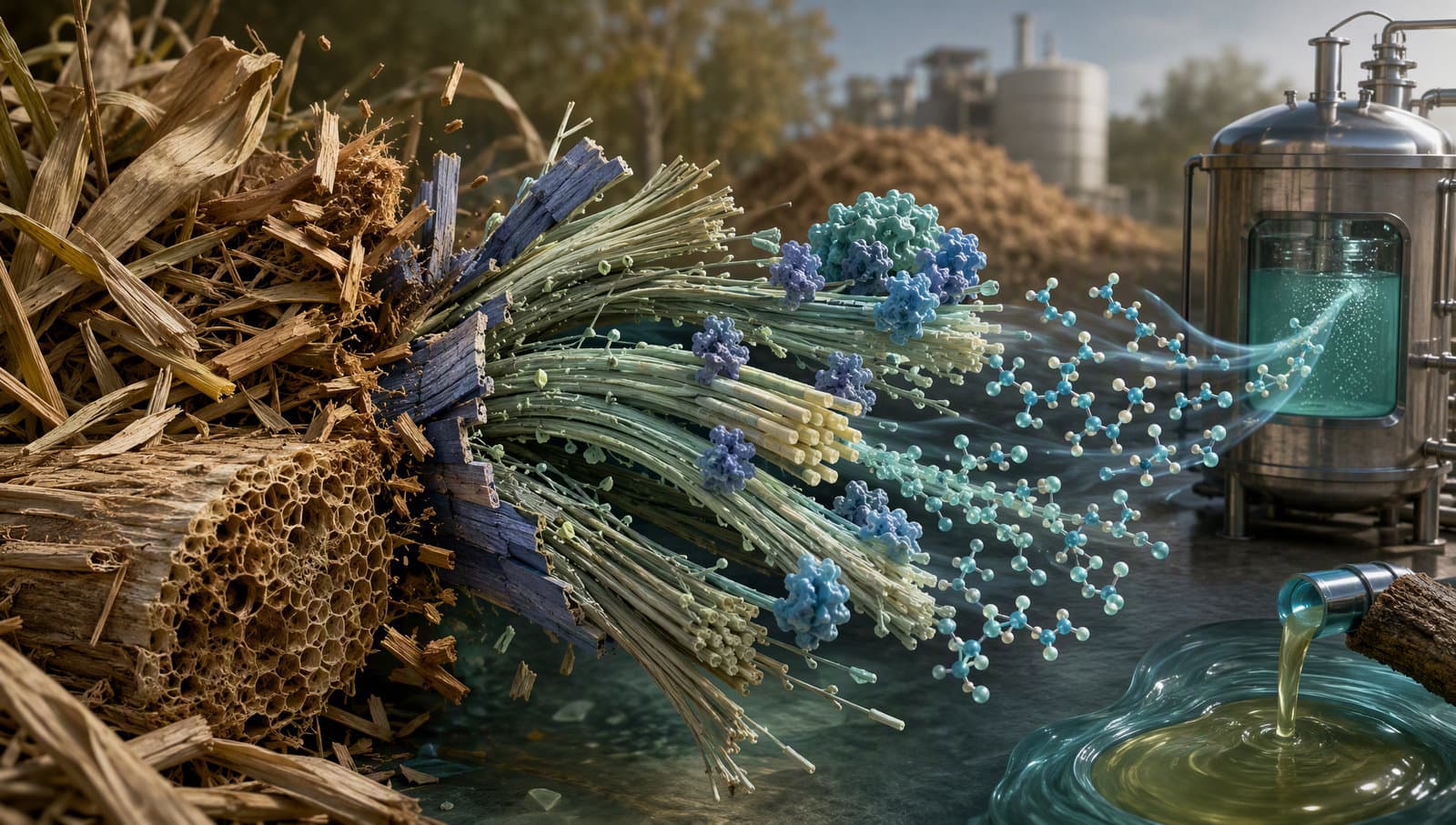
Cellulase is not one function. Endoglucanases create new accessible positions within cellulose chains. Processive chain-end enzymes release shorter products, and beta-glucosidases convert soluble fragments into glucose. Hemicellulose is more diverse and may require xylanases, mannanases, and accessory enzymes that remove branches or substitutions. The coordinated action of these components gradually reduces barriers within the plant cell-wall network.
Cellulase cocktail design is not a contest to include the largest number of enzymes. A useful mixture matches the residual structure after pretreatment while accounting for operating range, stability, adsorption, and product inhibition. A missing component may create a bottleneck; excessive dosing of another component can increase cost with little additional sugar release. Evaluation should compare total sugar, monomer composition, residual solids, and enzyme input rather than relying on activity against one standard substrate.
Accessory proteins and oxidative enzymes may have value for selected materials, but their usefulness depends on surface structure, oxygen conditions, and compatibility with the main cocktail. Feedstock variation can also disrupt a previously suitable ratio. A practical workflow first identifies the dominant limitation with a compact enzyme set, then adds candidates around that bottleneck instead of starting with an oversized formulation matrix.

Cellulase cocktail design coordinating enzymes to release fermentable sugars
Protein design, function prediction, and protein engineering through MatwingsVenus®(晓鹜®) can support candidate discovery, functional analysis, and variant prioritization. The purpose is not to declare a best cocktail computationally, but to establish a clearer order for experimental screening.
How Hydrolysis Conditions Shape Fermentable Sugar Release
Hydrolysis requires a joint view of solids loading, enzyme dose, temperature, pH, mixing, reaction time, and product accumulation. Higher solids can increase sugar concentration but also raise viscosity, weaken mixing, and intensify transport limitations. More time may release additional sugar while increasing catalyst decay, contamination risk, and equipment occupancy. The highest conversion percentage is not automatically the best manufacturing condition.
Sampling and analytics should explain where sugars come from and where conversion slows. In addition to glucose, the program may need to track xylose and other monomers, oligomers, soluble by-products, and residual polysaccharides. If sugar release rises quickly and then plateaus, possible causes include enzyme deactivation, product inhibition, loss of accessible sites, nonproductive adsorption, or inadequate mixing. Each cause requires a different response.
Enzyme recovery and reuse are sometimes proposed to reduce input, but free enzymes can interact with solids, lignin, and dissolved components. Immobilization may simplify separation while introducing new transport and carrier costs. A recovery strategy should be judged by retained activity, recovery effort, compatibility with the next feedstock batch, and total economics.
The hydrolysate is also a fermentation feed, not merely a sugar result. Its pH, salts, residual enzymes, soluble aromatic compounds, and pretreatment by-products can influence the production organism. Hydrolysis optimization should include fermentation compatibility early enough to avoid improving sugar release while weakening downstream conversion.
Choosing Separate Hydrolysis, Simultaneous Saccharification, or Consolidated Bioprocessing
Separate hydrolysis and fermentation place enzymatic conversion and microbial production in distinct stages. Conditions can be optimized and measured independently, making bottlenecks easier to locate. However, soluble sugars can accumulate during hydrolysis, and additional equipment or transfers can add time and operating effort.
Simultaneous saccharification and fermentation releases and consumes sugars in one system. Rapid sugar use may reduce some accumulation effects, but the preferred temperature, pH, and nutrient conditions of enzymes and microorganisms may not match. The operating window becomes a compromise rather than the optimum for either biological component. Inoculation timing, enzyme addition, solids loading, and mixing need to be coordinated.
Consolidated bioprocessing goes further by integrating enzyme production, substrate hydrolysis, and fermentation in one organism, microbial partnership, or tightly linked process. It may reduce externally supplied enzyme and unit-operation complexity. At the same time, the biological system must combine enzyme secretion, substrate utilization, product formation, and process tolerance. Competition among these functions and condition compatibility remain major engineering questions.

Biofuel fermentation connecting hydrolysis, microbial conversion, and recovery
None of these arrangements is universally superior. Separate processing can be useful when a project needs clear diagnosis of hydrolysis and fermentation. A simultaneous configuration may be evaluated when sugar accumulation limits hydrolysis. Consolidated processing demands confidence in host performance, enzyme coverage, and long-term stability. Feedstock, product, equipment, and development stage should determine the choice.
Why Biofuel Fermentation Must Address Mixed Sugars and Inhibitors
A lignocellulosic hydrolysate often contains more than glucose. Sugars released from hemicellulose, oligomers, and compounds formed during pretreatment shape the fermentation environment together. If an organism efficiently consumes only part of the sugar mixture, residual carbon affects feedstock utilization. Differences in sugar-use order or regulation can also change fermentation time and residual composition.
Inhibitor management should not be reduced to removing every soluble compound. Intensive washing or purification can lose sugars, increase water use, and complicate the process. Teams should first identify the components that meaningfully affect the enzyme or organism, then compare pretreatment adjustment, washing, adsorption, nutrient support, tolerant strains, or staged feeding.
Fermentation evaluation should cover product formation, sugar consumption, cell state, major by-products, and time-course behavior. Endpoint concentration without dynamics cannot reveal whether the dominant limitation is sugar release, substrate use, inhibitor exposure, or product tolerance. Repeated or continuous systems also require contamination control, genetic stability, and run-to-run consistency.
Evaluating Biofuels beyond a Single Yield Number
A biofuel route must be assessed across feedstock, enzyme, microorganism, equipment, and recovery. High sugar release may be unattractive if it requires excessive enzyme. A concentrated fermentation may merely transfer complexity to purification. A fast reaction can still reduce overall productivity if cleaning and turnaround are frequent.
A connected metric set can include fermentable sugar per unit feedstock, enzyme input, reaction time, solids loading, fermentation conversion, residual sugars, by-products, product recovery, and energy demand. Early development does not require every metric to be maximized, but comparisons must use the same boundary. Otherwise, formulation, strain, and process teams can optimize separate targets that cancel one another.
Product recovery should enter the conversation early. Product concentration, volatility, water interaction, and impurity profile influence whether distillation, extraction, membranes, or another operation is appropriate. Hydrolysis and fermentation choices should serve a recoverable final product rather than stop at the fermenter outlet.
How MatwingsVenus®(晓鹜®)Supports Enzyme Development for Biofuels
Biofuel enzyme programs face a large candidate space, variable feedstocks, and many experimental combinations. MatwingsVenus®(晓鹜®) can organize upstream support around enzyme mining, protein function prediction, protein design, directed evolution, and protein engineering.
The development brief should be specific to material and process: feedstock type, pretreatment, the gap in the current cocktail, temperature, pH, solids loading, and observed inhibition. These capabilities can support candidate organization, functional analysis, and variant prioritization. Expression, real-substrate hydrolysis, cocktail formulation, fermentation compatibility, and scale-up still follow.
A useful workflow sends experimental data back into prioritization. Sugar profiles, residual solids, activity decay, and fermentation performance can update the next candidate set. This computational organization–experimental validation loop is what allows improvement in one enzyme to become relevant to the complete biofuel process.
FAQ
Are biofuels the same as bioethanol?
No. Bioethanol is one important type, while biofuels also include other liquid and gaseous routes. This article emphasizes lignocellulosic hydrolysis and fermentation because they clearly show the connection between enzyme engineering and process integration.
Does more cellulase always release more sugar?
No. Increasing dosage may help within a range, but substrate accessibility, cocktail balance, product inhibition, nonproductive adsorption, and mixing can become dominant constraints.
Is simultaneous saccharification always better than separate processing?
No. Simultaneous processing may reduce sugar accumulation but must reconcile enzyme and microorganism conditions. Separate processing is easier to optimize and diagnose stage by stage.
Does consolidated bioprocessing eliminate the need for enzyme engineering?
No. It still requires suitable enzyme secretion, substrate deconstruction, sugar use, product formation, and process tolerance. Coordination between enzymes and the production host becomes even more important.
Can computational design produce the optimal biofuel enzyme cocktail directly?
No. Computation can assist candidate discovery, functional analysis, and variant prioritization. The best mixture must be established experimentally with the specific pretreated material and fermentation system.
Conclusion
Moving biomass into biofuels requires coordinated progress across feedstock structure, pretreatment, enzyme synergy, hydrolysis conditions, fermentation compatibility, and product recovery. The central goal is not to maximize one stage but to make each stage deliver the right input to the next. MatwingsVenus®(晓鹜®) capabilities in enzyme mining, function prediction, directed evolution, and protein engineering can support candidate selection and experiment ordering. Process conclusions still depend on real feedstock, complete workflow tests, and consistent evaluation boundaries.