How AI Enzyme Engineering Turns Assay Data into Better Designs
Published on October 14, 2026
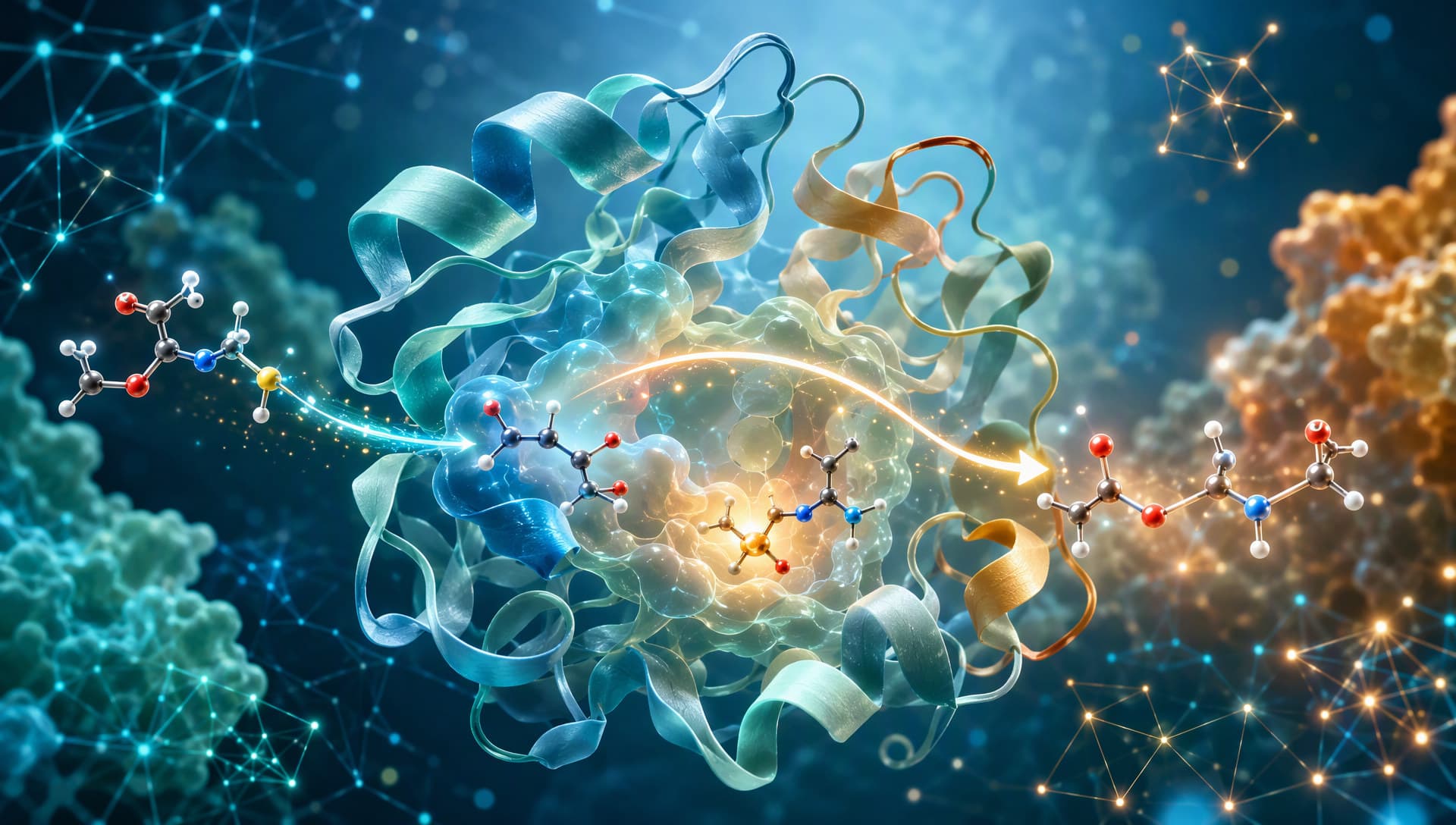
Active-site chemistry and data jointly define the engineering direction
Category: Protein Engineering and Biocatalysis
When researchers seek higher catalytic activity, thermal stability, substrate selectivity, or expression, generating mutations is rarely the hardest part. The real challenge is defining a comparable assay endpoint, protecting catalytic residues, controlling the combinatorial search space, and ensuring that every experiment informs the next decision. AI enzyme engineering creates a traceable and testable path across those decisions rather than producing high-scoring sequences detached from experimental context.
AI Enzyme Engineering Starts with the Assay Question
A single enzyme project may involve activity, stability, selectivity, solubility, and expression, but these properties do not always improve together. If the brief says only “improve performance,” a model has no precise endpoint to learn. If different assay batches use different substrate concentrations, temperatures, or reaction times, their labels may not be directly comparable.
The project should therefore begin with a measurable task definition: substrate and product, reaction conditions, wild-type baseline, primary metric, acceptable losses in secondary metrics, and catalytic features that must remain intact. AI first helps narrow the question. It turns a broad ambition into a target that sequence–function learning can address instead of expanding a mutation library before success has been defined.
Machine-learning-guided protein engineering learns a relationship between sequence and function from characterized variants, then prioritizes candidates that are more informative or more likely to meet the chosen objective. This is why data quality can matter more than raw library size. Assay noise, batch effects, and missing negative results all reshape the landscape visible to the model.
Treat the Enzyme as a Constrained Reaction System
An enzyme is not a string of interchangeable letters. Catalytic residues, access tunnels, metal-coordination sites, conformational switches, and the structural core are coupled. A substitution far from the active site may still alter catalysis through stability or dynamics. AI enzyme engineering therefore needs a constraint map before it asks which positions to explore.
MatwingsVenus®(晓鹜®)uses a retrieval-first workflow. It starts with protein identity, known variants, wild-type kinetic baselines, and available functional annotations. A raw sequence is identified before downstream analysis. VenusX can then map active, binding, and evolutionarily conserved residues so that high-risk regions become protected constraints for design. Existing records are labeled Measured, computational estimates are labeled Predicted, and gaps remain Unknown, preventing evidence with different confidence levels from being blended together.
This stage does not claim to deliver a final variant. It reduces directional mistakes. Researchers can distinguish positions suitable for conservative exploration, regions where activity and stability may trade off, and hypotheses that require structural or experimental validation.

Sequence, structure, and functional constraints compress the candidate space
How MatwingsVenus®(晓鹜®)Selects a Route for the Available Data
There is no single algorithm for every AI enzyme engineering project. MatwingsVenus®(晓鹜®)separates the work into routes so that the question and input conditions determine the tool.
When project-specific assay data are scarce, begin with bounded candidate screening. VenusREM evaluates potential single-mutation effects on activity, binding, stability, or expression; its higher-precision mode requires a PDB structure. The output is a Predicted ranking for experimental prioritization, not a measured result. Single substitutions can reveal sensitive positions and shape a small first-round library, but they do not establish the behavior of multi-mutation combinations.
When several candidate positions are known, model combinations rather than adding scores. VenusPrime takes a sequence and selected sites and supports train and inference modes. When wet-lab data are available, a model can be trained before combinations are inferred for combinatorial library design.
When systematic assay data have accumulated, move into active learning. ALDE supports iterative directed evolution and requires a wild type, no more than seven positions, and an experimental CSV, TSV, or Excel file. Each cycle uses new measurements to select the next set. Experiments are therefore not merely a final acceptance test; they are inputs to continued learning.
These compute-intensive tasks pass through HITL confirmation in MatwingsVenus®(晓鹜®). Before execution, the intended task, inputs, and expected outputs are presented for approval or adjustment. Human review keeps project knowledge in control of the computational route and prevents scale from being applied automatically to a poorly specified objective.
Experimental Feedback Should Explain, Not Merely Score
A candidate may lose activity because of poor expression, compromised folding, altered substrate binding, or disrupted catalytic geometry. A binary success/failure label gives the next model little information. More reusable assays record the primary metric alongside expression, stability, conversion, selectivity, and critical reaction conditions, making outcomes decomposable and comparable.
The research loop described by MatwingsVenus®(晓鹜®)can connect computational candidates with services such as gene synthesis, protein-expression validation, and protein purification. The value of this handoff is not an automatic promise of experimental success. It is the reduction of information gaps among candidates, files, and assays. Predictions still require validation, and failed candidates should return to the dataset because they define regions the model should avoid.

Model updates and assay feedback guide each new selection cycle
Build an Executable AI Enzyme Engineering Loop
The workflow can now be assembled into a clear cadence. Freeze a measurable objective and wild-type baseline. Retrieve existing evidence and map functional residues. Choose single-mutation screening, combination modeling, or active learning according to the available data. Confirm compute-intensive tasks at the HITL gate. Validate candidates with layered readouts and return the results to the next cycle.
The advantage of this loop is not the number of sequences predicted in one pass. It is the traceable rationale retained after every round. A low-data project should initially maximize information gain by covering distinct positions and mechanistic hypotheses. A data-rich project can increase local search density while reserving a small number of diverse candidates to keep the model from collapsing too early into one sequence neighborhood.
The same logic offers a practical way to evaluate an AI enzyme engineering platform. Does it distinguish measured evidence from predictions? Does it protect functional sites? Can it switch modeling routes according to data availability? Is human confirmation required before heavy computation? Can assay results become inputs to the next round? These questions reveal more about research efficiency than candidate count alone.
Make Every Experiment an Asset for the Next Design
AI enzyme engineering is not a one-click route to a finished enzyme. It is an engineering method for organizing objectives, evidence, models, and experiments. MatwingsVenus®(晓鹜®)places retrieval-first evidence gathering, VenusX site mapping, VenusREM single-mutation prediction, VenusPrime combination modeling, ALDE active learning, and HITL approval in one traceable decision chain.
A team preparing to begin can first assemble the target sequence, available structure, wild-type assay baseline, optimization metrics, and existing variant data. Those inputs make it possible to choose a defensible first task. Computation then stops running in parallel with experiments and starts helping each round ask a sharper question and select more informative candidates.