Protein Function Classification: Is One Label Ever Enough?
Published on October 13, 2026
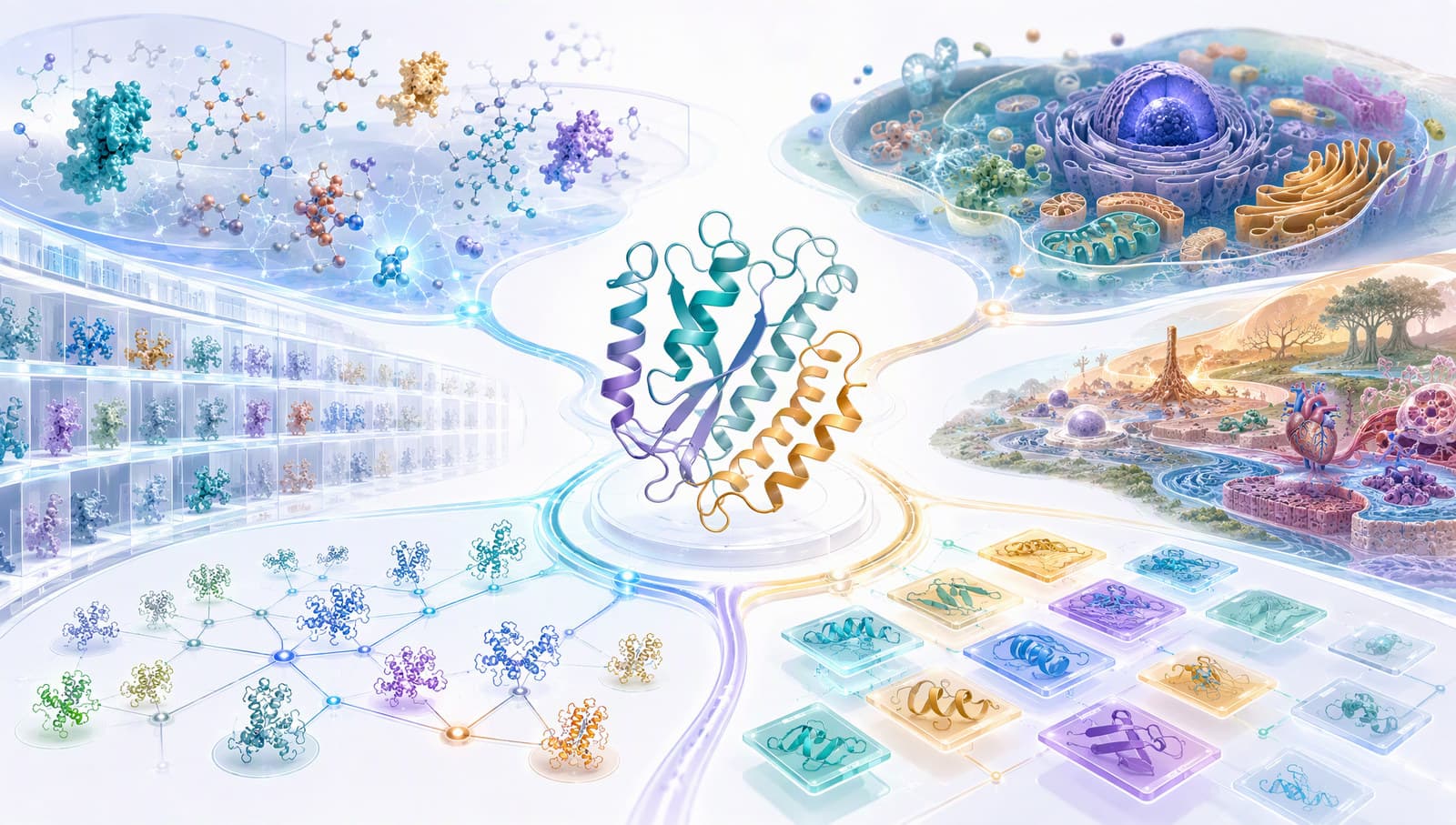
A multidimensional map places one protein in its full functional context
Protein function classification often begins with a deceptively simple question: “What kind of protein is this?” Yet the question quietly combines several others: What molecular action can the protein perform? Which larger process does it support? Where does it act? Which family does it belong to? Which domains or residues carry the relevant capability? Compressing all of those questions into one label discards information and can send downstream experiments in the wrong direction.
How MatwingsVenus®(晓鹜®)Supports the Classification Workflow
The platform can connect identity checks, database retrieval, sequence analysis, structural clues, and validation planning without presenting computation as experimental proof. Users can state the research object and classification goal in natural language, then decide—based on existing evidence—whether to enter prediction steps that require HITL confirmation. The sections below follow this retrieval-first, evidence-layered logic.
Why Protein Function Classification Is Inherently Multi-Axis
“Function” is not a flat property. Gene Ontology, for example, organizes knowledge through molecular function, biological process, and cellular component. Molecular function describes an activity performed by a gene product. Biological process places that activity within a larger event. Cellular component indicates the cellular context in which the activity occurs. These views complement one another, but they are not interchangeable.
Other systems answer different questions. Protein family classification emphasizes ancestry and sequence relationships. Domain annotation identifies modular regions that may fold or operate semi-independently. EC classification describes enzyme-catalyzed reactions. Functional-site analysis moves to the residue level. A protein can therefore carry several valid labels at once, each with its own scope.
This is why robust protein function classification should be multi-label and hierarchical. Multiple labels do not indicate indecision. They preserve the actual architecture of biological knowledge and prevent one kind of evidence from being mistaken for another.
Confirm Identity Before Interpreting Function
Classification should begin with the object itself. A shared protein name does not guarantee the same species, isoform, or sequence boundary. A truncated sequence may omit a targeting signal or regulatory domain. At minimum, analysts should inspect organism, isoform, sequence completeness, domain boundaries, signal peptides, transmembrane regions, and other context-setting features.
For an unlabeled sequence, identification should precede protein function classification. MatwingsVenus®(晓鹜®)connects conversational requests with protein sequence analysis and database retrieval, helping users establish what the object is and which records already exist before deciding whether structural or functional computation is needed. This retrieval-first order reduces the risk of treating similar names as identical biological entities.
Granularity matters as well. If the evidence supports only “nucleic-acid binding,” it should not be expanded into a specific regulatory mechanism. If one domain is recognized, its local capability should not automatically be assigned to the entire protein. The resolution of the label should match the resolution of the evidence.
Five Evidence Streams That Should Converge
Reliable interpretation rarely comes from one hit. It emerges when several evidence streams agree—or when their disagreement is made explicit.
Sequence relationships provide a starting point. Close homologs, orthologs, and conserved motifs can narrow the search space. Similarity, however, is not identity of function. Paralog divergence, domain rearrangement, or changes at a few critical residues can alter biological roles.
Domain architecture explains modular capability. Two proteins may share one domain while differing elsewhere. Domain evidence can support a local activity or family assignment, but it should not automatically be elevated into a complete mechanism.
Three-dimensional structure adds spatial constraints. Fold similarity, pocket geometry, and the arrangement of residues can reveal distant relationships that sequence analysis misses. Structural resemblance indicates a plausible physical basis; by itself, it does not prove the role played inside a cell.
Functional sites connect mechanism to experiments. Predicted active, binding, or conserved residues can turn a broad classification into testable hypotheses. MatwingsVenus®(晓鹜®)supports functional-site and selected protein-property predictions. These compute-intensive steps require HITL confirmation, should be labeled Predicted, and should lead to appropriate activity, binding, or mutational validation.
Database records establish known context. GO annotations, EC numbers, subcellular location, interactions, and pathways are retrieval targets rather than claims that should be presented as direct model predictions. MatwingsVenus®(晓鹜®)can organize searches across relevant data resources while preserving the source object and evidence type.

Evidence streams converge into measured, predicted, and unknown layers
Keep Measured, Predicted, and Unknown Separate
Evidence labels determine how a conclusion can be used. A result directly established for the query protein can be treated as Measured. A conclusion inferred from homology, structural similarity, or a computational model belongs under Predicted. A property that current evidence cannot resolve should remain Unknown.
One of the most consequential errors is to treat an experimentally validated annotation on a source protein as direct validation of the query protein. The experiment directly supports the measured object. Once the annotation is transferred to another protein—even a highly similar one—an inferential step has been introduced. The transferred claim should remain Predicted until the query protein receives direct experimental support.
Unknown is not an empty result. It identifies the break in the evidence chain and helps select the next action: verify sequence boundaries, find a closer homolog, obtain structural information, inspect key residues, or design a wet-lab assay. Preserving uncertainty can save more time than producing an unjustifiably precise label.
A Reusable Decision Path for Protein Function Classification
A practical workflow can follow four stages: identity, retrieval, integration, and validation. First establish the protein entity and sequence version. Next retrieve family, domain, GO, EC, localization, and structural records. Then test whether sequence, structure, functional sites, and biological context tell a coherent story. Finally, report conclusions in Measured, Predicted, and Unknown layers and translate important uncertainties into validation tasks.
MatwingsVenus®(晓鹜®)can support the information flow across this chain. Users can initiate database searches in natural language, add sequence analysis and structural prediction when appropriate, and request functional-site computation after confirmation. The purpose is not to compress every question into a single score, but to make evidence from different sources and confidence levels easier to compare.
For an R&D team, the useful deliverable is not merely a category name. It should state the classification axis, label resolution, evidence object, evidence level, conflicts, and recommended next experiment. That format supports candidate prioritization, experimental planning, and communication across disciplines.

A retrieval-first workflow moves classification toward testable conclusions
How to Judge Whether a Classification Is Trustworthy
A compact quality check asks four questions. Does the result distinguish family, domain, molecular function, and biological process? Does it state whether a conclusion applies to the full protein or only a region? Does it separate experimental records from computational inference? Does it preserve unresolved points and propose a route to validation?
If the answer is yes across all four, the classification can become a defensible starting point for research. If not, even an impressive-looking collection of labels may simply hide uncertainty.
The best protein function classification does not try to say everything in one phrase. It gives every label a coordinate, every claim a boundary, and every unknown a next step. By connecting retrieval, sequence, structure, and prediction within MatwingsVenus®(晓鹜®), researchers can build a clearer evidence map and hand computational hypotheses to experimental validation with appropriate caution.