How Protein Active Site Analysis Reveals Catalytic Mechanisms
Published on October 8, 2026
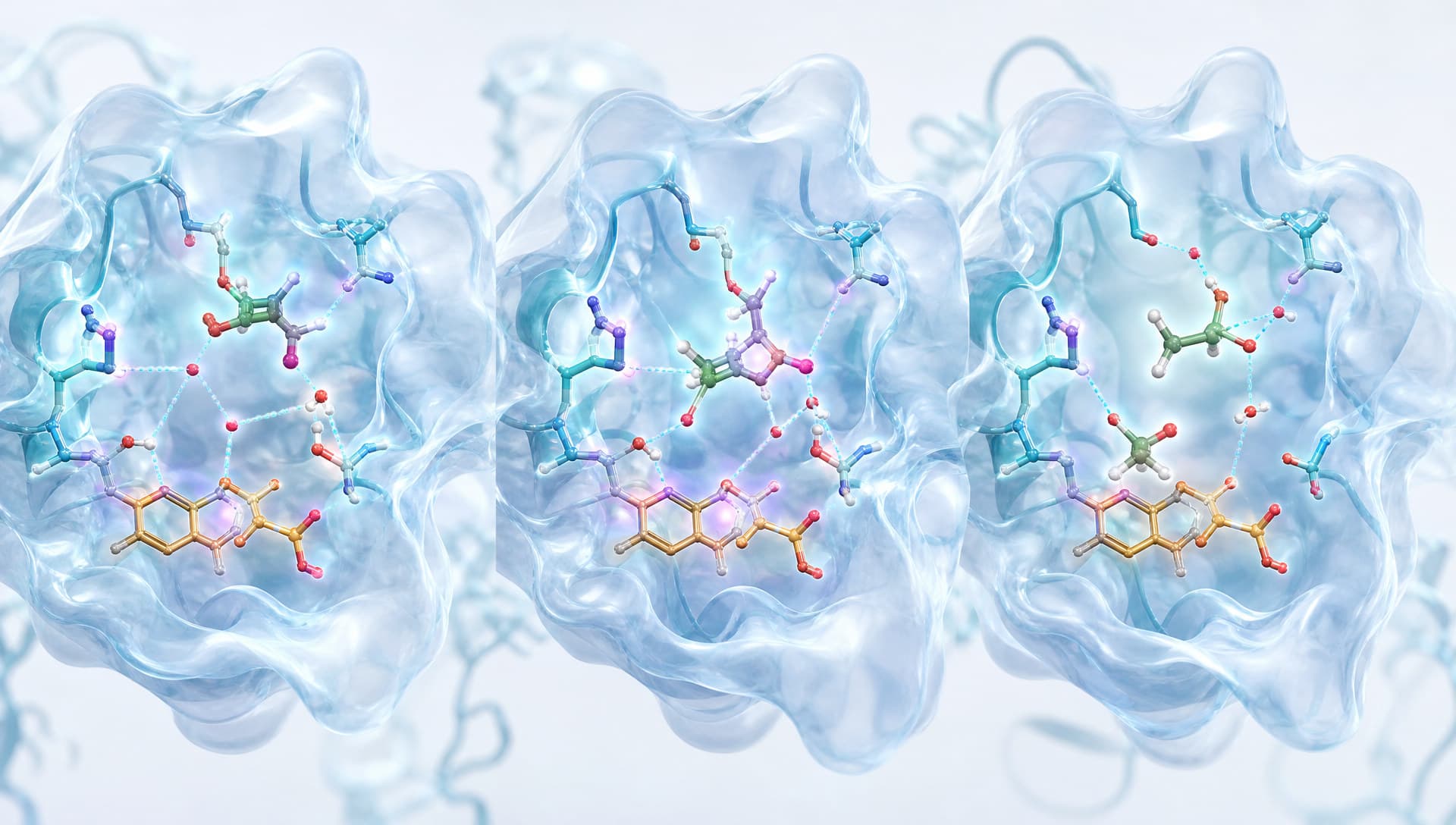
Residues, cofactors, and water create the catalytic microenvironment
A fast and selective enzymatic reaction rarely depends on one residue acting alone. Substrate positioning, acid–base chemistry, nucleophilic attack, charge stabilization, cofactor participation, and conformational coordination work together. The real purpose of protein active site analysis is therefore not to color one region of a 3D structure. It is to explain which atoms and residues cooperate under defined conditions, how they facilitate a reaction, and how experiments can separate catalytic effects from ordinary binding.
Protein active site analysis is not a search for the deepest cavity
An active center often lies in a region that accommodates a substrate, but geometry is only the beginning. A pocket may recognize and hold a molecule without performing the chemical transformation. A binding residue may affect affinity without breaking a bond, forming a bond, or transferring a proton. By contrast, a small number of catalytic residues can control a reaction through precise distance, orientation, and local electrostatics.
This distinction changes the research question. A search for a possible binding location emphasizes contact and complementarity. A study of enzymatic activity must continue: Which residue positions the substrate? Which group donates or accepts a proton? What stabilizes charge in the transition state? Does a metal or organic cofactor participate? Do ordered water molecules form a relay? Protein active site analysis focuses on the division of labor among these elements rather than a single site score.
Inputs should therefore be organized around the reaction. In addition to sequence and structure, a useful task includes substrate, product, reaction type, relevant pH and temperature, and any available kinetic or mutation data. Without that context, a model may nominate residues, but it cannot provide a well-grounded mechanistic explanation.
Curated mechanisms bring the analysis closer to the real question
Authoritative resources may already connect an enzyme or its homologs with catalytic residues, cofactors, and stepwise reaction mechanisms. Retrieving this information first reveals which conclusions are experimentally supported, which are transferred from homology, and which parts of the mechanism remain unresolved. An unannotated sequence should also be identified before mechanism transfer is attempted.
A curated mechanism provides more than residue numbers. It assigns residues to chemical steps. A side chain may act as a base early in the cycle and later require proton restoration. A metal may stabilize negative charge or position the substrate in a reactive conformation. Connecting location with a reaction step turns a static coordinate into a testable model.
When authoritative annotation is insufficient, computational protein active site analysis becomes a reasonable next layer. Its outputs should remain candidates, with uncertainty from structural quality, homology, and reaction conditions kept visible.
Protein active site analysis must capture residue cooperation
A catalytic center resembles a small coordinated team rather than a single switch. Around residues directly involved in chemistry, a second shell may position the substrate, tune acidity, arrange water, or preserve a productive conformation. A peripheral mutation can alter catalysis even without touching the substrate if it changes the orientation or microenvironment of a catalytic group.
Structural analysis can test whether candidate residues occupy plausible positions. Sequence conservation can reveal functional constraint. Homologous mechanisms can suggest possible roles, and kinetic measurements can distinguish different effects. A decrease in total activity may reflect a slower chemical step, weaker substrate binding, reduced stability, or lower expression. One endpoint rarely separates these explanations.
Cofactors and water molecules should not be treated as decoration. Metals, nucleotide-like cofactors, and other small molecules may carry electrons or chemical groups directly. Ordered waters may complete a proton pathway. Their positions, coordination patterns, and experimental conditions belong in the analysis alongside the protein chain.

Proton and electron relays reveal cooperation inside the active center
Mutagenesis should measure catalysis, binding, and integrity separately
Site-directed mutation is a powerful test of a mechanistic hypothesis, but lower activity after mutation does not automatically prove direct catalytic participation. A change can weaken substrate binding, disrupt folding, reduce expression, or alter oligomerization. In one specific enzyme system, some catalytic-site mutants retained a degree of substrate-binding ability while showing a marked reduction in catalytic activity. This example supports measuring binding and catalysis independently, but its effect size should not be generalized to other proteins.
An interpretable validation plan combines several readouts. Activity or kinetic measurements probe reaction efficiency; binding assays test substrate recognition; expression and purification control for yield; and structural-integrity or stability measurements determine whether the mutant remains comparable with the original protein. Conservative substitutions, nonconservative substitutions, and remote controls are often more informative than a single destructive mutation.
Evidence status should remain explicit. Database measurements and published experiments can be labeled Measured, computational active-site candidates Predicted, and unresolved steps Unknown. These labels distinguish a validated mechanism from a plausible model and from a gap that still requires evidence.
MatwingsVenus™(晓鹜™)turns active-site predictions into validation tasks
MatwingsVenus™(晓鹜™) publicly provides capabilities related to database retrieval, protein sequence analysis, structure prediction, functional reasoning, and protein engineering, organized through conversational bioinformatics workflows. For an active-site question, the platform can first clarify protein identity and the target reaction, retrieve available structural, functional, and kinetic evidence, and then determine whether prediction is necessary.
When authoritative resources are insufficient and the user explicitly chooses to proceed, VenusX in MatwingsVenus™(晓鹜™) can perform residue-level active-site prediction. The results are presented as Predicted and accompanied by validation recommendations rather than described as a confirmed mechanism.
Protein active site analysis can also inform engineering. High-confidence catalytic residues and essential supporting networks can become protected “do-not-touch” regions, allowing stability or expression optimization to avoid core function. When activity itself is the engineering target, second-shell residues and the local microenvironment can define a more controlled candidate space for physical evaluation and wet-lab testing. MatwingsVenus™(晓鹜™) therefore connects site identification, evidence interpretation, and engineering decisions in a traceable task chain.

Multiple readouts separate catalytic loss from structural failure
A credible conclusion answers three levels of questions
First: where is it? The candidate residue must be placed in a structural environment relative to the substrate, cofactor, and relevant water molecules.
Second: what does it do? Its proposed role may involve substrate positioning, proton transfer, charge stabilization, or maintenance of a catalytic conformation. That role should map to a reaction step rather than stop at the word “important.”
Third: how can it be falsified? Which kinetic, binding, or structural readouts should change after mutation, and which observation would reject the current hypothesis? Once this question is answerable, computation has become an experimental design.
Conclusion: move from a coordinate to a testable mechanism
The value of protein active site analysis lies in organizing catalytic residues, substrates, cofactors, microenvironments, and conditions into a reaction model that experiments can challenge. MatwingsVenus™(晓鹜™) combines retrieval-first reasoning, explicit evidence status, and residue-level active-site prediction to connect candidate positions with validation and protein engineering. Instead of asking only where the active center is, begin with the reaction and available data—and require each candidate residue to carry a proposed role, an evidence level, and a next experiment.