What Should a Molecular Dynamics Comparison Before and After Protein Mutation Reveal?
Published on October 12, 2026
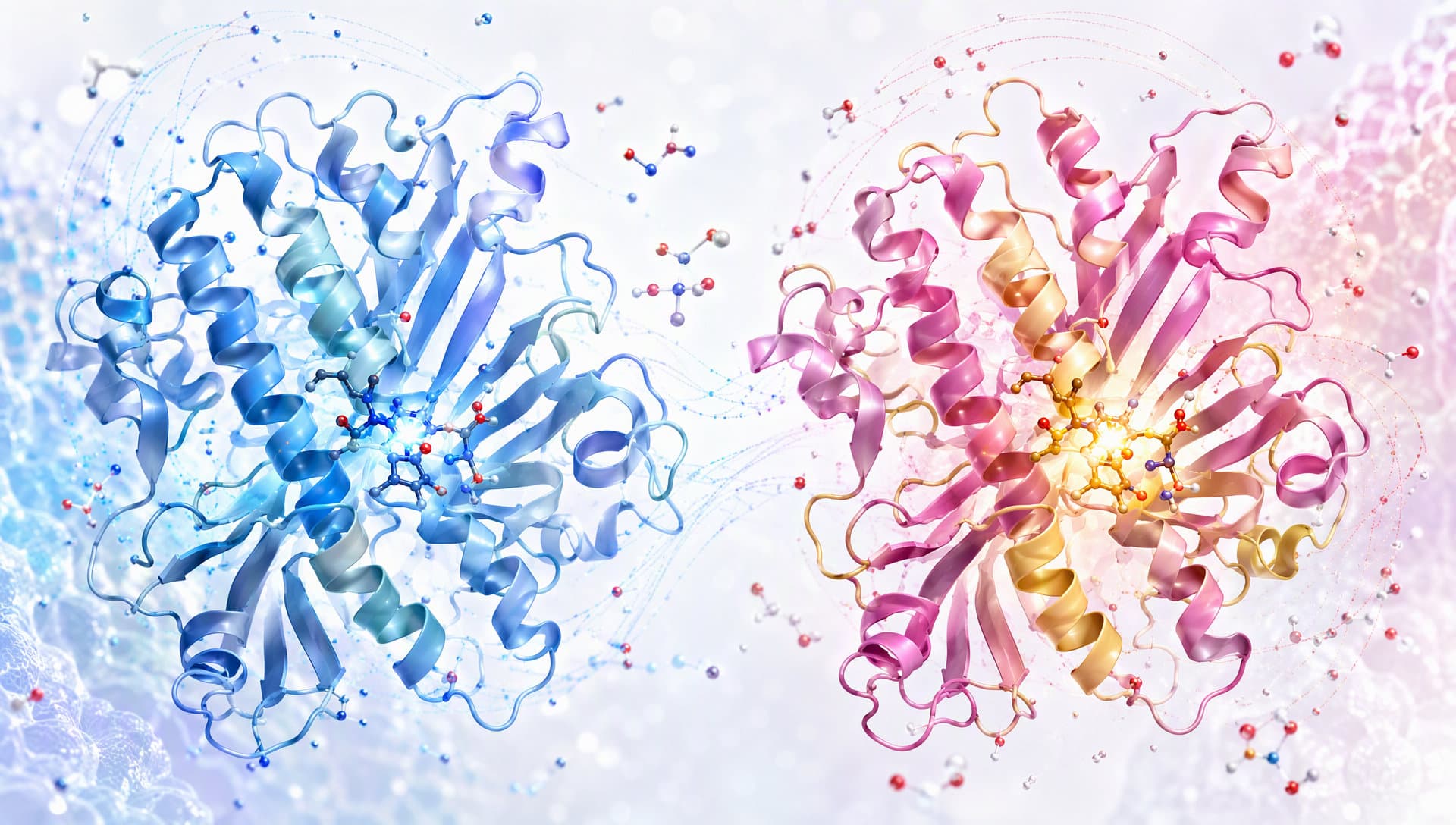
The goal is not to find a different curve, but to explain a relevant difference
In enzyme optimization, antibody engineering, thermal-stability screening, and resistance research, a mutant may look nearly unchanged in a static structure while displaying altered flexibility, contact patterns, or conformational populations over time. This is where a molecular dynamics comparison before and after protein mutation becomes valuable: it shows how an atomic system explores conformational space and whether the resulting changes affect regions connected to the engineering objective.
That value is easily overstated. “The mutant has a lower RMSD, so it is more stable” is not a sufficient conclusion. RMSD describes the overall deviation of a selected atom group from a reference structure, whereas RMSF describes the fluctuation of individual residues around their average positions. The first helps track global displacement and apparent plateaus; the second helps locate local mobility. Neither metric alone proves thermodynamic stability, stronger binding, or improved function.
A decision-relevant analysis must return to the biological question. Did the mutation stabilize the intended domain? Did it reshape motions around a catalytic or binding pocket? Were key geometric relationships preserved? Did a distant substitution alter an allosteric pathway? These questions determine which measurements matter and prevent a generic dashboard from replacing scientific interpretation.
How Does a Molecular Dynamics Comparison Before and After Protein Mutation Stay Comparable?
A credible molecular dynamics comparison before and after protein mutation begins with matched preparation and analysis conditions. Protonation states, missing-residue treatment, ligand parameters, force field, water model, ion concentration, box dimensions, minimization, and equilibration should be consistent and traceable. Production runs should use equivalent durations and output frequencies. During analysis, periodic-boundary treatment, fitting atoms, reference structures, calculated atom groups, and time windows must also be aligned. Otherwise, an apparently smoother trajectory may reflect preprocessing rather than mutation biology.
A single trajectory should not be treated as a replicate experiment. Different initial velocities can lead nominally identical systems into different conformational basins. A stronger design uses multiple independent runs for both wild type and mutant, then asks whether the effect direction persists. If the difference between variants is smaller than the variation among replicates, the result should not be promoted as a defined mechanism. If the same pattern survives independent seeds and reasonable analysis windows, it becomes a stronger candidate for validation.
At this stage, MatwingsVenus®(晓鹜®)can help structure the upstream task. Protein identity, available structures, known variants, and functional annotations can be checked across resources such as UniProt and PDB before heavy computation begins. Measured information can be kept distinct from predicted results, while a user approval gate for computationally intensive steps provides an opportunity to review inputs, parameters, and expected outputs before a long simulation is launched.
Integrated metrics separate local perturbations from system-level reorganization
A practical comparison can be organized into three levels. The first covers global conformational behavior: RMSD, radius of gyration, and solvent-accessible surface area indicate overall displacement, compactness, and exposure. The second covers local behavior and interaction networks: RMSF, secondary-structure persistence, hydrogen bonds, salt bridges, hydrophobic contacts, pocket volume, and selected residue distances indicate where the change occurs. The third covers conformational ensembles: clustering, dynamic cross-correlation, PCA, and free-energy landscapes help assess whether the variants favor different states or reorganize collective domain motions.

Integrated metrics connect global shifts with local flexibility and energy basins
These outputs should form an evidence chain rather than a vote. Suppose a binding-pocket loop has lower RMSF in the mutant. If that change coincides with greater occupancy of a relevant hydrogen bond, tighter distributions of functional distances, and a higher population of the desired conformational cluster, it may support a hypothesis of improved local preorganization. By contrast, lower global RMSD accompanied by a frozen functional loop, a narrower transport channel, or loss of necessary opening motions may be undesirable.
PCA and free-energy landscapes can summarize complex trajectories, but they also require restraint. Low-dimensional projections discard information, and undersampled trajectories can make conformational basins appear more definitive than they are. These methods are most useful when they reinforce observations from structural contacts, repeat consistency, and functionally selected coordinates.
Within a protein-engineering workflow, MatwingsVenus®(晓鹜®)can connect a GROMACS molecular dynamics toolset with simulation preparation, trajectory analysis, custom scripts, and format conversion in a shared task context. The benefit is not an automatic “good mutation” verdict. It is continuity: inputs, analysis choices, and outputs remain connected, making it easier to interpret RMSD, RMSF, interaction networks, and ensemble behavior against the same research objective.
Trajectory differences become decisions only after cross-validation
When a molecular dynamics comparison before and after protein mutation identifies a consistent difference, the next step is to translate it into a falsifiable hypothesis. For a stability objective, the trajectory interpretation may be combined with Rosetta physical scoring, expression and solubility measurements, and thermal-stability experiments. For a binding objective, interface contacts, docking poses, and an appropriate free-energy estimate may help prioritize candidates, but techniques such as SPR or ITC remain necessary for experimental confirmation. For catalytic engineering, catalytic geometry, channel opening, and substrate positioning should be examined, with enzyme kinetics serving as the final test.
MatwingsVenus®(晓鹜®)supports this staged logic by linking functional-site and conserved-residue mapping with single-mutation assessment, multi-mutation modeling, GROMACS dynamics, and Rosetta-based physical evaluation. Functionally essential positions can be treated as protected regions before design options are expanded. Computational outputs remain Predicted rather than being presented as measured facts, while the resulting rationale can guide candidate ranking and wet-lab planning.

Evidence, modeling, dynamics, and experiments create a traceable engineering loop
How MatwingsVenus®(晓鹜®)Connects Molecular Dynamics Comparison Before and After Protein Mutation to an R&D Workflow
A review-ready molecular dynamics comparison before and after protein mutation should answer four questions. Were the two systems truly comparable? Were sampling and independent repeats adequate for the claimed trend? Did multiple metrics converge on a functionally relevant region or motion? Was the computational signal converted into a specific experimental plan? If any link is missing, confidence should be reduced rather than concealed behind additional plots.
For R&D teams, the scarce resource is often not another analysis command but a coherent connection among retrieval, modeling, simulation, interpretation, and validation. MatwingsVenus®(晓鹜®)is useful in this context because the workflow can begin with a natural-language objective, establish a database-backed baseline, keep computationally intensive steps under explicit approval, and direct the output toward the next design or experimental decision. Molecular dynamics then becomes more than a presentation layer at the end of a project; it becomes part of candidate prioritization and mechanism testing.
Conclusion
The credibility of a molecular dynamics comparison before and after protein mutation comes from matched systems, replicate sampling, a multi-metric evidence chain, and experimental validation—not from the height of one curve. Define the question before selecting metrics, establish comparability before discussing mechanism, and express every computational result as a hypothesis that can be tested. That discipline turns a visually interesting trajectory into evidence that can guide protein engineering.