Hemicellulase Is an Enzyme System, Not a Single Tool
Published on October 8, 2026
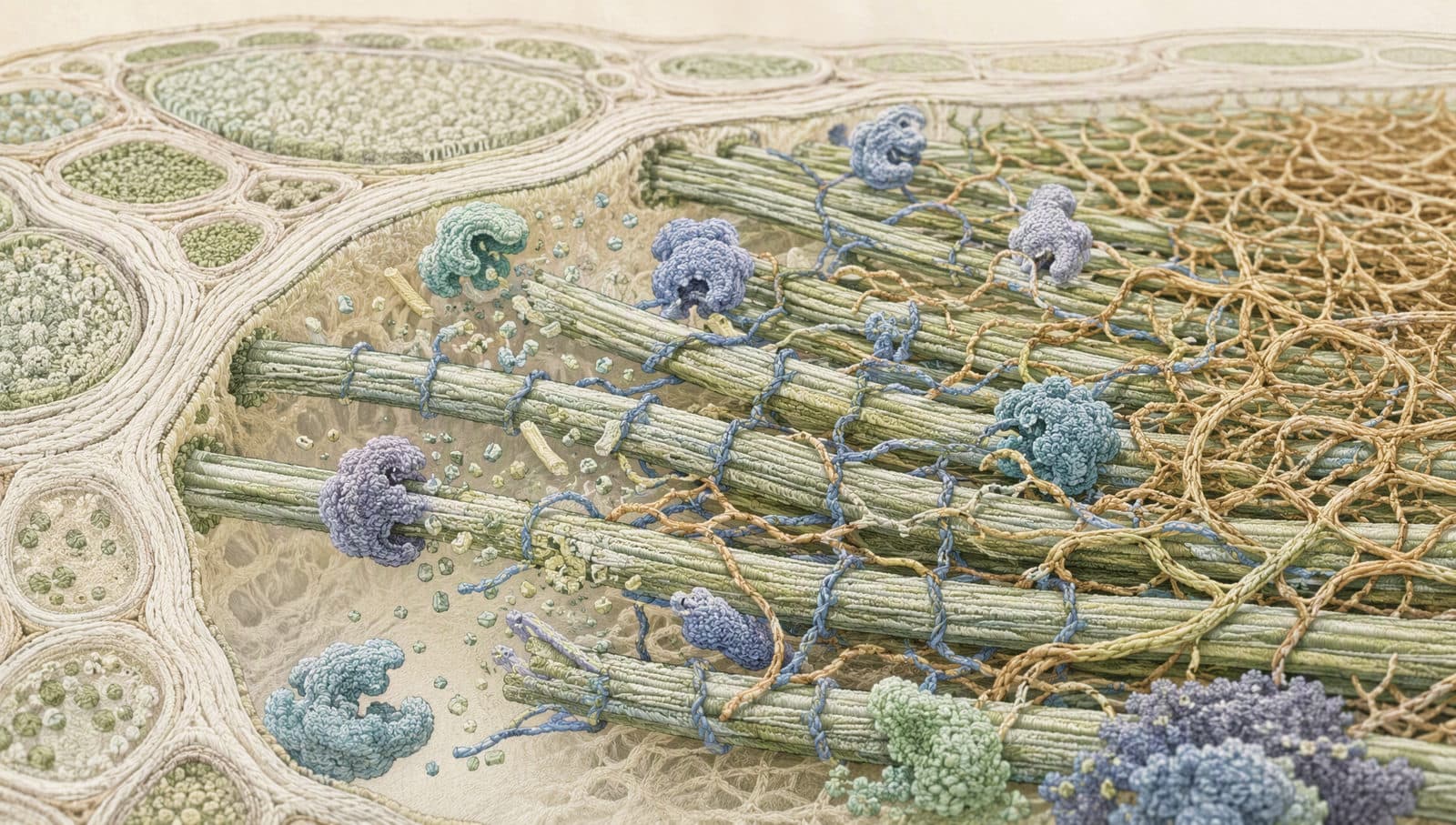
Hemicellulase mechanism reveals structural access
Category: Biotechnology, Industrial Enzymes, Plant Cell Walls, Biomass Conversion
Hemicellulase is often introduced as if it were one enzyme that cuts one substrate. Plant cell wall research quickly reveals a different picture. The term usually describes a coordinated set of activities that act on xylans, mannans, xyloglucans, and the many side groups attached to these backbones.
This diversity changes the development question. A team should not begin only by asking how high the activity number is. It should first identify which hemicelluloses are present, how the main chains and substitutions are arranged, what pretreatment has changed, and whether the desired output is fermentable sugar, a functional oligosaccharide, a modified fiber, or improved processing behavior. Once that substrate map is clear, enzyme selection becomes much more meaningful.
What Is Hemicellulase in the Architecture of a Plant Cell Wall?
A plant cell wall behaves like a layered composite. Cellulose microfibrils provide a structural framework. Hemicelluloses associate with this framework and connect surrounding structures, while lignin can create a denser and more hydrophobic network in many tissues. Hemicellulose is not one fixed polysaccharide. It is a broad group of heterogeneous polymers with different backbones and substitutions.
Xylan, for example, commonly contains a backbone of linked xylose units decorated with groups such as arabinose, acetyl groups, or glucuronic acid. Mannan has a mannosyl-related backbone that may also contain glucose or galactose. Xyloglucan presents another combination of backbone and branching. Wheat straw, corn residues, hardwood, softwood, and cereal processing streams therefore present different enzyme problems.
Hemicellulase is best understood as a functional umbrella. It may include endoxylanases and endomannanases that cleave main chains, xylosidases and mannosidases that continue processing shorter products, and accessory enzymes that remove arabinose, acetyl, glucuronoyl, or other substituents. These activities remove different structural barriers and do not contribute equally to every feedstock.
Why the Hemicellulase Mechanism Depends on Enzyme Synergy
Endo-acting enzymes commonly begin by finding accessible positions within a polymer backbone. Their cleavage produces oligosaccharides of different lengths and creates more chain ends. Enzymes that act on short products or chain ends can then release monosaccharides. When bulky side groups limit access, debranching enzymes may first remove selected substitutions and open additional sites for backbone enzymes.
The xylan system illustrates this division of labor. Endoxylanases cleave beta-1,4-linked xylan backbones and generate xylooligosaccharides. Beta-xylosidases process shorter products and release xylose. Arabinofuranosidases, acetyl xylan esterases, and other accessory activities address different side groups. If the target is a defined xylooligosaccharide range, the process must also avoid converting valuable products into smaller sugars.
Synergy does not mean that adding more enzymes always improves the result. An accessory activity may improve backbone access while removing a substitution that the target product should retain. A strong exo-acting activity may increase monosaccharide release but reduce oligosaccharide yield. A useful cocktail follows the feedstock structure and the product objective rather than a fixed list of enzyme names.
The Difference Between Hemicellulase and Cellulase
The two enzyme groups frequently appear in the same biomass process, but they focus on different polymers. Cellulase systems center on the beta-1,4-glucan framework of cellulose and commonly combine endoglucanase, cellobiohydrolase-related activities, and beta-glucosidase. Hemicellulose-active systems face greater variation in backbone composition, side-chain substitution, and ester bonds.
This distinction affects both assay design and enzyme mixing. If hemicellulose covers cellulose surfaces and limits cellulase access, selective removal or modification may expose more of the cellulose structure. If pretreatment has already solubilized much of the hemicellulose, adding a high proportion of the same activities may offer less value. The solid and liquid fractions after pretreatment should guide the decision.
Hemicellulose conversion is also not merely a supporting step for cellulose hydrolysis. Some projects treat hemicellulosic sugars as a separate product stream. Others target substituted oligosaccharides or require only mild fiber-surface modification. As the endpoint changes, so do the preferred activities, conversion depth, and stopping time.
How Hemicellulase in Biomass Conversion Splits into Different Routes
Biomass processing does not always aim for complete saccharification.
One route releases platform sugars for later fermentation or chemical conversion. In that setting, backbone enzymes, debranching enzymes, and cellulases may need to complement one another, and the evaluation may track the combined recovery of xylose, mannose, glucose, and other sugars.
A second route produces xylooligosaccharides or mannooligosaccharides. Product distribution becomes more important than total reducing sugar. Cleavage position, exo-activity, side-group retention, and reaction time all influence the final mixture. A single total-sugar reading cannot distinguish desired oligosaccharides from monosaccharides formed by continued hydrolysis.
A third route modifies fibers for pulp, paper, or plant-based material processing. The main endpoint may shift toward surface structure, drainage, fiber interaction, or compatibility with later treatment rather than maximum sugar release. Food and feed processes add other endpoints, including viscosity, soluble fractions, processing stability, and nutrient accessibility.
These routes show why one hemicellulase label can hide several definitions of success. Industrial development should define the product and process endpoint first, then infer the required activity profile. Comparing only the activity value printed for a preparation leaves too many variables unresolved.

Hemicellulase enzyme cocktail follows substrate structure
How Pretreatment Rewrites a Hemicellulase Enzyme Cocktail
Native lignocellulosic material is compact, and enzymes cannot directly reach every potential site. Physical, chemical, or biological pretreatment is therefore often used to alter the wall. Pretreatment may solubilize part of the hemicellulose, remove some lignin, increase porosity, create inhibitors, or change substitution patterns in the remaining polysaccharides. Before and after treatment, the material represents a different enzymatic problem.
If the pretreatment liquor contains soluble oligosaccharides, the next task may focus on separation, purification, or selective conversion. If recalcitrant xylan remains on the solid fraction, the enzyme set may need activities that can work near fiber surfaces and remove obstructing groups. High-solids operation adds mixing limits, local product accumulation, and mass-transfer constraints that may change the ranking observed in a dilute buffer assay.
A cocktail design therefore needs at least the feedstock, pretreatment route, solids level, target pH, temperature history, and desired product. Only after these inputs are defined does it make sense to discuss proportions of xylanases, mannanases, accessory enzymes, and cellulases. Without substrate characterization, a universal recipe is only a starting guess.
Why a Hemicellulase Activity Assay Cannot Be One Number
Laboratories may test xylan, mannan, or a synthetic substrate. They may measure reducing sugars, a specific monosaccharide, an oligosaccharide profile, or a change in substrate viscosity. Each method answers a different question, and the resulting numbers cannot be compared responsibly without the substrate and reaction conditions.
A practical assessment has four layers. The first measures individual activities against xylan, mannan, or a selected side-chain substrate. The second maps products over time, separating monosaccharides, disaccharides, and oligosaccharides of different lengths. The third tests synergy by comparing single enzymes, pairs, and larger mixtures. The fourth returns to the real material under relevant pretreatment, solids, and process conditions.
The endpoint determines which layer matters most. Complete saccharification may emphasize target monosaccharide recovery and inhibition. Oligosaccharide production requires chain-length distribution and substitution analysis. Fiber modification needs material and processing measurements. Applying one assay logic to all these routes can make high activity look more useful than it actually is.
Time and dose series add another dimension. One mixture may generate oligosaccharides quickly but continue degrading them during a longer reaction. Another may have a lower initial rate yet remain effective at high solids. Relating the reaction curve to the product specification is more informative than recording a single endpoint.
Matching Temperature and pH Stability to a Real Process
Industrial enzymes are often compared by optimum temperature and optimum pH, but an optimum point is not the same as a production window. A real process also includes high solids, shear, salts, sugars, pretreatment residues, and product inhibition. An enzyme that performs well on a purified substrate may rank differently on processed biomass.
Stability criteria should follow the process. High-temperature saccharification may require remaining activity over a defined period. Food processing may place more weight on selectivity under moderate conditions. A multienzyme system requires several components to retain useful activity in a shared environment. If their preferred conditions are far apart, combining them may not produce the expected synergy.
Protein engineering can explore heat tolerance, pH adaptation, substrate binding, product inhibition, and expression performance. Computational ranking can reduce the number of candidates entering the laboratory, but it does not establish process performance. Variants still require expression, purification, single-enzyme characterization, product profiling, and real-substrate tests. In a multienzyme system, an improvement to one component must be tested at the cocktail level.
Organizing Hemicellulase Research with MatwingsVenus™(protein agent)
Hemicellulase projects often scatter information across databases, enzyme families, activity units, and pretreatment-specific experiments. MatwingsVenus™(晓鹜™) is positioned as a conversational platform for protein research with a connected dry-lab and wet-lab workflow. Protein database retrieval, candidate organization, research task design, and experimental handoff can be arranged as one traceable sequence.
A practical workflow begins with substrate composition and the target product. Inputs may include xylan or mannan type, substitution pattern, pretreatment conditions, and desired product range. Database retrieval and family annotation can then organize candidates by backbone cleavage, short-product conversion, and debranching roles. The next step defines assays, controls, product-profile measurements, and stop criteria for laboratory validation.
MatwingsVenus™(晓鹜™) can also help preserve the relationship between each experimental result and the next candidate decision. If debranching increases monosaccharide release but reduces the desired oligosaccharides, the next round can adjust accessory-enzyme ratio or reaction time. If activity on a standard substrate is strong but performance on processed biomass is limited, the team can examine accessibility and pretreatment residues.
The role of MatwingsVenus™(晓鹜™) is to organize the research task and connect evidence to experimental handoffs. It does not make a database hit or computational ranking equivalent to measured industrial performance. Candidate value remains a question for expression, biochemical testing, product analysis, and process validation.

Hemicellulase activity assay meets biomass testing
From Single-Enzyme Screening to Explainable System Design
Hemicellulase development is moving from the search for one high-activity protein toward a clearer understanding of substrate architecture, division of labor, and process constraints. A useful cocktail is not the mixture with the largest number of enzymes. Each component should address a defined barrier: a backbone enzyme for inaccessible chain length, a debranching activity for substitutions, or an exo-acting enzyme when product accumulation requires further conversion.
This perspective creates a practical sequence. Characterize the feedstock and the material after pretreatment. Define whether the endpoint is monosaccharides, oligosaccharides, or fiber modification. Choose assays that can answer that question and establish single-enzyme baselines. Only then move into cocktail optimization, protein engineering, and scale-relevant validation.
The central value of hemicellulase is not that one label can cover every reaction. Its value lies in turning a complex plant polymer network into a set of understandable, combinable, and testable tasks. When substrate differences are visible, enzyme-system differences become easier to interpret. When the process endpoint is explicit, synergy can be measured rather than assumed.
FAQ
Is Hemicellulase One Enzyme or Many Enzymes?
It is generally an umbrella term for several related activities, including backbone-cleaving enzymes, enzymes that act on shorter products, and debranching enzymes. The required combination depends on the substrate and target product.
Can Xylanase Represent Every Hemicellulase Activity?
No. Xylanase is an important member, but mannans, xyloglucans, and diverse side groups require other activities. Measuring xylanase alone does not describe a complete hemicellulose-active system.
Why Are Hemicellulase and Cellulase Often Used Together?
They act on different plant-wall polymers. Removing or modifying hemicellulose may improve access to cellulose, but the degree of synergy depends on the feedstock and pretreatment.
Which Substrate Should a Hemicellulase Activity Assay Use?
The substrate should match the target feedstock and the activity being measured. Application screening should also include product profiling and tests on the real processed material.
How Can a Hemicellulase Enzyme Cocktail Be Judged Effective?
Compare single enzymes and mixtures under the same conditions using the target product, reaction curve, and process endpoint. A mixture that increases total sugar while reducing a desired oligosaccharide may not meet the project goal.