Gene Ontology Functional Annotation: What Does the Evidence Really Mean?
Published on October 11, 2026
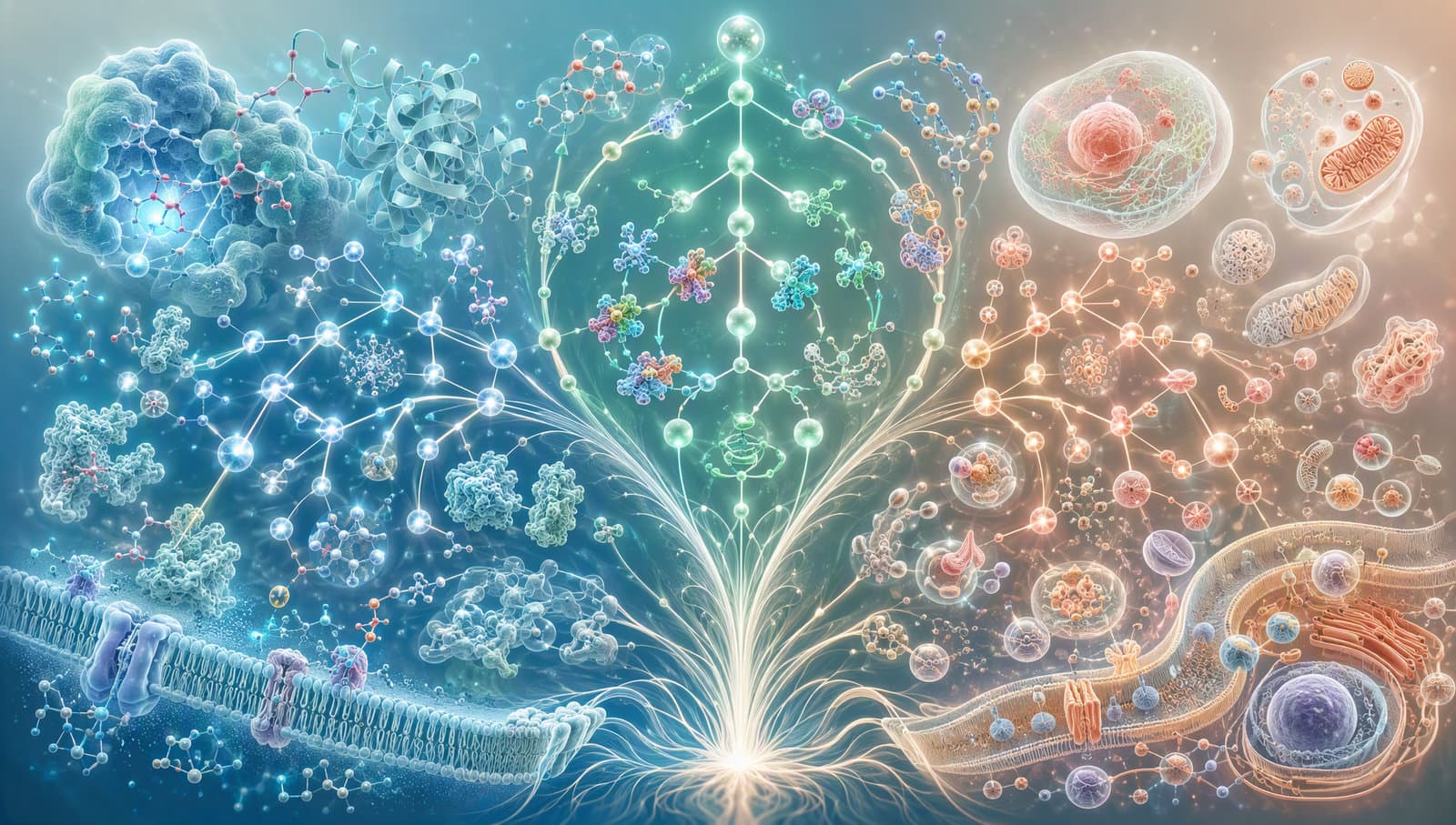
Three ontology aspects describe complementary dimensions of gene-product function
Category: Bioinformatics / Protein Function / Research Data Interpretation
What Does Gene Ontology Functional Annotation Actually Describe?
A protein-function search often begins with the hope of finding one concise answer: what enzyme is this, which pathway does it belong to, or where does it act? Biology rarely fits into one label. A gene product can perform a molecular activity in a particular location and thereby contribute to a broader biological program. Its interpretation may also change with cellular state, tissue, interacting partners, or experimental conditions.
Gene Ontology, or GO, separates that complexity into three related but non-interchangeable aspects:
• Molecular Function describes an activity at the molecular level, such as catalysis, binding, or transport.
• Biological Process places that activity within a larger program, such as signal transduction, DNA repair, or metabolic regulation.
• Cellular Component describes the cellular structure, compartment, or stable complex where the activity occurs.
The first rule for reading Gene Ontology functional annotation is therefore simple: do not use one aspect as a substitute for the other two. “Protein kinase activity” does not, by itself, identify the pathway in which a protein acts. A mitochondrial location does not establish a specific molecular activity. The three views become informative when they are assembled into a coherent biological context.
An Annotation Is Only as Useful as the Evidence Behind It
A standard GO annotation is more than a protein-to-term link. A useful interpretation considers the gene product, GO term, relation, reference, and evidence code together. The evidence code indicates whether the association is supported by a direct experiment, sequence similarity, phylogenetic inference, an author statement, or an automated process that was not individually reviewed by a biocurator.
Evidence categories should not be mistaken for a universal quality score. Direct experiments are close to the tested object, but their meaning still depends on the assay, construct, conditions, and detection limits. Computational inference scales coverage, yet its reliability depends on the reference, degree of similarity, and inference rule. An author statement can be valuable, but it still needs its original context. The productive question is not merely “Does an annotation exist?” but “What exactly does this evidence support?”

Evidence type determines how confidently an annotation can guide a decision
With MatwingsVenus™(晓鹜™), a function investigation can begin with a protein name, accession, or sequence and use conversation to organize identity checks and database retrieval. Identifying a raw sequence before transferring an annotation helps reduce the risk of assigning conclusions from a merely similar protein. Each annotation should then be classified by its own evidence code: experimentally supported conclusions as Measured, similarity-based, phylogenetic, or automated computational inferences as Predicted, and missing evidence as Unknown. A record does not become Measured merely because it appears in a database. This distinction keeps established knowledge, plausible hypotheses, and validation needs visible in the same research map.
Why Gene Ontology Functional Annotation Often Becomes Broader
GO is not a flat vocabulary. It is a hierarchy of terms connected by formally defined relations. More specific terms connect to broader parents. Positive annotations can propagate upward through appropriate relations: a protein annotated with a specific protein kinase activity can also be classified under a broader enzyme-activity concept. This structure makes cross-species and cross-dataset aggregation possible, but it also creates a common illusion. A long list of high-level terms does not necessarily represent an equally long list of independent observations.
A better review asks three questions. What is the most specific term supported by evidence? Which entries are broader parents produced through propagation? Do annotations across Molecular Function, Biological Process, and Cellular Component make sense in the same biological setting? These checks prevent a dense vocabulary list from being presented as if the protein were already understood in full mechanistic detail.
GO is also a living knowledge system. Terms can be added, reorganized, or made obsolete, and parent-child relations change as biological understanding develops. Reproducible analysis therefore requires more than a screenshot of enrichment results. It should preserve the ontology or database version, access date, species background, and filtering rules.
Missing Annotation Does Not Mean Missing Function
GO follows an open-world assumption. If a statement is absent, the database currently has no available assertion; absence does not prove that the gene product lacks that activity, process involvement, or location. Understudied organisms, sparsely characterized families, newly discovered sequences, and condition-specific functions are especially likely to have incomplete coverage.
In this situation, Gene Ontology functional annotation should route the investigation rather than end it. Researchers can confirm identity and homology, inspect conserved domains and key residues, evaluate the cellular setting, and retrieve relevant literature. If authoritative records remain empty, function-site or protein-property prediction may be considered, provided the output is clearly marked Predicted and converted into a targeted experiment.
MatwingsVenus™(晓鹜™) publicly presents capabilities including conversational assistance, protein sequence analysis, structure prediction, and database retrieval. These capabilities can connect otherwise fragmented tasks, but they do not turn a computational result into experimental proof. The product’s retrieval-first logic is most useful when it preserves that boundary instead of hiding it.
Enrichment Significance Is Not Mechanistic Proof
GO enrichment is frequently used with transcriptomic, proteomic, or candidate-gene sets to identify overrepresented functional themes. It asks which terms occur more often in the selected set than expected under a chosen background. It does not, on its own, prove a mechanism or establish that a pathway has been activated.
The input list, species mapping, background universe, annotation coverage, ontology hierarchy, database version, and multiple-testing procedure can all affect the output. A decision-oriented interpretation begins by checking identifiers and species mapping, then identifies the genes driving each significant term. It consolidates overlapping parent and child terms, compares signals across the three ontology aspects, and finally rewrites the pattern as a testable question. “Do these candidate proteins jointly contribute to a stress response in a defined compartment?” is a better experimental prompt than “The pathway is active.”
For a research team, these boundaries make analysis more useful rather than less useful. MatwingsVenus™(晓鹜™) can organize GO records and related database information, then separate Measured, Predicted, and Unknown layers so that sequence, structure, residue, or literature analysis focuses on the evidence gap that matters most. If a task requires substantial computation, its input, expected output, and validation purpose should be clear before it begins.

Evidence gaps determine the priority of the next computational or experimental task
How MatwingsVenus™(protein agent)Organizes a Function-Annotation Workflow
Whether the starting point is a name, accession, or raw sequence, MatwingsVenus™(晓鹜™) can organize fragmented operations into a continuous task flow. It begins with identity resolution and retrieval of authoritative function records, then separates evidence types and ontology levels into Measured, Predicted, and Unknown layers. The remaining gaps can guide the next property, residue, structure, or experimental question. The purpose is not to manufacture certainty, but to reduce tool switching while keeping each input, source, and evidence boundary visible.
The platform publicly describes conversational assistance, protein sequence analysis, structure prediction, and database retrieval among its capabilities. That makes it suitable for early-stage evidence organization and problem decomposition across information sources. Existing annotations should be inspected before prediction is considered. When substantial computation is needed, the objective, input, expected output, and validation plan should be defined first.
Turning Gene Ontology Functional Annotation into an Actionable Question
A useful result does not stop after exporting ontology terms. It makes three transformations.
First, it converts a term hit into an evidence statement: which object is associated with which term, by what relation and evidence, and which parts remain inferred or unknown. Second, it converts a hierarchy into biological context by considering activity, process, and location together rather than inflating information through broad parent terms. Third, it converts a functional hypothesis into a validation task, prioritizing the uncertainty that could change the research decision. A final mechanistic claim still belongs in an appropriate experimental system.
Conclusion: Better Annotation Means Clearer Evidence Boundaries
The central value of Gene Ontology functional annotation is not the ability to generate a definitive sentence for every protein. It provides a computable, comparable, and updateable language for representing functional knowledge. Only by reading the three ontology aspects, evidence codes, hierarchical propagation, and open-world assumption together can a researcher decide whether a result is suitable for background description, candidate prioritization, or experimental planning.
When function information is scattered across sequences, database records, and evidence levels, MatwingsVenus™(晓鹜™) can connect retrieval-first research, evidence separation, and downstream analysis through a conversational task flow. Keeping known evidence traceable, labeling predictions honestly, and turning unknowns into specific questions is more valuable than simply accumulating more terms.