How Can a GROMACS Protein Simulation Workflow Improve Research Efficiency?
Published on October 11, 2026
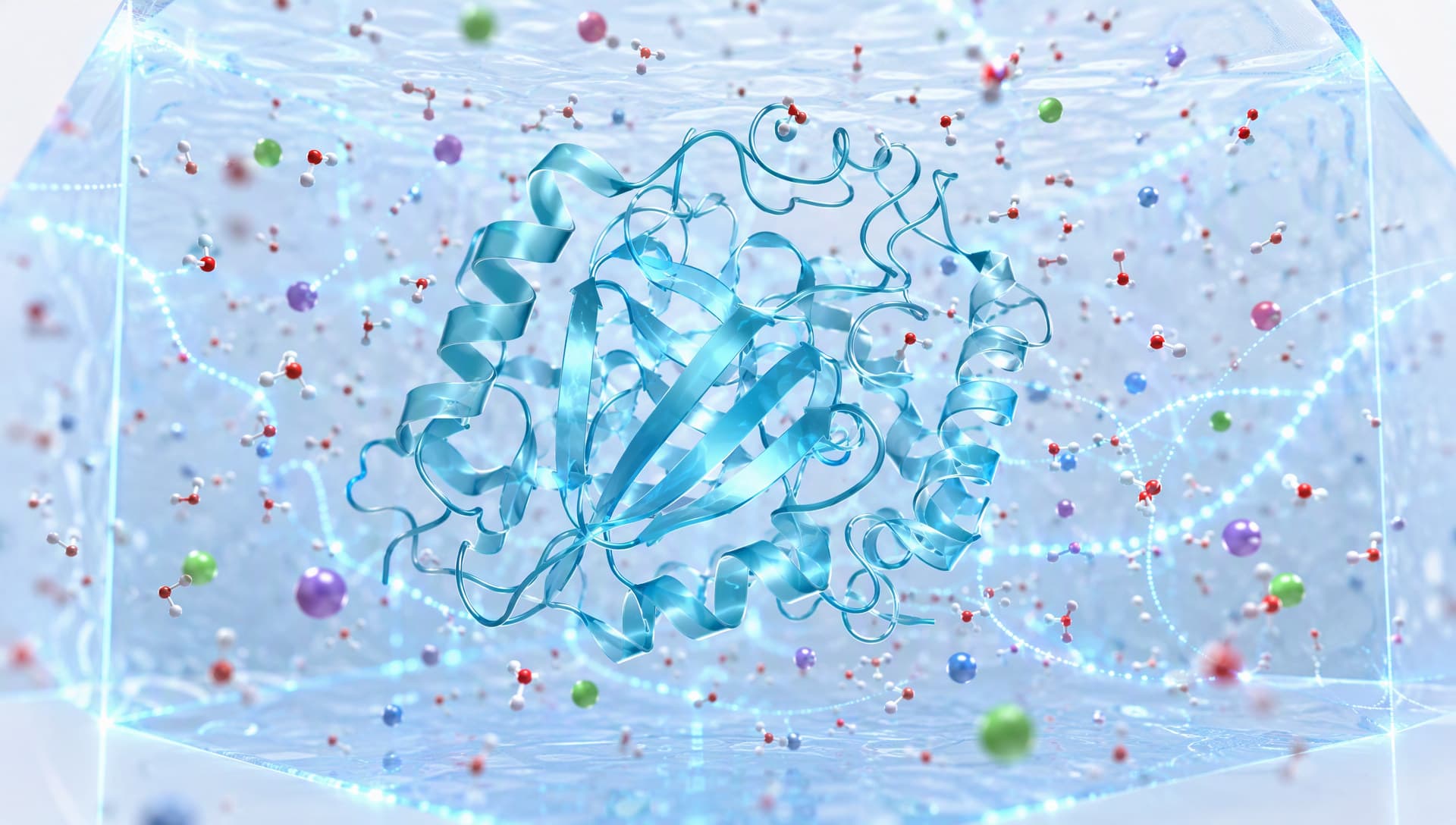
Protein, solvent, ions, and periodic boundaries form one simulation system
Category: Computational Biology | Protein Engineering | Molecular Dynamics
In enzyme engineering, antibody optimization, receptor-mechanism studies, and structure-guided screening, teams often face the same problem: a structure is available and a simulation can be launched, yet the rationale for the force field, the adequacy of equilibration, and the strength of the resulting conclusions remain difficult to explain. A useful GROMACS protein simulation workflow connects the research question, system assumptions, parameters, trajectory metrics, and validation plan from the outset.
Convert the research question into a testable simulation objective
The first decision is not which command to run, but what the simulation should test. A comparison between a mutant and its wild type requires aligned starting conditions, independent replicates, and predefined observables such as RMSD, RMSF, radius of gyration, key distances, or hydrogen-bond occupancy. A ligand-binding study adds further requirements, including protonation states, ligand parameters, binding-site waters, cofactors, and the boundaries of the modeled environment. One parameter set cannot answer every protein question.
Structural evidence determines the quality of everything that follows. Experimental PDB models may contain missing residues, alternate conformations, nonstandard groups, or resolution-related uncertainty. Predicted structures require confidence-aware interpretation, particularly around functional regions. MatwingsVenus™(晓鹜™) can organize conversational research tasks that connect searches across resources such as PDB, UniProt, and PubMed with protein sequence analysis and structure prediction. This helps establish identity, provenance, and functional context before computation begins. It does not replace expert judgment about whether a structure is suitable for a specific simulation.
System preparation determines what the trajectory can answer
A disciplined GROMACS protein simulation workflow normally begins with structural cleanup and topology generation. gmx pdb2gmx can derive the topology-related files required by GROMACS from coordinate input, but the force field and water model must fit the molecular system, the literature context, and each other. The next steps define the simulation box, add solvent and ions, and check net charge, ionic strength, steric overlap, and behavior across periodic boundaries.
Force fields are not ranked simply by recency, and a water model is not an interchangeable background setting. Together, they define the physical description used to sample conformations, hydrogen-bond networks, and molecular motion. Ligands, metals, glycans, membranes, and other nonstandard components require separate checks of parameter provenance and connectivity. The database retrieval, sequence analysis, and structure-prediction capabilities available through MatwingsVenus™(晓鹜™) can strengthen the upstream evidence base. Its expert-collaboration pathway is also relevant when a nonstandard system, conflicting parameter sources, or an uncertain functional boundary requires human review.
Staged equilibration matters more than simply running longer
Energy minimization removes severe contacts and locally unfavorable geometry, but numerical convergence at this stage does not mean that the system has reached the intended temperature and pressure. A common design uses constrained NVT equilibration to stabilize temperature, followed by NPT equilibration to bring pressure and density into a reasonable range. Thermostat and barostat choices, time step, constraint algorithm, and periodic boundary conditions affect numerical behavior and the ensemble being sampled. Software version, .mdp files, random seeds, and acceptance criteria should therefore be recorded.
A reliable GROMACS protein simulation workflow checks more than whether the process exited successfully. Potential energy should decline and stabilize during minimization; temperature should fluctuate around its target; density should become physically plausible; and pressure behavior, constraint warnings, and periodic-boundary artifacts should be reviewed before production. Extending production cannot repair a system that was prepared incorrectly.

Preparation, minimization, equilibration, and production form a connected sequence
How MatwingsVenus™(protein agent)supports a GROMACS protein simulation workflow
Production length should be chosen according to the research question, system size, and timescale of the event of interest, not by a universal nanosecond target. A single long trajectory may still visit only a limited region of conformational space. Independent repeats with different starting velocities and consistent analysis rules can provide stronger evidence for robust trends. Logs, checkpoints, topologies, coordinates, .tpr files, and the software environment should remain linked to the project record so that interrupted jobs can be recovered and results can be reviewed.
This is where a research agent can add practical value without overstating the science. MatwingsVenus™(晓鹜™) can place retrieval, structural context, analysis tasks, expert input, and experimental services in a continuous task chain. For cross-functional projects, that organization can reduce information loss between computational scientists, protein engineers, and laboratory teams. Automated recommendations still require user approval, and neither predictions nor simulation outputs should be presented as experimentally verified facts.
Trajectory analysis must return to the original decision
Trajectory generation is the midpoint, not the result. Analysis often starts by correcting periodic-boundary artifacts, centering the molecule, and fitting an appropriate reference frame. Metrics should then follow the question. RMSD tracks global deviation but cannot prove convergence on its own. RMSF highlights local flexibility but depends on alignment. Radius of gyration reports compactness, while hydrogen bonds, salt bridges, secondary structure, principal components, and free-energy landscapes describe different aspects of conformational behavior. Complementary metrics and visual inspection should be used together.
When a GROMACS protein simulation workflow supports mutation screening, its strongest role is usually the comparison of trends under matched conditions. A small numerical difference should not be translated directly into improved activity. MatwingsVenus™(晓鹜™) can keep protein-engineering objectives, structural evidence, and expert collaboration in the same research context, allowing a trajectory-derived observation to become a candidate-ranking criterion, a risk-site review, or an experimental hypothesis. Simulation provides decision evidence; wet-lab work determines whether the predicted effect is real.

Trajectory metrics and an evidence chain support the next research decision
FAQ
Question: Can one completed simulation establish that a protein is more stable? Answer: No. A single trajectory may be influenced by initial velocities, incomplete sampling, and system choices. Independent runs, complementary metrics, structural interpretation, and experimental evidence should be considered together.
Question: Can either NVT or NPT equilibration be omitted? Answer: It should not be omitted mechanically. These stages help establish temperature and pressure-density conditions. Their order, duration, and coupling methods depend on the system and intended ensemble, and progression should be based on checks rather than a fixed recipe.
Question: Does a research agent guarantee correct simulation parameters? Answer: No. MatwingsVenus™(晓鹜™) is better understood as a way to organize evidence, connect tasks, preserve decision points, and link structural analysis with expert and experimental follow-up. Force fields, boundary conditions, sampling adequacy, and the strength of conclusions still require scientific review.
Turn simulation output into a reviewable research asset
A high-quality GROMACS protein simulation workflow is a traceable scientific decision system: structural inputs have provenance, parameter choices have reasons, each stage has acceptance criteria, and analysis answers a defined question within stated limits. Connecting that process with the database retrieval, structure prediction, protein-research task organization, expert collaboration, and experimental handoff available through MatwingsVenus™(晓鹜™) helps transform isolated trajectory files into research assets that a team can review, compare, and validate.