What Are Food Enzymes? Selection Logic for Starch, Protein, Juice, and Dairy
Published on October 15, 2026
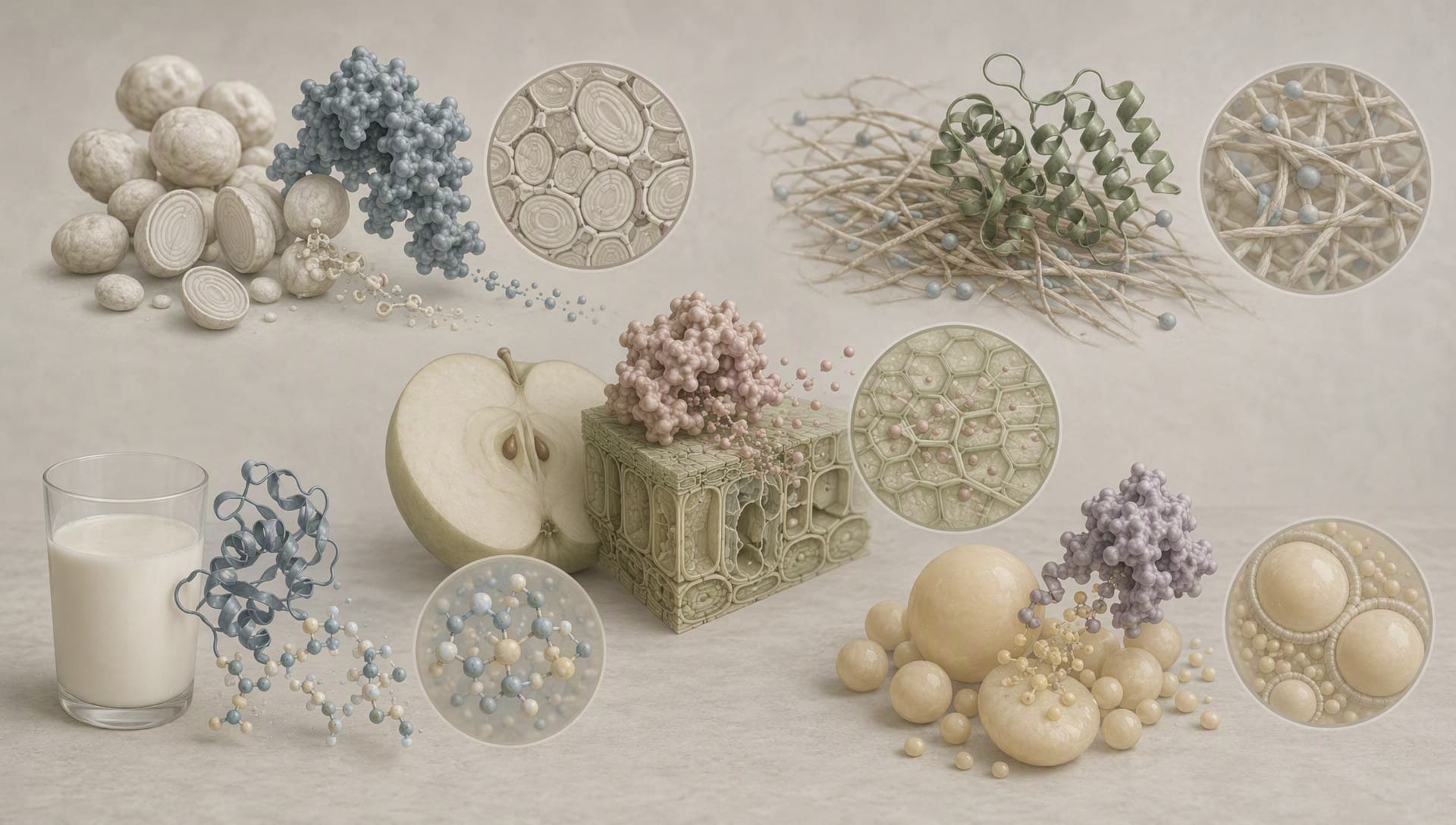
Food enzymes matching starch, protein, fat, pectin, and lactose
Category
Category: Food Biotechnology, Food Processing, Industrial Enzyme Engineering, Formulation Development, Food Quality
Abstract
Abstract: Food enzymes act on starch, protein, fat, pectin, and lactose. Learn how matrix, process conditions, dosage, and validation shape food use.
Food enzymes are not simply a collection of processing aids. They are biocatalysts selected for a specific food component and a defined reaction task. Amylases modify starch, proteases perform limited protein hydrolysis, lipases act on lipids, pectinases alter pectin networks, and lactase breaks down lactose. The value of each enzyme must be assessed in a real food matrix under the intended temperature, pH, time, and quality targets.
The same enzyme can behave differently in dough, an emulsion, fruit juice, or a high-protein formulation. Substrate exposure, available water, competing interactions, mixing, and subsequent heating all change what the catalyst can accomplish. The practical task is therefore not to memorize enzyme names, but to connect quality target, food matrix, catalytic reaction, process window, and validation metric.
Which Types of Food Enzymes Act on Different Food Matrices?
The main macromolecules in food include carbohydrates, proteins, and lipids. Structural polysaccharides such as pectin and smaller molecules such as lactose can also determine processing behavior. Selection begins by identifying which component should change and how far that change should proceed.
Amylases cleave starch chains and are relevant to saccharification, viscosity control, and fermentable-sugar generation. Proteases convert large proteins into smaller fragments and may alter solubility, texture, or flavor-development processes. Excessive hydrolysis, however, can create bitterness, weaken structure, or destabilize a formulation. Lipases modify lipid substrates and flavor precursors, requiring control that matches the raw material and subsequent maturation.
Pectinases act on pectin networks and may support juice extraction, viscosity adjustment, or clarification. Lactase changes the sugar composition of dairy products by hydrolyzing lactose. Transglutaminase, laccase, and other enzymes may support protein crosslinking or additional structural changes. A family name indicates a direction; it does not replace testing of a particular preparation in a particular food.
MatwingsVenus®(晓鹜®) capabilities in enzyme mining and protein function prediction can help organize candidate space around a defined food matrix. The development brief should specify the target substrate, intended change, and processing conditions. Computational support can assist candidate discovery, functional analysis, and experiment ordering, but it cannot predict the final food outcome by itself.
How Food Enzymes in Baking Affect Dough and Finished Products
Baking systems contain starch, gluten proteins, lipids, water, and fermenting microorganisms, making them a classic multicomponent matrix. Amylases can influence sugar supply during fermentation and the behavior of starch after baking. Proteases alter the strength and extensibility of the gluten network. Lipases and related enzymes may affect dough interfaces and crumb structure through changes in lipids.
Stronger enzyme action is not always better. Excessive gluten hydrolysis can reduce dough support, while too much starch breakdown can alter stickiness, crumb, or storage behavior. Enzyme selection should account for flour protein, damaged starch, hydration, fermentation time, mixing intensity, and baking profile. A change in flour batch or formulation may require the dose to be revalidated.
A study plan can begin with one quality objective, such as dough handling, loaf volume and crumb, or texture during a defined storage period. Changing only a limited set of variables while recording rheology, fermentation, baking loss, internal structure, and sensory differences helps distinguish enzyme effects from ordinary formulation variation.
What Conditions Matter for Food Enzymes in Dairy Processing?
Dairy systems contain protein, lactose, fat, minerals, and an aqueous phase, while individual products differ in pH, heat treatment, and fermentation. With lactase, evaluation extends beyond lactose conversion because the new sugar profile can influence sweetness, fermentation substrates, and later heat processing. Proteases and lipases can participate in flavor and maturation, but reaction rate and endpoint must remain controlled.
Enzyme performance in dairy depends on substrate state, temperature, pH, ionic conditions, and heat history. Some processes require activity during one stage followed by a temperature step that terminates or greatly reduces the reaction. Others must prevent continued change during storage. Dose timing, reaction time, and the method used to stop the reaction should therefore be designed together.
Quality validation should not rely only on target-substrate reduction. Viscosity, gel or emulsion behavior, flavor, color, fermentation, and storage changes may all matter. Formulations containing plant proteins, dietary fibers, or additional ingredients create more complex interactions and should not inherit parameters directly from a simple dairy matrix.

Food enzyme preparations connecting baking, dairy, and juice processing
Function prediction, protein engineering, and directed-evolution directions within MatwingsVenus®(晓鹜®) can help narrow candidates and prioritize variants for a food-enzyme project. Every candidate still requires verification in the real dairy matrix, target heat treatment, and intended storage conditions. Standard-substrate activity is not a substitute for product testing.
Why Enzymes for Juice Clarification Must Match Pectin and Product Design
Pectin contributes to plant cell walls and intercellular structure and can influence pressing, viscosity, turbidity, and filtration. Pectinase is not one reaction. Related enzymes may act on the main pectin chain or on substituted structures. Fruit variety, maturity, pectin composition, and pretreatment can therefore change the useful enzyme combination.
In juice processing, enzyme treatment can be evaluated for extraction, viscosity reduction, filtration, or a defined clarification target. Product design comes first: clear juice, cloudy beverages, and pulp-containing products require different suspended structures. Maximizing clarity without considering product identity can remove texture or appearance that should have been retained.
Temperature, pH, time, and dose jointly determine the degree of pectin breakdown. Insufficient treatment may miss the filtration objective, while excessive treatment may change body or suspension stability. Sugars, phenolics, minerals, and other colloids can influence both reaction and measurement. A pectinase protocol should therefore be built for a specific material and product rather than copied across juices.
Validation may combine viscosity, turbidity or light transmission, filtration performance, extraction behavior, color, aroma, and sedimentation during storage. Before-and-after samples should use consistent temperature, sampling, and filtration procedures so that handling differences are not mistaken for catalytic effects.
Why Food Enzyme Selection Cannot Rely on Labeled Activity Alone
Labeled activity is commonly measured with a defined substrate under specified assay conditions. It helps characterize a preparation but cannot fully predict performance in a complex food. Matrix components may restrict substrate access, inhibit or bind the enzyme, or change water availability. Two preparations with similar activity units can perform differently in the same formulation.
Food enzyme selection can be divided into five dimensions. The first is the reaction task: hydrolysis, crosslinking, oxidation, or another transformation. The second is the process window, including temperature, pH, water activity, salt and sugar concentration, and reaction time. The third is matrix compatibility and substrate access in the real food. The fourth is reaction termination and residual activity during heating, cooling, or storage. The fifth is the product outcome, integrating texture, flavor, appearance, processing stability, and target-component change.

Food enzyme selection balancing activity with the processing window
Screening should include an untreated control, a dose range, and a time course instead of one endpoint. When several enzymes are combined, the experiment should test synergy, overlapping action, and possible interference. During pilot work, mixing, heating and cooling rates, residence-time distribution, and batch variation become more important, so the small-scale optimum often needs confirmation.
Building a Validation Chain from Reaction to Food Quality
A reliable evaluation should not stop at showing that an enzyme is active. First, the intended reaction must be demonstrated through a relevant measure such as sugar profile, degree of protein hydrolysis, lipid change, or pectin breakdown. The next question is whether that reaction creates a processing benefit in mixing, pumping, filtration, fermentation, forming, or maturation.
The third layer is product quality. Texture, flavor, color, aroma, stability, and sensory acceptance should be compared with an untreated control. The fourth layer is process robustness under raw-material variation, temperature deviation, dosing error, and treatment-time changes. The fifth layer covers production and applicable requirements, including preparation specifications, dosing management, process records, and batch traceability.
This chain prevents two common mistakes: treating standard-substrate activity as product performance, and celebrating one improved measurement while missing changes elsewhere. Food systems require an integrated decision because one reaction can affect several sensory and processing attributes at the same time.
How MatwingsVenus®(protein design agent)Can Support Food Enzyme Development
Food enzyme development involves diverse substrates, complex formulations, and limited experimental capacity. MatwingsVenus®(晓鹜®) can support upstream organization through enzyme mining, protein function prediction, protein design, directed evolution, and protein engineering, with the verified scope of candidate discovery, functional analysis, and variant prioritization.
The brief should focus on the real task: food matrix, target substrate, processing temperature and pH, reaction time, desired quality or processing change, and unacceptable side effects. Computational organization narrows exploration. Candidate expression, screening in real food, formulation trials, sensory and quality evaluation, pilot work, and production verification still follow.
Experimental results should continuously update priorities. If standard-substrate activity is high but performance in food is limited, substrate access, stability, and formulation interference need to be reconsidered. If the reaction succeeds but flavor or texture does not, the degree of conversion and process window need adjustment. Connecting protein development with food-process data is what allows a candidate advantage to become a usable solution.
FAQ
How are food enzymes different from ordinary chemical catalysts?
Enzymes often have defined substrate and reaction selectivity and operate within suitable food-processing conditions. Selection still depends on matrix, target transformation, process design, and product requirements rather than broad labels such as natural or efficient.
Does a higher food enzyme dose always produce a stronger benefit?
No. More enzyme may accelerate a reaction, but it can also cause excessive hydrolysis or structural change. Dose must be optimized with substrate, time, temperature, and quality target.
Does pectinase always make juice clearer?
No. Results depend on pectin structure, raw material, treatment conditions, and product design. Cloudy or pulp-containing beverages may not seek maximum clarity.
Are food enzymes always fully inactivated by heating?
Not necessarily. Inactivation depends on the enzyme, temperature, time, and matrix. Residual activity or later product change should be checked under the actual heat treatment.
Can computational prediction replace real food-formulation experiments?
No. Computation can assist candidate discovery, functional analysis, and variant prioritization. Processing performance, sensory properties, stability, and production compatibility require real formulation tests.
Conclusion
Food enzymes connect selective reactions with processing goals. Development begins by identifying the starch, protein, lipid, pectin, or lactose that should change, then defining enzyme type, dose, temperature, pH, time, and termination in the real matrix. Baking, dairy, and juice each have distinct structural and quality requirements and cannot share one fixed set of parameters. MatwingsVenus®(晓鹜®) capabilities in enzyme mining, function prediction, directed evolution, and protein engineering can support candidate selection and experiment ordering. The final solution still depends on formulation, integrated quality, and production validation.