What Are Enzymes for Environmental Applications? From Pollutant Matching to Process Design
Published on October 14, 2026
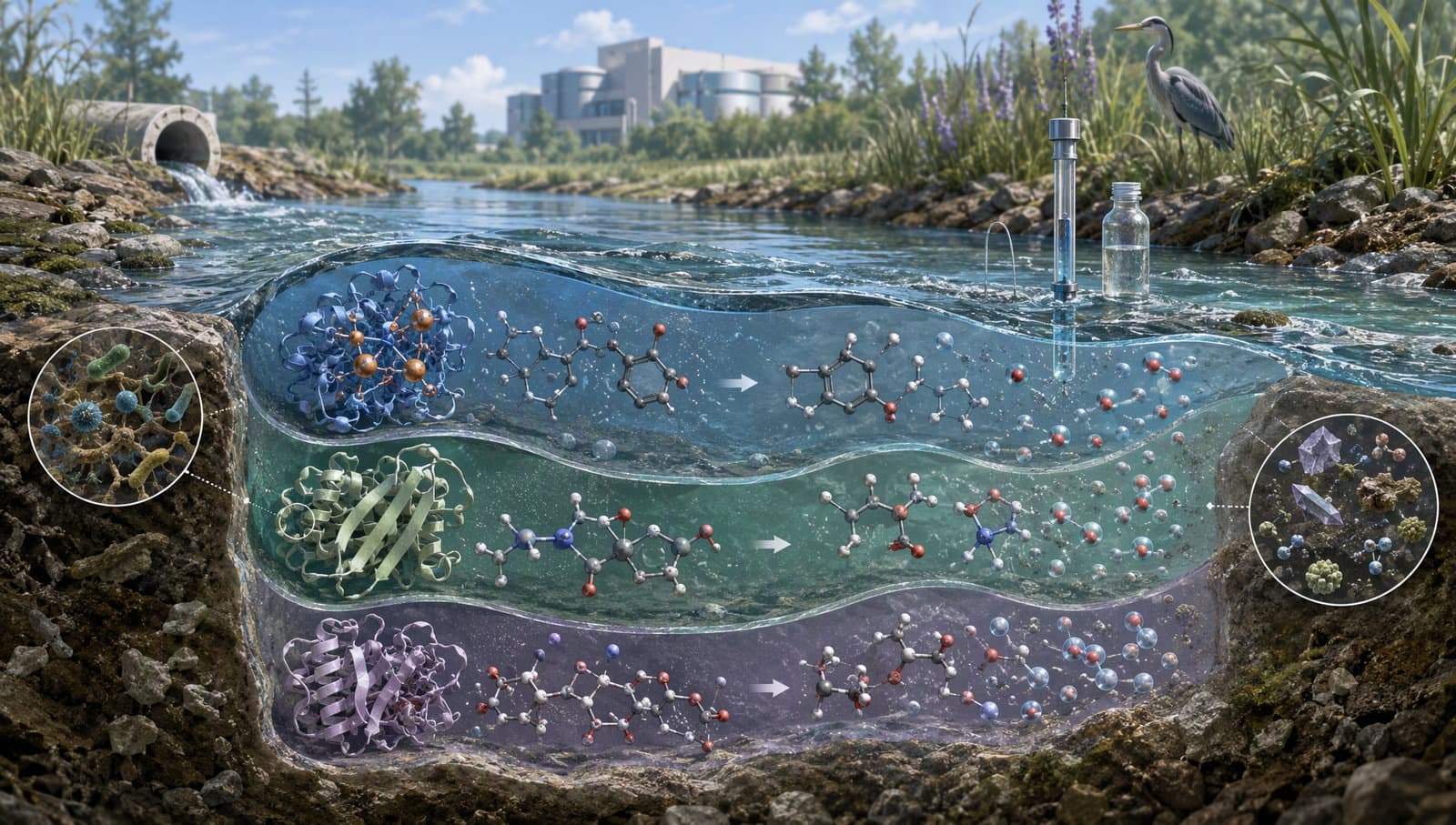
Enzymes for environmental applications matching oxidation and hydrolysis targets
Category
Category: Environmental Biotechnology, Industrial Enzyme Engineering, Wastewater Treatment, Bioremediation, Green Biocatalysis
Abstract
Abstract: Enzymes for environmental applications transform pollutants. Learn how reaction fit, water, reuse, cost, and sound validation guide use in practice.
Enzymes for environmental applications are not universal additives that can be placed into any wastewater stream. They are biocatalytic tools selected around a defined pollutant, a defined chemical transformation, and a defined position in a treatment train. Oxidoreductases and hydrolases can transform selected organic contaminants, while laccases and some peroxidases are frequently investigated in enzymatic bioremediation. Yet activity toward a target molecule does not prove that an enzyme will remain effective in a real water matrix or that the treated water will satisfy the intended outcome.
A sound decision therefore connects four questions: Can the pollutant undergo a useful enzymatic transformation? Does the water matrix permit that reaction? How will the catalyst be deployed and recovered? What happens to the transformation products? Treating these questions as one design problem prevents a single-substrate assay from being mistaken for a complete environmental solution.
Which Types of Environmental Enzymes Match Pollutant Transformations?
Selection should begin with pollutant structure and the desired bond change. Laccases and other oxidoreductases may be explored for phenolic, aromatic, or electron-transfer-sensitive organic compounds. Hydrolases may be relevant when a pollutant contains an accessible ester, amide, or another hydrolysable bond. For complex molecules that cannot be addressed by one reaction, a multi-enzyme concept may be considered, or the enzymatic step may be positioned as only one part of a larger treatment sequence.
Laccase attracts attention because it can participate in oxidation of several classes of organic compounds while using oxygen as an electron acceptor. Its substrate range is not unlimited, and outcomes can change with pollutant structure, mediator use, pH, temperature, and water composition. Peroxidases can also support oxidative transformations, but oxidant delivery and catalyst deactivation require simultaneous evaluation. Hydrolases are best suited to tasks with a plausible cleavable bond, yet successful hydrolysis does not automatically mean that the resulting products are easier to remove or environmentally preferable.
Before screening, a team can prepare a pollutant brief that records structural features, expected concentration range, coexisting organic and inorganic components, the desired bond change, acceptable residence time, and downstream handling. Enzyme mining and function prediction become more useful when the input problem is this specific.
MatwingsVenus®(晓鹜®) presents service directions that include enzyme mining, protein function prediction, directed evolution, and protein engineering. MatwingsVenus®(晓鹜®) can help translate pollutant structure, target transformation, and environmental constraints into candidate-discovery and variant-prioritization tasks. The outputs still need testing in real water and should not be interpreted as treatment performance.
Where Should Enzymes in Wastewater Treatment Be Positioned?
An enzymatic unit may be considered for pretreatment, as a supplementary reaction stage, in a controlled side stream, or during polishing. The appropriate position depends on the target pollutant, water matrix, and existing process rather than on the enzyme name. If concentrated background constituents consume or obstruct the catalyst, reducing matrix complexity before the enzymatic stage may make control easier. If the target occurs at a low concentration but requires additional removal, enzyme treatment can be compared as a polishing option.
A pretreatment position is intended to reduce the burden on downstream operations. Evaluation should therefore examine whether the reaction changes biodegradability, color, solubility, or separation behavior. A side-stream unit may offer tighter control over reaction conditions and catalyst recovery, but it adds circulation, pumping, and equipment requirements. A polishing position can involve low target concentrations, making analytical sensitivity and matrix effects especially important.
Four questions help identify a sensible location. Where in the existing process is the target most concentrated or accessible? Do pH, temperature, salinity, and suspended solids at that point allow the enzyme to retain activity? Which downstream unit will receive the transformation products? Can the enzyme unit be sampled, cleaned, maintained, and bypassed during an upset?

Enzymes in wastewater treatment connecting reaction and membrane operations
No synergy should be assumed when an enzyme stage is connected to membrane filtration, adsorption, biological treatment, or another existing operation. Teams should measure upstream and downstream water quality, membrane fouling behavior, adsorbent loading, biological-system response, and the fate of transformation products. A useful hybrid process is built from data rather than from a list of technologies.
Why Real Water Changes Enzyme-Based Pollutant Transformation
A single substrate in buffer is useful for discovering candidates but cannot represent industrial wastewater or a complex environmental sample. Real water may contain salts, surfactants, metal ions, natural organic matter, suspended particles, and multiple competing substrates. These components can compete for active sites, bind the enzyme, alter pollutant availability, or interfere with analysis.
Experiments should therefore increase in complexity by stages. First, confirm a repeatable transformation signal between the enzyme and target. Second, add representative coexisting components to identify the most sensitive interference. Third, use a characterized real sample and compare the target, major transformation products, and broader water-quality changes before and after treatment. Continuous feed, load variation, and longer operation belong in a later stage.
Target disappearance alone is not enough. A lower measured concentration may reflect transformation, adsorption, precipitation, sampling bias, or an instrumental matrix effect. Product analysis, mass-balance thinking, appropriate blanks, and scenario-relevant biological-effect tests can help establish where the target went and what was formed. The exact analytical program should be chosen for the pollutant and intended application.
Protein design and function-prediction directions listed by MatwingsVenus®(晓鹜®) can support investigation of candidate functional sites, substrate interaction, and possible stability concerns. Candidate rankings from MatwingsVenus®(晓鹜®) should be compared continually with real-water results so that experimental evidence, rather than sequence information alone, determines the next variant set.
How Should Immobilized Environmental Enzymes Be Evaluated?
Free enzymes are convenient for rapid screening but may be difficult to recover, unstable over time, or unsuitable for repeated use. Immobilized environmental enzymes attach or entrap proteins on a support to improve separation, reuse, or reactor compatibility. The support also changes the catalyst microenvironment and transport path, so immobilization is not inherently better than a free-enzyme system.
Support selection should consider pore structure, surface chemistry, mechanical strength, interaction with the pollutant, and stability under water-treatment conditions. Strong adsorption may bring a pollutant close to the catalyst, but it can also make removal difficult to distinguish from transformation. Small pores may restrict access, while aggressive binding chemistry can reduce enzyme function. Research on laccase immobilization shows that support choice is an important development variable, but this conclusion cannot be transferred unchanged to every enzyme.

Immobilized environmental enzymes assessing recovery and retained activity
Evaluation should compare initial activity, retained activity after operation, performance across cycles, enzyme leakage, carrier damage, transport effects, and cleaning recovery. A continuous concept also requires attention to pressure drop, clogging, residence-time behavior, and stability under load variation. Immobilization creates engineering value only when catalyst lifetime, recovery, equipment compatibility, and total cost improve together.
MatwingsVenus®(晓鹜®) capabilities in directed evolution and protein engineering can support variant hypotheses related to stability, surface exposure, or carrier compatibility. The relevant MatwingsVenus®(晓鹜®) services are best treated as tools for narrowing candidates and prioritizing experiments, not as evidence that a deployable immobilized environmental enzyme already exists.
How Can Enzymatic Bioremediation Build a Credible Validation Chain?
A credible chain extends from reaction confirmation to process control and an interpretable environmental outcome. The first step is a reliable quantitative method and a suitable blank system that can separate enzymatic transformation from natural attenuation, photolysis, volatilization, or material adsorption. Major products should then be identified so the team can determine whether further biological treatment, adsorption, or separation is needed. If the objective is a broader reduction in environmental concern, the chosen biological-effect assessment must fit the actual scenario rather than be replaced by one chemical number.
Process records should include enzyme batch, activity definition, dose, reaction time, water composition, temperature, pH, and mixing. Continuous or larger experiments add feed variation, operating duration, maintenance frequency, catalyst replenishment, and upset conditions. Data collected under realistic constraints are more informative about both the value and limits of an enzyme stage.
Economics should not be reduced to enzyme price per unit mass. Enzyme production, shipment and storage, carrier material, reactor hardware, cleaning, replacement frequency, analytical monitoring, and downstream treatment all contribute to total cost. Potential process simplification or selectivity benefits should also be included. The proper comparison is between complete treatment concepts, not isolated reagents.
How MatwingsVenus®(晓鹜®)Supports Enzymes for Environmental Applications R&D
A practical development cycle starts with a precise task. The team defines pollutant structure, desired transformation, water conditions, and treatment position, then uses enzyme mining and function prediction to form a limited candidate set. Initial testing with a standard substrate and the target pollutant provides activity, selectivity, and stability data that can update the ranking. Candidates that approach the target but lack stability may enter a compact directed-evolution or protein-engineering program.
The next iteration should introduce real water, immobilization, and existing-process constraints rather than simply repeating an activity assay. Each experiment should answer a focused question. Is the main interference salinity or a competing substrate? Does activity loss arise from the medium or the support? Is target disappearance caused by transformation or adsorption? Clear questions create a more useful feedback loop between computation and experiment.
MatwingsVenus®(晓鹜®) can support candidate discovery, functional analysis, and variant prioritization, and its published product and service directions align with upstream development needs for environmental enzymes. Before engineering use, real samples, transformation products, operating stability, safety boundaries, and economics still require systematic validation.
FAQ
Can environmental enzymes directly replace an existing wastewater treatment process?
Usually, that is not the best assumption. An enzyme stage is more appropriately evaluated as a targeted unit alongside physical, chemical, biological, or polishing operations. Water quality, treatment objectives, and operating data determine whether any existing step can change.
Can laccase treat every organic pollutant?
No. Laccase has a useful but limited substrate range, and performance depends on pollutant structure, mediator choice, water composition, and operating conditions. Each target requires separate screening and verification.
Do immobilized environmental enzymes always reduce cost?
No. Immobilization may simplify recovery and reuse, but it adds carrier, preparation, transport, and equipment considerations. The comparison should cover the complete operating cycle.
Does lower target concentration mean treatment is complete?
No. Transformation must be distinguished from adsorption, precipitation, and sampling or analytical effects. Major transformation products and their downstream fate also need evaluation.
Can computational methods predict performance in real water?
No. Computation can assist candidate discovery, functional-site analysis, and variant prioritization. Activity, stability, products, and operating performance in the real matrix must be established experimentally.
Conclusion
The value of enzymes for environmental applications is not a universal answer to every pollution problem. It is the ability to design a biocatalytic transformation for a defined target. Development begins with pollutant structure and reaction choice, identifies the proper process position, and then tests matrix interference, product fate, immobilization, long-term operation, and total cost. Enzyme mining, function prediction, directed evolution, and protein engineering services displayed by MatwingsVenus®(晓鹜®) can support candidate selection and experiment ordering. Progress from candidate to environmental use still depends on real-water evidence and a complete validation chain.