How Enzymes for Chemical Manufacturing Connect Selectivity and Scale-Up
Published on October 14, 2026
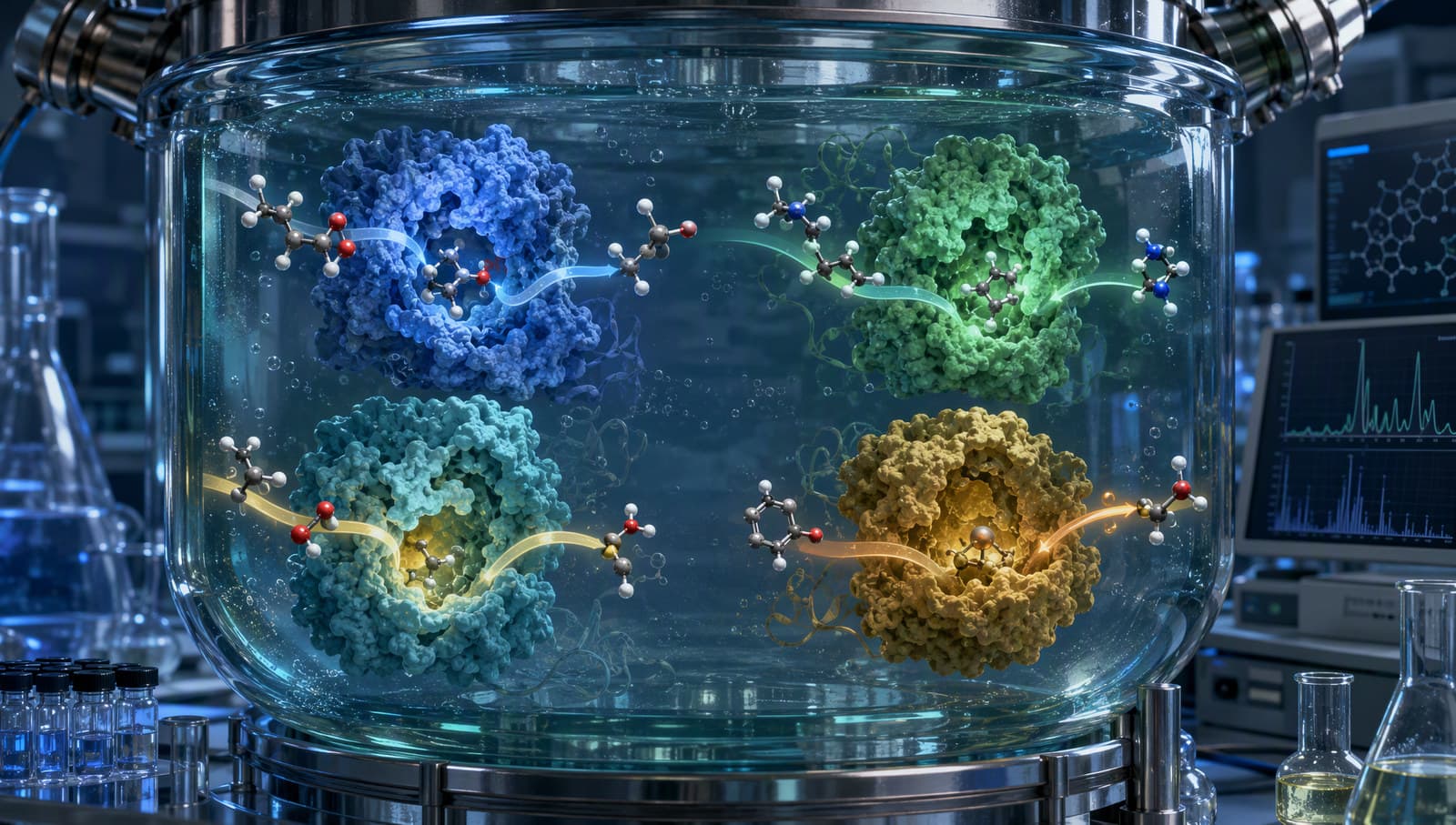
Enzymes for chemical manufacturing across reduction, transamination, and hydrolysis
Category: Industrial Biotechnology, Enzyme Engineering, Biocatalysis, Fine Chemicals, Process Development
Enzymes for chemical manufacturing are not a single product class. They are a toolbox of biocatalysts used to make or break specific bonds and transform functional groups. Depending on the substrate and operating window, they can support reductions, transaminations, hydrolyses, and oxidations while offering an alternative way to control chemoselectivity, regioselectivity, or stereoselectivity.
The practical question is not simply whether an enzyme produces a signal in a small assay. A development team must also determine whether the catalyst can operate at useful substrate loading, retain activity in the selected medium, work with an affordable cofactor strategy, integrate with product isolation, and remain predictable as the process grows. A useful framework therefore starts with the desired bond change, identifies plausible enzyme families, and then tests whether molecular performance can be converted into a controllable manufacturing operation.
How Types of Enzymes for Chemical Manufacturing Match Reaction Goals
Catalyst selection should begin with an explicit description of the molecular transformation. Ketoreductases may be considered when a carbonyl group must be reduced selectively. Transaminases or imine reductases may be explored for routes that create carbon–nitrogen bonds. Ene reductases can address selected reductions of activated carbon–carbon double bonds. Hydrolases may be screened for transformations involving ester, amide, or related bonds, while oxygenases can provide routes to certain oxygen-insertion reactions.
These family names are starting points rather than ready-made answers. Sequences and variants within one family can differ in substrate recognition, stereochemical outcome, cofactor preference, thermal tolerance, and compatibility with process media. Two substrates that look similar on paper may bind differently because of substituent position, electronic effects, or steric demand. That difference can alter rate, selectivity, and the formation of side products.
Ketoreductases are often explored for chiral alcohol synthesis, but their process value depends partly on cofactor recycling and achievable substrate concentration. Transaminases may enable routes to chiral amines, yet amine-donor selection, reaction equilibrium, and by-product handling require attention. Hydrolases cover diverse potential applications, although regioselectivity, enantioselectivity, and possible reverse reactions must be evaluated for each system. Oxygenases may perform transformations that are difficult to control through other routes, while oxygen transfer, electron delivery, and catalyst lifetime can become central engineering concerns.
A productive screening brief defines the desired product, acceptable impurities, required selectivity, feedstock constraints, and downstream boundaries at the same time. This turns the task from finding any active enzyme into identifying a catalytic route with a credible path toward process development.
Why Biocatalytic Process Development Cannot Rely on Activity Alone
Activity is essential, but it is only one part of chemical manufacturing. Early screening commonly uses dilute substrates, convenient buffers, short reaction times, and carefully prepared materials. Process evaluation introduces higher loading, longer exposure, feedstock impurities, mixing and mass-transfer effects, and expectations for batch-to-batch consistency. A candidate with a strong initial signal may still be unattractive if it deactivates rapidly in the intended medium or requires excessive catalyst loading.
The assessment can be organized into four connected layers. The molecular layer covers catalytic efficiency, substrate scope, regioselectivity, and stereoselectivity. The formulation layer covers pH, temperature, salt, cosolvent, cofactor, and substrate-feeding strategy. The process layer covers reaction time, enzyme concentration, mixing, oxygen delivery, gas–liquid contact, and by-product accumulation. The manufacturing layer covers catalyst production, storage, recovery, downstream operations, equipment compatibility, and waste-stream management.
These layers interact. Raising substrate concentration can improve volumetric productivity but reduce solubility, increase inhibition, or change phase behavior. Lowering temperature may protect the protein but extend cycle time. Adding a cosolvent can disperse a hydrophobic substrate while disrupting protein hydration or conformation. Optimization is therefore the search for an acceptable multi-parameter operating window, not the maximization of one isolated metric.
MatwingsVenus®(晓鹜®) capabilities in enzyme mining, protein function prediction, and protein engineering can support the early organization of candidate space. A team can translate the target transformation, substrate structure, and known constraints into candidate-search and computational-assessment tasks, then use the output to prioritize experiments. This support can reduce undirected screening, but it does not replace reaction data or predict scale-up performance on its own.
Balancing Solubility and Stability in Enzymatic Catalysis in Organic Media
Many chemical substrates have limited usable concentration in water, so a project may evaluate cosolvents or biphasic operation. No medium should be assumed to be superior in advance. Medium composition is instead treated as a variable to test alongside catalyst stability, substrate loading, and downstream handling.
Media selection must be specific to the enzyme and substrate. Comparative experiments can determine whether the substrate reaches a reactive state, whether initial and retained activity remain acceptable, whether phase distribution affects the reaction, and whether analytical sampling represents the whole system. Agitation, phase ratio, and separation behavior in a biphasic process should likewise be verified at small scale.

Enzymatic catalysis in organic media balancing substrate access and stability
A cautious workflow first maps the experimental relationship among medium composition, substrate loading, and catalyst lifetime. A limited set of promising conditions can then be tested with cofactor recycling, feed strategy, phase ratio, and downstream handling. If the enzyme is clearly unstable in a necessary medium, protein engineering can define a compact variant set, but every improvement still requires confirmation with the real substrate under target conditions.
When Immobilized Enzyme Reactions Merit Process Evaluation
Immobilized enzyme reactions can be evaluated as options for catalyst recovery, repeated use, or continuous operation. They may also improve activity retention in a specific setting. They are not automatic improvements, because carrier material, binding method, pore structure, and particle size must be matched to the enzyme and process.
Immobilization becomes worth comparing when a free enzyme performs the target reaction but is difficult to recover, requires high per-batch dosing, or must support a defined continuous-processing concept. Evaluation should extend beyond first-cycle activity. Relevant observations include retained performance over repeated operation, particle integrity, transfer of substrate and product, cleaning strategy, and the effect of the carrier on downstream separation. If transport already limits the system, the additional transfer path introduced by immobilization must be measured experimentally.
The full catalyst lifecycle matters as well. Carrier preparation must be reproducible, the immobilization step must be scalable, storage should not trigger excessive leaching or aggregation, and spent catalyst needs a practical handling route. Immobilization creates engineering value only when activity, lifetime, equipment use, and downstream operations produce a net process benefit.
MatwingsVenus®(晓鹜®) capabilities in protein function prediction, protein engineering, and directed evolution can help organize candidate sites related to surface exposure or stability and prioritize a compact experimental library. The resulting ranking still needs expression, immobilization, reaction testing with the real substrate, and repeated-cycle evaluation. It should not be treated as proof of immobilized performance.
Decision Gates for Biocatalytic Process Scale-Up
Scale-up is not a simple multiplication of volume. It is a staged reduction of uncertainty. The first gate confirms the chemistry: the transformation must be repeatable, product identity and selectivity must be clear, and the analytical method must distinguish product, side products, and unreacted substrate. The second gate confirms the catalyst: enzyme preparation should be consistent, activity units should be defined, and loss during storage and use should be measurable.
The third gate defines the operating window. It covers substrate concentration, feeding rate, temperature, pH, oxygen delivery, cofactor recycling, and the reaction endpoint. Exothermic, gas-evolving, or gas-dependent processes require laboratory mixing conditions to be translated into measurable engineering parameters. The fourth gate addresses downstream integration. Enzyme, salt, cofactor, solvent, and by-products can all affect extraction, crystallization, membrane operations, or chromatography. A mild reaction does not guarantee an easy isolation.
The fifth gate tests robustness. Development teams should intentionally examine feed variation, trace impurities, residence-time changes, equipment shear, and short temperature excursions. This identifies factors most likely to reduce activity or selectivity. The sixth gate considers economics and operational boundaries together: enzyme loading, cofactor and medium consumption, cycle time, equipment utilization, waste handling, and process control. A biocatalytic route should be compared at the level of the complete manufacturing concept, not just one reaction flask.

Biocatalytic process development connecting screening with reactor scale-up
Decision gates also improve project discipline. Each phase can define the evidence required to proceed before the team expands an experiment, returns to enzyme engineering, or changes the synthetic route. This prevents premature investment in scale while preserving the option to improve the catalyst.
How MatwingsVenus®(晓鹜®)Can Support Chemical-Enzyme Development
The early challenge in an enzyme project is often the mismatch between an enormous candidate space and a limited experimental capacity. MatwingsVenus®(晓鹜®) can organize an upstream support workflow around enzyme mining, protein function prediction, protein design, directed evolution, and protein engineering.
Inputs should be as specific as possible: the desired bond change, substrate features, known enzyme families, cofactor conditions, temperature and medium constraints, and unacceptable side reactions. These inputs can be used to develop a candidate sequence set, highlight possible functional sites, identify structural or stability considerations, and prioritize variant directions for testing. The output is intended to narrow exploration and create an interpretable experiment order. It does not declare that a given enzyme is production-ready.
The next steps remain expression and purification, screening with the real substrate, condition optimization, bench reaction development, downstream integration, and scale-up verification. Experimental results should flow back into candidate assessment so that priorities can be revised. This computational organization–experimental test–data feedback loop allows enzyme engineering and process development to progress together and exposes substrate-fit or stability problems earlier.
FAQ
Are enzymes for chemical manufacturing limited to fine chemicals?
No. Selectivity can make them especially attractive for chiral molecules and fine-chemical routes, but other manufacturing settings may also be explored. Suitability depends on reaction type, feed conditions, target scale, catalyst economics, and downstream requirements rather than product category alone.
Does high activity in a screen mean an enzyme is ready for scale-up?
No. A screening hit shows activity under one small-scale condition. Development must still test substrate loading, retained activity, cofactor recycling, mass transfer, impurity tolerance, downstream integration, and batch consistency.
Does an organic medium always improve conversion of a hydrophobic substrate?
No. A medium may improve solubility or partitioning while also deactivating the enzyme, increasing interfacial complications, or distorting analytical sampling. Each enzyme–substrate–medium combination requires comparison.
Is an immobilized enzyme always more economical than a free enzyme?
No. Recovery and reuse can be beneficial, but carrier cost, activity loss, diffusion limits, mechanical stability, and end-of-use handling determine the overall economics.
Can computational prediction replace experimental enzyme screening?
No. Computation can help find candidates, interpret sites, and prioritize variants. Real-substrate reactions, process conditions, downstream behavior, and scale-up performance must still be established experimentally.
Conclusion
The value of enzymes for chemical manufacturing lies in converting molecular recognition into manageable reaction selectivity. Development should begin with the required bond change, identify plausible enzyme families, and evaluate substrate fit, medium, stability, immobilization, mass transfer, downstream integration, and economics in one framework. Enzyme mining, function prediction, and protein engineering can make early exploration more efficient, but the process answer emerges through iterative experiments and scale-up decisions. Connecting molecular performance with manufacturing constraints is what moves biocatalysis from an interesting reaction to a developable route.