Choosing Enzymes for Flavor and Fragrance Synthesis
Published on October 11, 2026
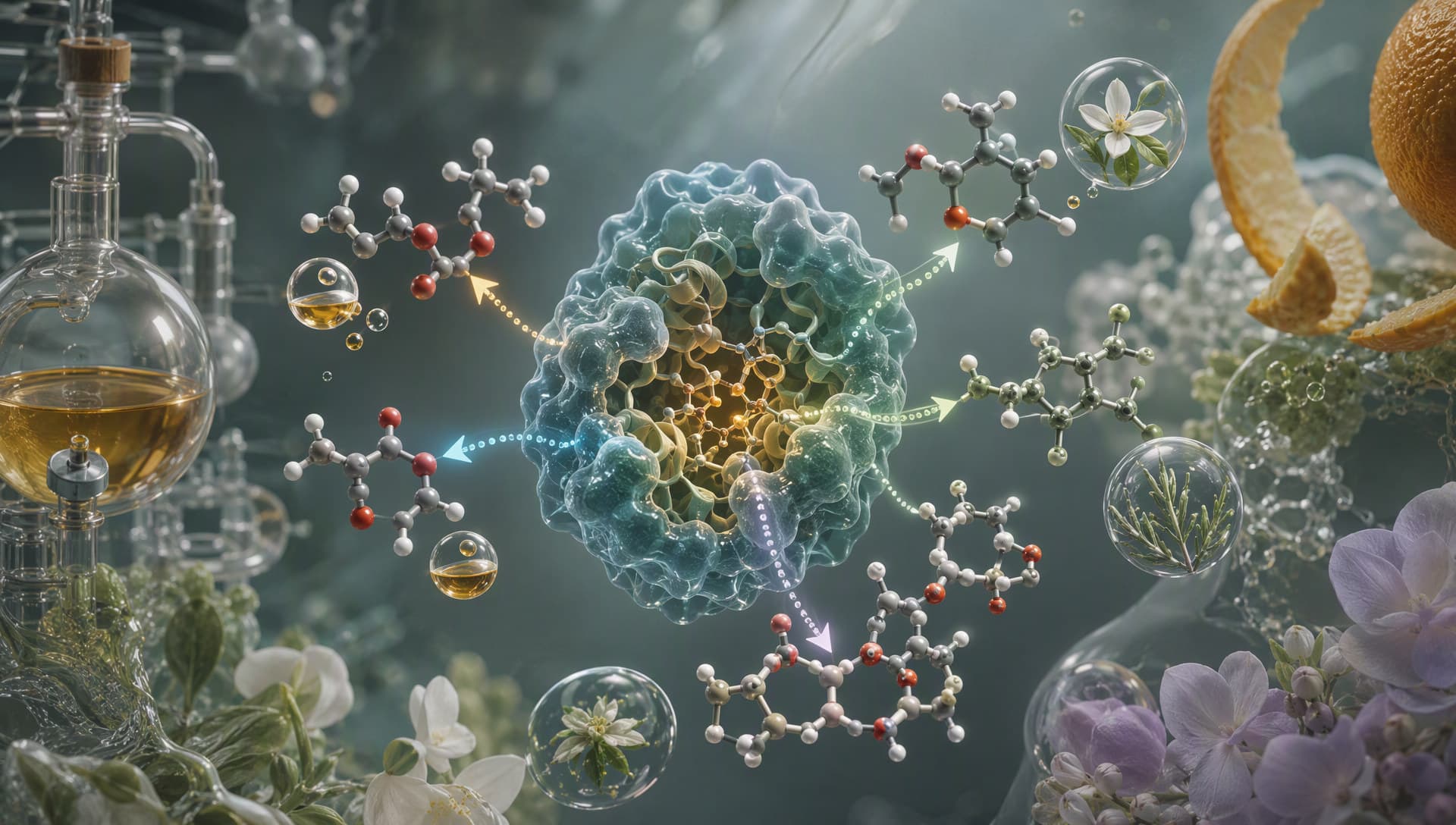
Enzymes for Flavor and Fragrance Synthesis by Reaction
Category: Biocatalysis | Enzyme Engineering | Flavors and Fragrances | Fine Chemicals | Process Development
A successful aroma molecule is not defined only by whether a reaction produces the expected molecular formula. Its value can depend on which bond is formed, which stereoisomer is obtained, how much secondary material remains, and whether the resulting odor profile survives isolation and formulation. Biocatalysis offers a selective and potentially efficient way to address these requirements, but enzyme selection should not begin with a catalog of available products. It should begin with the target molecule and the transformation that creates its most important structural feature.
Enzymes for Flavor and Fragrance Synthesis therefore describe a toolkit rather than a single enzyme class. Lipases can form or exchange ester bonds. Alcohol dehydrogenases and ketoreductases can create chiral alcohols. Terpene synthases build diverse carbon skeletons, while glycosidases can release volatile compounds from nonvolatile precursors. The best catalyst is not simply the enzyme with the highest activity in a standard assay. It is the candidate that works with the real substrate, medium, analytical specification, downstream separation, and intended operating mode.
How to Select Enzymes for Flavor and Fragrance Synthesis by Reaction Type
The first decision is to translate a sensory objective into a defined chemical transformation. Is the process intended to form an ester, reduce a ketone selectively, release an aroma compound from a glycoside, or construct a terpene skeleton? Does the desired product require a single conversion or a multienzyme cascade? Once the key bond-forming or bond-cleaving step is known, the enzyme search space becomes much smaller.
The second decision concerns the physical form of the substrate. Convenient model substrates are often soluble, chemically simple, and easy to quantify. Production substrates may be hydrophobic, viscous, volatile, or supplied as mixtures containing competing molecules and trace inhibitors. Activity against a model compound does not guarantee performance at the required substrate loading. Screening should therefore move toward realistic feed composition early enough to reveal solubility, inhibition, mass-transfer, and selectivity problems.
The third decision is how the product will be isolated. An enzyme can appear attractive at reaction scale yet create a difficult emulsion, require expensive cofactors, or generate an aqueous stream from which a volatile product is hard to recover. The preferred route should simplify reaction and downstream processing together. Conversion, selectivity, product recovery, and enzyme removal are parts of the same design problem.
Why Lipases Are Common in Enzymatic Flavor Ester Synthesis
Many fruity, floral, and creamy aroma compounds are esters, making lipases frequent starting points for process development. Depending on conditions, a lipase may catalyze direct esterification, transesterification, or selective acylation. Lipases can also distinguish among substrates by chain length, branching, position, or stereochemical arrangement. These properties make them useful for creating products with a controlled composition under comparatively mild conditions.
However, the statement that lipases catalyze esterification is not enough to choose one. Individual enzymes differ in pocket volume, hydrophobicity, conformational dynamics, interfacial behavior, and tolerance to reaction media. A catalyst that accepts a short linear alcohol may perform poorly with a branched alcohol or a sterically demanding aromatic substrate. A small panel of diverse lipases should be compared under identical substrate loading, temperature, water activity, and medium composition before a lead is selected.
Esterification is also constrained by equilibrium. Excess water may favor hydrolysis, whereas an extremely dry environment may disturb the hydration layer required for catalytic conformation. Process developers can adjust initial water content, remove generated water, use a substrate in excess, or choose a medium that shifts the apparent equilibrium. Each choice affects viscosity, mass transfer, selectivity, safety, and recovery. The best condition is therefore not necessarily the driest one or the condition with the fastest initial rate.

Lipase-Catalyzed Esterification in a Non-Aqueous System
Why Stereoselectivity Matters in Chiral Fragrance Biocatalysis
Enantiomers sharing the same molecular connectivity can differ in odor character or perceived intensity. Sensory behavior also depends on purity, concentration, formulation, and interactions with other aroma compounds, so stereochemistry alone should not be used to make absolute sensory claims. Even so, enantiomeric composition can be a critical quality attribute for high-value fragrance ingredients.
When enzyme and substrate are well matched, alcohol dehydrogenases and ketoreductases can favor formation of one alcohol configuration. Lipases may also support kinetic resolution or stereoselective acylation. These routes must be assessed by more than total conversion. Enantiomeric composition, substrate loading, reaction time, side products, and the utilization of the unreacted fraction all matter. A process that achieves excellent selectivity while leaving half of the material unused may need substrate recycling, racemization, or a dynamic resolution strategy.
Redox enzymes commonly depend on cofactors. Supplying a cofactor in stoichiometric amounts can quickly become impractical. For ketone reduction, enzyme-coupled, substrate-coupled, or electrochemical cofactor regeneration can be evaluated; oxygen transfer is mainly relevant to applicable oxidation directions or specific coupled systems. A cascade may avoid intermediate isolation, but the enzymes in that cascade may prefer different pH values, temperatures, or substrate concentrations. The operating window must preserve the performance of the system rather than maximizing one component in isolation.
Balancing Enzyme Activity and Equilibrium in Non-Aqueous Catalysis
Flavor and fragrance substrates are frequently hydrophobic, and esterification may benefit from conditions that suppress hydrolysis. Non-aqueous biocatalysis is therefore attractive, but it does not mean that every organic medium is suitable or that the system should contain no water. Solvents can alter the enzyme’s surface hydration, flexibility, substrate partitioning, and mass transfer. Performance depends on the interaction among enzyme preparation, medium, substrate, and operating conditions.
Medium selection can begin with four questions. Does the enzyme retain useful activity? Does the medium dissolve the substrate and product at the desired loading? Does it limit evaporative loss of valuable volatiles? Can it be handled and recovered safely at process scale? High substrate loading may reduce solvent use but increase viscosity or local inhibition. Higher temperature may improve transfer while accelerating enzyme deactivation or product loss. Biphasic systems introduce additional variables such as interfacial area, mixing intensity, and phase-to-phase transport.
Complete progress curves are more informative than a single initial-rate value. A candidate may start rapidly and then deactivate, encounter equilibrium limitation, or become inhibited by product. Volatile products also require closed sampling and a credible material balance. Otherwise, an apparent loss of conversion may actually be a loss of analyte rather than a reduction in catalytic activity.
When Enzyme Immobilization and Continuous Biocatalysis Are Worthwhile
Immobilization can simplify catalyst recovery and enable repeated or continuous use, but it does not guarantee greater intrinsic activity. Carrier pore size, surface charge, attachment chemistry, and enzyme loading affect accessibility to the active site. Excessive loading can create internal diffusion limitations, while rigid attachment may restrict conformational motions needed for catalysis.
The decision to immobilize should reflect the intended use cycle. It is more attractive when enzyme cost contributes substantially to total cost, the reaction will be repeated many times, and free enzyme would otherwise be difficult to remove from the product. It may be less attractive when feeds foul the carrier, enzyme preparation is inexpensive, or product campaigns change frequently. The relevant comparison is not free enzyme versus immobilized enzyme in a short assay, but total product generated over the useful life of each catalyst form.
Continuous operation places an even stronger demand on stability. Developers need to monitor pressure drop, residence-time distribution, carrier attrition, contamination, and product variation in addition to average conversion. A small flow reactor can establish deactivation profiles before larger equipment is considered. Continuous processing becomes compelling only when catalyst lifetime, productivity, cleaning, and product quality remain acceptable together.
Why Enzyme Screening Must Go Beyond Initial Activity
A robust screening funnel can be organized in four layers. The first verifies that a candidate recognizes the target substrate. The second compares selectivity and side-product formation. The third introduces realistic substrate loading, medium, temperature, and water activity. The fourth evaluates expression, stability, recovery, and scale-up constraints. Each layer should have explicit decision criteria so that candidates working only under idealized conditions do not consume disproportionate development resources.
Analytical methods determine whether those decisions are reliable. Colorimetric assays can support high-throughput discovery but may not distinguish closely related products. Confirmatory screening should identify the target molecule, impurities, and stereoisomer composition with suitable separation and detection methods. For complex aroma profiles, instrumental analysis can be complemented by controlled sensory evaluation. Sample concentration, preparation, and blinded assessment should be standardized to reduce subjective variation.
Stability must also be tested on the timescale relevant to manufacturing. Short thermal challenges do not represent prolonged reaction stability, and storage stability does not substitute for operating stability. Thermal tolerance, solvent exposure, shear, freeze-thaw behavior, and multicycle performance can be measured separately. Residual activity should be interpreted alongside actual product formation because an assay substrate may conceal losses that matter for the target reaction.
How MatwingsVenus™(protein agent)Connects Discovery and Validation
When available catalysts do not cover a target substrate, development shifts toward discovery of natural candidates and protein engineering. MatwingsVenus™(晓鹜™) can help organize homologous sequences, functional annotations, and structural clues from protein databases to build a focused candidate set. The goal is not to maximize the number of sequences. It is to narrow the experimental space using catalytic residues, substrate channels, family diversity, and the requirements of the target transformation.
If a candidate has useful activity but insufficient selectivity, stability, or expression, MatwingsVenus™(晓鹜™) can support analysis of functional sites and their structural environment. Protein engineering hypotheses can then be framed around a defined bottleneck, such as changing a hydrophobic channel, reducing instability in a solvent-exposed region, or adjusting active-pocket volume. Computational ranking can prioritize tests, but it should not be treated as experimental proof.
The workflow can be stated explicitly: the task is to retrieve and rank proteins for the target transformation; the output is a candidate set with sequence, structural clues, and testable hypotheses; the next step is protein expression, purification, activity testing, and process validation. Wet-lab work connected through MatwingsVenus™(晓鹜™) converts computational candidates into comparable data. Failed conditions, batch details, and analytical parameters should be retained because they improve subsequent ranking and design cycles.

Immobilized Enzymes Linked to Continuous Processing
Scaling Enzymes for Flavor and Fragrance Synthesis
Moving beyond milliliter-scale experiments changes more than the amount of enzyme. Mixing, mass transfer, oxygen supply, heat removal, volatile loss, and sampling can all shift. Oxidative transformations may become limited by oxygen transfer. Viscous media can develop local concentration gradients. A reactor containing volatile products must balance containment, process control, and safe operation. Recording these variables during early development makes later deviations easier to interpret.
An economic model should include enzyme production, cofactors and regeneration, substrate purity, reaction time, medium recovery, product isolation, catalyst reuse, and waste treatment. High selectivity may reduce purification cost. A slower but durable enzyme may outperform a highly active candidate that deactivates quickly in continuous operation. Cost per unit of specification-grade product is therefore more useful than activity per unit of enzyme alone.
Quality control must connect molecular identity, stereoisomer distribution, impurity profile, and odor performance. Traceability from feed batch through reaction and isolation helps determine whether variation comes from the catalyst, substrate, operating environment, or downstream processing. Specifications should match the intended application, whether the material will be used in food, personal care, or fine-chemical development. Laboratory performance should not be generalized into a finished-product claim without application-specific evaluation.
FAQ
Can lipases cover every route to a flavor ester?
No. Lipases are useful for many esterification and transesterification reactions, but performance depends on steric demand, chain length, aromatic substitution, and reaction medium. Some targets may be better served by other acyl-transfer enzymes, cascades, or hybrid catalytic routes. The target substrate and product specification must drive the decision.
Does immobilization always improve activity and stability?
No. Immobilization can improve recovery and operational stability, but active-site obstruction, diffusion limitation, or excessive conformational restriction can reduce apparent activity. Free and immobilized forms should be compared under realistic conditions for productivity, lifetime, selectivity, and total cost.
Why can a high standard-assay activity produce low target conversion?
The standard assay may differ from the actual reaction in substrate structure, solubility, loading, medium, and temperature. Equilibrium limitation, product inhibition, cofactor shortage, volatile loss, or analytical interference may also contribute. Complete progress curves, material balance, and product confirmation are needed to identify the limiting factor.
When is protein engineering justified?
Protein engineering is most useful when a candidate already shows relevant activity but has a defined weakness in substrate scope, selectivity, temperature tolerance, solvent tolerance, expression, or long-term stability. If thermodynamic equilibrium or downstream isolation is the true bottleneck, changing the enzyme alone may not solve the process problem.
Conclusion
Selecting Enzymes for Flavor and Fragrance Synthesis is a joint design exercise linking target structure, reaction mechanism, and production environment. A practical workflow defines the key transformation and quality attributes, compares enzyme classes under realistic conditions, and then integrates cofactors, medium, immobilization, separation, and scale-up into one evaluation system. Digital candidate discovery and structural analysis can make development more focused, but reproducible experiments and complete quality data remain the basis for deciding whether a reaction can become a sustainable process.