Cellulase Development from Activity Numbers to Real Processes
Published on October 8, 2026
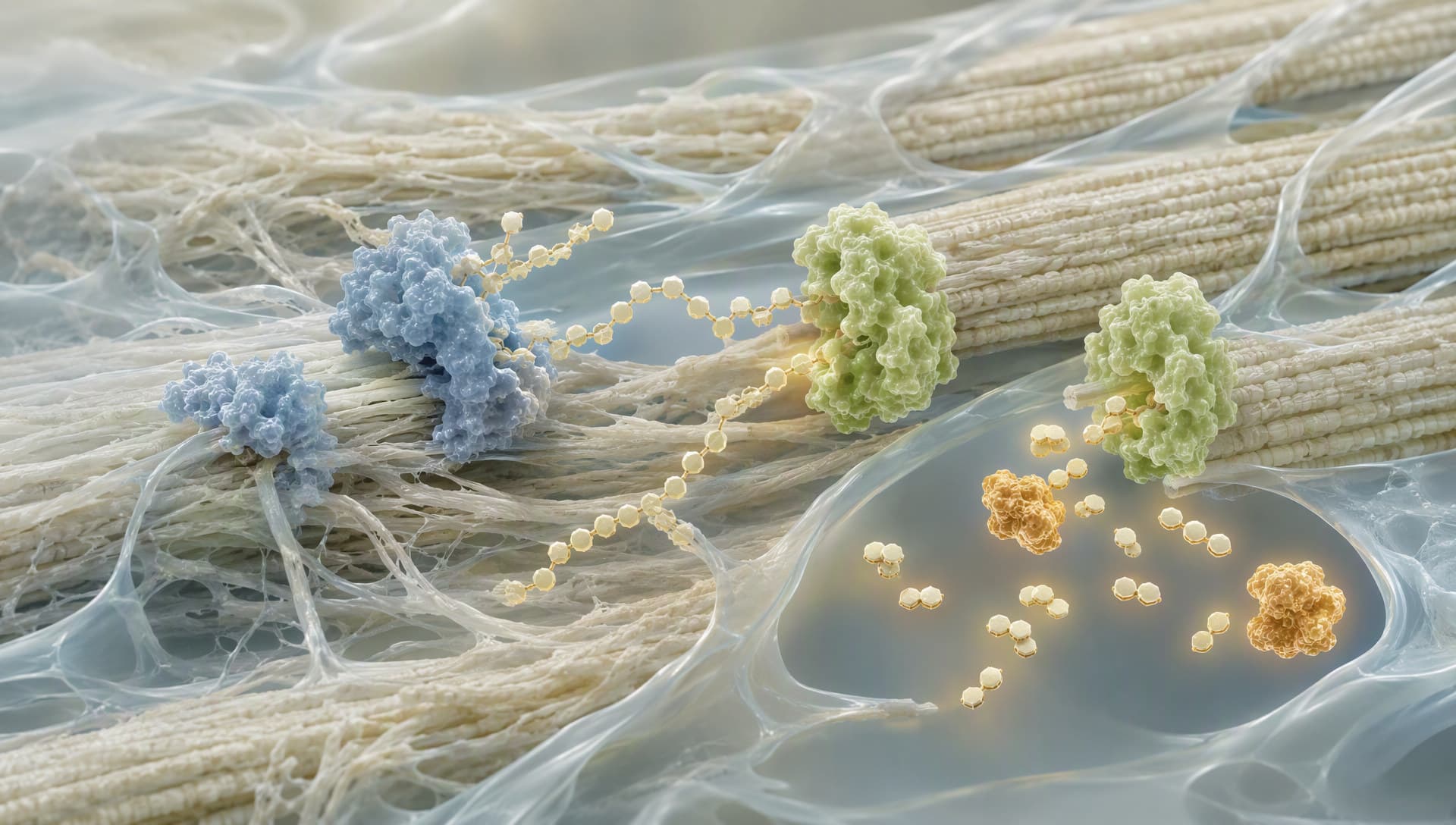
Cellulase mechanism shows three coordinated activities
Category: Industrial Enzymes, Biocatalysis, Biomass Conversion, Protein Engineering
Cellulase is often summarized by one activity value, but that value meets its limits in a real process. Cellulose contains amorphous and crystalline regions. Natural feedstocks also contain hemicellulose and lignin. Pretreatment changes pore structure, surface chemistry, and inhibitory compounds. As solids loading rises, available water, mixing, and mass transfer become additional constraints.
Development should therefore begin with the endpoint, substrate, and validation path rather than the highest activity number. The workflow below follows six connected steps: define the process goal, identify substrate barriers, understand enzyme-system roles, choose assays, design a cocktail, and bring candidates into real feedstock and process conditions. Each step answers a distinct question and creates an entry criterion for the next.
Step One: Define the Endpoint for Cellulase in Biomass Hydrolysis
Projects that all appear to involve cellulose may have very different endpoints. A biorefinery may prioritize glucose concentration, conversion, and compatibility with fermentation. Food or feed processing may focus on viscosity, soluble fractions, or processing behavior. Textile and pulp applications may value surface modification, strength retention, and compatibility with downstream operations.
The required conversion depth changes with the endpoint. Extensive saccharification requires continued backbone opening and efficient processing of soluble intermediates. Mild modification may lose product quality if hydrolysis proceeds too far. A development plan should specify the desired product, unacceptable side effects, time window, and scale-related conditions before selecting an enzyme class or dose.
The second input is substrate state. Microcrystalline cellulose, filter paper, carboxymethyl cellulose, and pretreated straw are not interchangeable. A soluble laboratory substrate can reveal selected endo-activity but cannot fully represent action on crystalline cellulose or lignin-containing material. If the assay substrate is disconnected from the application, later comparisons may begin in the wrong direction.
Step Two: Split the Cellulase Mechanism into Three Tasks
Cellulose consists of glucose units connected through beta-1,4 glycosidic linkages, with multiple chains organized into microfibrils. Enzymatic hydrolysis usually depends on coordinated activities rather than one protein completing the entire conversion.
Endoglucanases preferentially cleave accessible positions within cellulose chains, shortening polymers and creating new chain ends. Exoglucanases or cellobiohydrolase-related enzymes continue from available ends and release soluble products such as cellobiose. Beta-glucosidases process cellobiose and selected short products into glucose, while reducing the accumulation of cellobiose that can interfere with upstream activities.
This three-part model is a framework, not a fixed formulation. Preparations may contain proteins with different domains, substrate preferences, and accessory activities. Some enzymes carry carbohydrate-binding modules that help position catalytic domains near a substrate surface. Candidates may also differ in their behavior on amorphous, crystalline, or substituted cellulose. Synergy must be measured from the target product of the mixture rather than inferred by adding isolated activity values.
Step Three: Build a Layered Cellulase Activity Assay Strategy
The first layer measures component activities. Endo-activity may be observed on a suitable soluble or low-crystallinity substrate through viscosity, reducing sugar, or chain-length change. Exo-related activity requires a substrate that reflects continued action from chain ends. Beta-glucosidase can be evaluated with cellobiose or another appropriate substrate. Values cannot be ranked outside their assay substrate, time, and unit definition.
The second layer measures the overall capacity of a mixture. Filter paper or another cellulose substrate with structural complexity can better reflect the combined action of several components, but it remains a standardized model. This layer is useful for batch comparison and early cocktail design, not as a replacement for pretreated feedstock testing.
The third layer follows products and process behavior. Glucose, cellobiose, and other soluble sugars should be tracked over time together with substrate conversion, enzyme dose, solids loading, and reaction environment. A single final reducing-sugar value may not distinguish insufficient chain opening, limited exo-action, inadequate beta-glucosidase, or product accumulation.
The fourth layer returns to the real process. Candidates are tested with the target feedstock, pretreatment residues, temperature history, and mixing conditions. The value of a layered assay strategy is that every result answers a defined question: Does the component work? Does the mixture complement itself? Does the product match the goal? Does the ranking survive process conditions?
Step Four: Design a Cellulase Enzyme Cocktail Around the Bottleneck
Cocktail design begins by locating where conversion slows. If long chains remain and new chain ends are limited, stronger endo-action may be needed. If accessible ends are present but soluble sugar release remains low, exo-related activity should be examined. If cellobiose accumulates, beta-glucosidase may be limiting. Ratios become interpretable only after the bottleneck has been identified.
Accessory activities should also follow the substrate. When residual hemicellulose covers cellulose surfaces after pretreatment, a suitable xylanase or another hemicellulose-active enzyme may improve accessibility. When lignin is abundant, nonproductive enzyme adsorption deserves attention. Adding one more activity does not guarantee a mixture-level gain and should be tested under equal protein dose, substrate, and reaction time.
A useful bench program establishes a baseline combination for the three core roles and changes one component through a limited dose series. Each round records target sugar, residual substrate, reaction time, and performance per enzyme dose. Maximizing final conversion alone may hide longer processing or higher enzyme demand. Minimizing enzyme dose alone may shift the burden to reaction time or equipment.
The output of cocktail design should include more than a ratio. It should state the substrate, reaction window, primary bottleneck, and failure boundary. When feedstock or pretreatment changes, the team can then see which assumptions require new testing.
Step Five: Explain Why High-Solids Cellulase Hydrolysis Changes Rankings
Higher solids can produce a more concentrated sugar stream and reduce later concentration demand. The trade-off is a more viscous system with less available water and more difficult mixing, heat transfer, and mass transfer. Enzyme and substrate contact becomes uneven, local sugar concentration rises, and advantages observed in dilute assays may disappear.
High-solids operation can also amplify inhibition. Glucose and cellobiose may affect relevant activities. Pretreatment-derived compounds may interfere with proteins. Lignin surfaces may adsorb enzymes without producing the target reaction. Because several constraints appear together, a conversion decline should not be assigned automatically to poor enzyme stability.

Cellulase hydrolysis reveals mixing and transport constraints
A practical validation program raises solids loading in stages rather than moving directly from a dilute assay to the final target. At each level, it records apparent rheology, mixing uniformity, sugar accumulation, conversion per enzyme dose, and sampling consistency. Fed-batch substrate addition, staged enzyme addition, or different mixing approaches may need to be compared so that enzyme evaluation and reactor conditions remain aligned.
If a candidate leads on a standard substrate but loses its advantage at high solids, the explanation may involve adsorption, inhibition, diffusion, or compatibility with other enzymes. Raising isolated activity again may not solve the process limitation. The experiment should return to the bottleneck map.
Step Six: Connect Cellulase Engineering to a Platform Workflow
Protein engineering can target thermal stability, pH adaptation, substrate binding, product-inhibition tolerance, or expression performance. The optimization goal must match the process bottleneck. If production is limited by secretion and enzyme yield, higher catalytic activity alone may not reduce total enzyme cost. If the application is constrained mainly by high-solids mixing, improving one protein’s thermal stability may not change system conversion.
MatwingsVenus™(晓鹜™) is positioned as a conversational platform connecting dry-lab and wet-lab protein research. Protein database retrieval, natural-candidate organization, variant planning, and experimental handoff can be arranged within one task chain. Inputs should include not only the sequence but also the substrate, target product, process conditions, current bottleneck, and available experimental data.
A clear task chain first retrieves and separates endoglucanase, exo-related, and beta-glucosidase candidates. It then ranks them against target temperature, pH, and expression host. The next output is a variant or cocktail plan with evidence and uncertainty, followed by expression, component assays, mixture hydrolysis, product profiling, and real-feedstock tests as connected validation nodes.
MatwingsVenus™(晓鹜™) can preserve the relationship between candidates, tasks, outputs, and next steps. If a variant gains activity on a model substrate but remains weak on lignocellulosic material, the next round can examine binding, adsorption, and cocktail compatibility instead of pursuing a prediction score alone. MatwingsVenus™(晓鹜™) supports research organization and evidence handoff; candidate performance still requires experimental confirmation.

Cellulase activity assays connect to real-feedstock testing
Summary
The key to cellulase development is not finding the highest number outside its conditions. It is building a continuous decision chain from the process endpoint to the substrate, from enzyme-system roles to assay definitions, and from cocktail composition to real operation. A component assay shows what a candidate can do. Mixture evaluation tests whether roles complement one another. Real-feedstock and high-solids studies show whether the formulation can enter the intended process.
When a project follows the six steps, even a failed result provides direction. A substrate mismatch calls for a different assay layer. Product accumulation points to an enzyme-system bottleneck. A ranking change at high solids calls for process analysis. A protein improvement that does not raise system performance sends the project back to cocktail and reactor conditions. This loop creates decisions that can be checked and repeated.
FAQ
Why Can Cellulase Preparations with Similar Total Activity Behave Differently on Real Feedstock?
Total activity may hide differences in component ratio, substrate preference, binding, and inhibition tolerance. Real feedstock also contains lignin, hemicellulose, and pretreatment residues, so layered assays and matched-condition controls are needed.
Why Might More Beta-Glucosidase Fail to Increase Glucose?
The bottleneck may occur earlier in chain-end generation or exo-hydrolysis. Accessibility, product inhibition, and mixing can also limit conversion. Check whether cellobiose actually accumulates before increasing the ratio again.
How Can Standard-Substrate Screening Stay Relevant to High-Solids Processing?
Use standard substrates to identify basic activity, then add pretreated feedstock and staged solids levels. A candidate should retain its advantage under the intended mixing, temperature, and sugar concentration before scale-related decisions are made.
Should Protein Engineering or Cocktail Optimization Come First?
Identify the process bottleneck first. If existing components can solve it through ratio adjustment, establish the cocktail baseline. If the limitation is stability, inhibition tolerance, expression, or substrate binding, targeted protein engineering becomes more relevant.