From Trash Bottles to Everything: 11 Transformations of rPET
Published on July 3, 2026
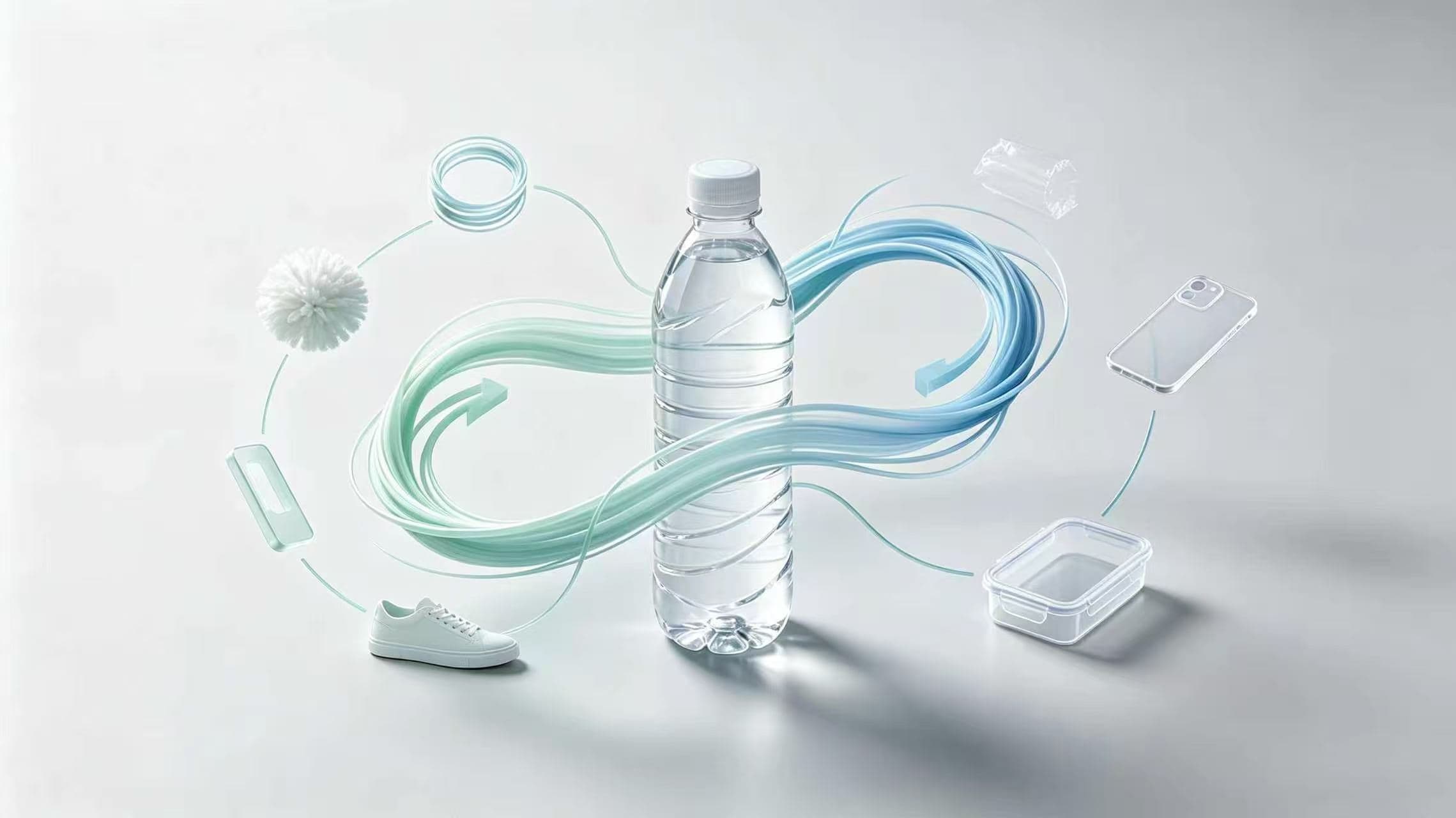
From a quick-dry T-shirt to the upper of a running shoe, from a backpack to a phone case, even the summer quilt you used last night — more and more product labels are stamped with "Made with recycled polyester."
They all come from the same source: discarded PET plastic bottles. When waste PET bottles go through a series of refined processes like sorting, cleaning, melting, and spinning, they can be transformed into two core base materials: rPET staple fiber and rPET filament yarn. These then give rise to three intermediate product forms: rPET industrial yarn, rPET filling fiber, and rPET recycled fabrics, which eventually empower six end-use categories: rPET apparel, rPET footwear, rPET bags, rPET home textiles, rPET phone cases, and rPET storage boxes — making 11 core products in total and covering the full spectrum from industrial raw materials to consumer products.
This article will use these 11 products as points on the map to create a panoramic view of rPET from recycling to application and explore how AI protein design can make this cycle move faster and more thoroughly.
I. Two paths, the same starting point

Physical Recovery vs Enzymatic AI-Assisted Biological Recovery
Before diving into the 11 types of products, let's clarify a basic fact: the rPET raw material used to make these products comes from two completely different recycling paths.
Physical recycling: Post-consumer PET bottles are sorted, washed, crushed, melted, and pelletized to produce rPET bottle flakes or pellets. This route is technologically mature, cost-effective, and currently dominates the market. However, each time the material is processed with heat, the molecular chains degrade, and the IV value (intrinsic viscosity, a key measure of polyester molecular weight) gradually decreases. This is called "downcycling" — bottles become short fibers, short fibers become filling cotton, and filling cotton eventually turns into waste. Solid-state polymerization can partially restore the IV value, but it can't reverse the cumulative increase in terminal carboxyl groups or the discoloration.
Enzymatic recycling: Specialized PET hydrolase enzymes break down waste PET into its original monomers — terephthalic acid (TPA) and ethylene glycol (EG) — under mild conditions. After purification, these monomers are re-polymerized into PET with the same molecular weight as virgin PET, without performance degradation. This is the "same-grade regeneration" route, theoretically allowing infinite closed-loop recycling. A 2022 review published in ACS Catalysis noted that current enzymatic PET degradation still faces challenges such as unbalanced enzyme-substrate interactions, insufficient thermal stability, and low catalytic efficiency at high temperatures, requiring systematic optimization through protein engineering. AI protein design platforms — like Shanghai Matwings Technology’s MatwingsVenus™ (Xiaowu™) — are using deep neural networks to efficiently search the amino acid sequence space, reducing the enzyme optimization cycle from ‘years’ to ‘days’. The platform integrates tens of billions of protein data points, 200 design tools, and 30 domain experts’ tuning skills, making 'design equals verification, verification equals iteration' possible.
These two paths convert PET waste into different grades of rPET raw materials, which then flow into the fiber and injection molding sectors, resulting in 11 types of end products.
II. The Fiber Chapter: The Textile Kingdom, from 'Filament' to 'Fabric'

A comprehensive range of rPET fibres and finished materials for the textile industry
Polyester—also known as PET fiber—accounts for about 54% of the global fiber production and is the largest end market for PET. When rPET enters the textile field, it first appears in two basic fiber forms, which are then spun, woven, and finished into the fabrics and products we see every day.
1. rPET Staple Fiber—The starting point for all textile applications
When rPET melt is extruded, stretched, crimped, and cut into short fiber bundles of 32 to 102 mm, rPET staple fiber is obtained. This is the most basic and highest-volume form of rPET in textiles.
Its core performance indicators—breaking strength (4.0–5.5 cN/dtex), elongation at break (20%–35%), and crimp rate (10%–15%)—fully match virgin polyester staple fiber. Staple fiber is like the 'flour' of the textile industry, forming the basis for all subsequent spinning and filling applications.
2. rPET Filament—Upgrading from 'short' to 'long'
Filaments are not cut after spinning but are wound into continuous long strands, with each fiber stretching for thousands of meters. They have better luster, drape, and strength compared to staple fibers. Based on post-processing, they are divided into POY (partially oriented yarn), DTY (draw textured yarn), and FDY (fully drawn yarn). FDY requires the highest raw material quality—any tiny impurity or uneven molecular weight distribution can cause spinning breaks (called 'flown yarn' in the industry). This is exactly the advantage of the enzymatic route: PET molecules obtained through monomer repolymerization have a uniform molecular weight distribution with no degradation accumulation, making it possible to reliably produce FDY-grade filaments.
3. rPET Industrial Yarn—When 'durability' comes first
Industrial yarn is the 'power player' of the polyester family. Its single-filament denier is coarser (usually 6–22 D), and its breaking strength is higher (6.5–9.0 cN/dtex, with high-end specs exceeding 9.5 cN/dtex), far surpassing ordinary apparel filaments. Typical applications include car seat belts (requiring high strength and low elongation, with 12%–18% breaking elongation), tire cords, conveyor belt reinforcements, geogrids, and industrial sewing threads. Industrial yarn has relatively relaxed requirements for color and feel but extremely high requirements for strength and batch consistency. rPET pellets with IV values restored through solid-state polycondensation (SSP) can meet most of these demands.
4. rPET Filling Fiber—Technology hidden in 'fluff'
Filling fiber is an important branch of rPET staple fiber, used in scenarios requiring loft, resilience, and warmth. The key technology lies in the fiber's crimp form (2D or 3D hollow crimp) and surface silicone oil treatment—the crimp provides a fluffy structure, while the silicone oil provides a smooth feel and bounce. Typical applications include faux-down fillings for jackets, pillow cores, cushions, stuffed toys, and mattress and sofa layers. More and more outdoor brands are labeling 'Filling: 100% Recycled Polyester' on their tags—this is the most direct way rPET appears on the consumer side.
5. rPET Recycled Fabric — From Fiber to "Cloth"
After rPET staple fibers go through processes like carding, drawing, roving, spinning, and winding, they are spun into yarn and then woven or knitted into rPET recycled fabric. From touch, appearance to physical performance, rPET fabric is nearly indistinguishable from virgin polyester fabric in terms of wearability. But its "recycled" identity gives it extra market value — in the three major areas of outdoor sports, fast fashion, and workwear uniforms, products labeled "100% recycled polyester" are especially attractive to the younger generation who care about sustainable consumption.
6. rPET Clothing — From T-Shirts to Down Jackets
After rPET fabric is cut and sewn into garments, it enters the largest, most consumer-facing area. Applications cover all categories: T-shirts, sweatshirts, sports leggings, shell jackets, down jacket fabrics and linings, trousers, school uniforms, and workwear. In addition, labels, sewing threads, zippers, and even buttons in clothes have also seen rPET versions.
7. rPET Footwear — From Uppers to Shoelaces
Footwear is one of the fastest-growing rPET end product categories in recent years. In a pair of running shoes, rPET can appear in multiple parts: upper mesh, shoelaces, lining, tongue padding, insole surface, heel support, and even outsole reinforcement fibers. Take integrated woven uppers as an example — this process is naturally suitable for rPET filaments. As long as color uniformity meets brand standards, rPET DTY filaments can fully meet the requirements.
8. rPET Bags — The Birth of a "Plastic Bottle Bag"
From backpacks to tote bags, from luggage shells to laptop sleeves, rPET fabric is almost everywhere in the bag field. The main application form is rPET Oxford fabric — made from rPET filaments, then finished with a waterproof coating for durability and water resistance. A standard-size backpack consumes the recycled amount of approximately 15 to 25 500 ml water bottles — this "bottle count" itself has become one of the most compelling narratives in brand marketing.
III. Injection Molding: When rPET isn’t spun into yarn but "injected"

Household post-consumer recycled PET consumer goods
Apart from spinning, another major direction for rPET is injection molding—melting the polyester pellets and injecting them into molds to form everyday products in one go.
9. rPET Phone Cases—Recycled Plastic You Touch Every Day
rPET injection-molded phone cases are one of the most successful sustainability examples in the consumer electronics accessory field in recent years. Technically, phone cases need to achieve high surface quality and dimensional accuracy within 1 to 2 mm thin walls (tolerance within ±0.05 mm), which demands excellent melt flow, consistent color, and low impurity content in rPET. rPET pellets, whose IV has been restored through SSP processing and thoroughly filtered, combined with nucleating agents to speed up crystallization and shorten molding cycles, can now be reliably mass-produced.
10. rPET Storage Boxes—Low-Key 'Sustainable Home'
rPET storage boxes cover a wide range of scenarios, from desktop stationery boxes to wardrobe storage bins. Transparent storage boxes (like cosmetic organizers) require high transparency and low yellowing, usually made with SSP bottle-grade rPET pellets; semi-transparent or solid-color products can be made with color masterbatches, allowing more flexible raw material sourcing. Storage boxes are medium-thickness products (1.5–3.0 mm), easier to mold than phone cases, and with proper drying (moisture content below 50 ppm) and mold temperature control (120–140°C), quality can be well managed.
IV, Home Textiles: The 'Gentle Presence' in Your Bedroom
11. rPET Home Textiles—Close Contact for Eight Hours Every Day
Home textiles are one of the key end markets for rPET staple fibers and fabrics. In bedding, rPET staple fibers are widely used for pillow cores and quilt filling, while rPET fabrics are used for duvet covers, sheets, and pillowcases—several global home retail brands have launched '100% recycled polyester' bedding lines. In the bathroom, rPET is replacing materials in shower curtains and the pile surface of anti-slip bath mats. In curtains and soft furnishings, rPET fabrics have UV resistance and colorfastness comparable to virgin polyester, with blackout curtains and sofa covers being typical examples. Pile yarn in carpets and mats is also a major destination for rPET staple fibers.
One often overlooked reason why home textiles have adopted rPET faster than apparel is that home textiles typically don’t have long-term contact with sweat and body oils, making brands and consumers more mentally open to 'recycled' products. Additionally, the replacement cycle (2–5 years) is longer than fast fashion, which favors long-term carbon lock-in with rPET.
5. Why Now?
The full rollout of rPET in these 11 products isn’t by accident—it’s driven by the convergence of three structural forces.
Policy Push. The EU’s PPWR mandates that by 2030, PET used in contact-sensitive packaging (excluding single-use beverage bottles) must contain 30% recycled content, rising to 50% by 2040. Single-use PET beverage bottles will require at least 25% recycled content starting in 2025. The EU's Eco-design for Sustainable Products Regulation (ESPR) designated textiles as a priority area in April 2025, and future delegated acts will set mandatory eco-design requirements, including recycled content, for textiles. China’s 14th Five-Year Plan for circular economy highlights recycling of used textiles as a core focus.
Brand Commitments. Top global consumer brands like H&M, Nike, Adidas, and IKEA have publicly set targets for rPET usage between 2025 and 2030. These commitments cascade through the supply chain—from clothing brands to fabric suppliers, from fabric suppliers to yarn manufacturers—ultimately creating strong demand for rPET staple fibers and filament yarns.
AI-Powered Enzyme Recycling Reduces Costs. Physical recycling hits a ceiling because it can’t effectively process blended textiles, like polyester-cotton or polyester-spandex. Enzymatic recycling, however, can selectively depolymerize polyester in blends using PET hydrolases. A 2025 review in ChemSusChem highlighted significant progress in selective depolymerization of polyester-cotton blends. AI protein design is speeding this up: the MatwingsVenus™ (XiaoWu™) platform efficiently searches amino acid sequence space with deep neural networks, cutting enzyme optimization cycles from months to days. Once recycling blended fabrics becomes economically viable, the full cycle of "used textiles → rPET → the 11 products above" will be completely unlocked.

AI-powered protein design enables closed-loop rPET technology
6. Conclusion
From the upper of a pair of running shoes to a phone case, from a T-shirt to a summer quilt—rPET is no longer just an 'eco-friendly concept'; it has permeated every corner of daily consumption.
These 11 products represent just one snapshot of the rPET circular economy. The full story is this: a discarded water bottle, once thrown into a recycling bin, is physically recycled into staple fibers, enzymatically recycled into polyester material equivalent to brand new, then diverted into spinning or injection molding workshops, and finally returns to your life in 11—or even more—forms.
The circular economy is not a slogan; it’s something you can wear.