Regenerated Purified Terephthalic Acid (r-PTA): How Are Waste Polyesters Reborn?
Published on June 28, 2026
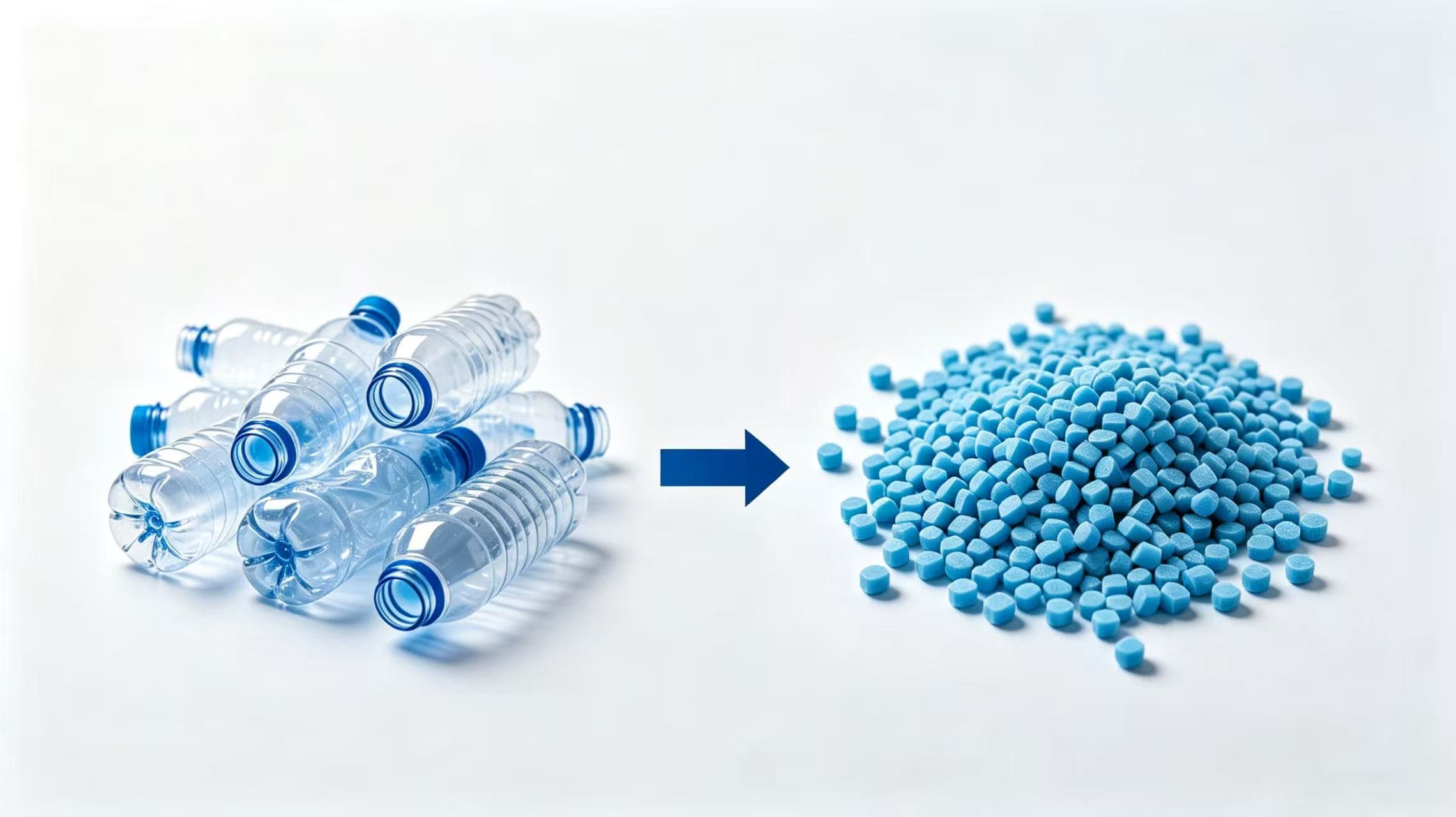
The bottled water in your hand, the polyester sportswear you’re wearing, the disposable packaging on your dining table—they all share the same chemical "surname": polyethylene terephthalate (PET). According to industry reports, the global production of virgin polyester (PET) resin reached 78.5 million tons by 2025. Of this, bottle-grade PET (used for beverage bottles and food packaging) consumes about 18.1 million tons, while fiber-grade PET (polyester filament and staple fiber) uses about 62 million tons. However, a large part of these materials is designed for single use. As the world's largest polyester producer, China generates over 20 million tons of waste textiles annually, but the recycling rate is less than 30%, and the proportion of materials achieving a "closed-loop cycle" is even less than 1%.
It is in this context that recycled purified terephthalic acid (rPTA)—a key recycled monomer that essentially "breaks down" waste polyester back to its molecular form—has stepped into the spotlight of industry transformation.
1. So, what is r-PTA?

r-PTA
To understand rPTA, you first need to understand PTA.
Purified terephthalic acid (PTA) is a white crystalline solid with the molecular formula C₈H₆O₄. It’s produced from the upstream raw material para-xylene (PX) through oxidation and purification and is a core monomer for making polyester materials like PET, PBT, and PTT. Everyday items like beverage bottles and textile fibers all rely on it.
Recycled purified terephthalic acid (r-PTA), on the other hand, refers to terephthalic acid monomers obtained from waste polyester materials through depolymerization and purification. It has the exact same molecular structure as virgin PTA derived from petroleum, but with a significantly lower carbon footprint. Estimates suggest that using enzyme-based recovery to obtain TPA monomers can drastically reduce greenhouse gas emissions.
In simple terms, r-PTA is an eco-friendly alternative to fossil fuel-derived virgin PTA. It’s used to produce recycled PET (rPET) resin, which is widely applied in packaging, textiles, and more. Producing r-PTA with enzyme technology can reduce energy consumption by 50%–80% compared to traditional PTA production, significantly cutting both plastic waste and greenhouse gas emissions.
2.Why should we pay attention to r-PTA?
The global textile and apparel industry is inevitably moving toward green, low-carbon transformation. China’s "dual carbon" strategy puts strict requirements on the greening of upstream raw materials.
2.1. Policy level — (1) EU regulations: The Packaging and Packaging Waste Regulation (PPWR) stipulates that by 2030, at least 30% of recycled content must be used in PET food-contact packaging; the Carbon Border Adjustment Mechanism (CBAM) will be implemented from January 1, 2026, covering six major industries including chemicals, meaning high-carbon footprint polyester exports will face extra carbon tariffs. (2) Domestic regulations: China’s "Ecological Environment Code," to be reviewed and passed in March 2026, encourages large-scale use of recycled materials and requires improving standards and certification systems for recycled materials, pushing upstream raw materials toward greener alternatives.
2.2. Brand level — Around 85 leading global apparel, consumer goods brands, and supply chain companies have committed to increasing the use of recycled polyester fibers to over 45% in their products. Fashion and sports leaders like Nike, Adidas, and Uniqlo have already established stable recycled polyester supply chains, and market demand for high-quality recycled monomers continues to rise.
2.3. Market level — According to NexantECA’s 2025 industry report, the total global demand for recycled polyester will reach 12 million tons that year; China’s rPET market size will be 23.14 billion RMB. Traditional physical melt recycling can only produce low-end recycled materials, unsuitable for food-grade or high-end filament products. Enzyme-based r-PTA production can yield monomers with performance equivalent to virgin materials, filling the gap in high-end recycled raw materials, and industry scale is expected to grow from tens of billions to hundreds of billions.
3. Enzymatic Method: The 'Gentle Revolution' in r-PTA Production
Traditional PET recycling mainly falls into two categories: physical and chemical methods. The physical approach melts and remakes used PET, but often faces the problem of quality degradation; chemical methods (such as hydrolysis, glycolysis, methanolysis, etc.) break PET down into monomers for repolymerization.
In recent years, a gentler approach—enzymatic regeneration—has been attracting a lot of attention.
The core idea is this: using genetically engineered, highly efficient PET-degrading enzymes, under mild heating (60-70℃, above PET's glass transition temperature but far below the 200-300℃ used in chemical methods) and normal pressure, combined with PET physical pretreatment (crushing/amorphization), waste PET is first cut by PETase into intermediate products mainly consisting of mono(2-hydroxyethyl) terephthalate (MHET). Then MHET is completely broken down into terephthalic acid (TPA) and ethylene glycol (EG) by MHETase (or engineered bifunctional enzymes). After crystallization and distillation purification, rPTA and rEG are obtained, which can be repolymerized into recycled PET (rbPET) with quality comparable to virgin material.
This process is vividly called 'molecular scissors'—the enzyme acts like a precise pair of scissors, cutting monomer units from the PET long chains, fully breaking the polymer chain, making the dream of 'turning clothes back into molecules and molecules back into clothes' a reality.
Compared with traditional processes, the enzymatic method has multiple advantages:
- Broad feedstock tolerance: it supports regeneration of both PIR (pre-consumer industrial textile waste) and PCR (post-consumer recycled) blended materials;
- High degradation efficiency: PETase activity has been increased 2,000 times, achieving the efficiency leap of PET degradation in just 8 hours;
- High product quality: r-PTA and rEG are on par with virgin materials, realizing 'zero difference' from petroleum-based feedstock;
- Low production costs: fully aqueous system, normal temperature and pressure reactions, no organic solvents added, and lower energy consumption.
Once this large-scale production line is operational, it will fully close the loop of 'waste textiles → r-PTA/rEG → rbPET → recycled fibers'.
4. The 'Catalyst' Behind the Technological Breakthrough: AI Protein Design
The core of enzyme-based biological regeneration—PET-degrading enzymes—didn't achieve breakthroughs in performance by chance. Enhancements in enzyme activity, thermal stability, and catalytic efficiency are all supported by protein engineering.
In this area, Shanghai Tianwu Technology's MatwingsVenus™ (Xiaowu™) platform offers a whole new technical pathway. MatwingsVenus™ (Xiaowu™) is an AI-centered, conversational, one-stop protein R&D platform. Users only need to input their objectives in natural language, and the system will automatically break down the task, coordinate corresponding design, prediction, analysis, and screening capabilities, and carry out in-depth research, enzyme mining, directed evolution, and de novo design.
The platform integrates over 200 protein design tools, more than 50 certified experts, and over 30 sets of expert-tuned skills, supporting the retrieval of tens of billions of real labeled protein data. More importantly, it achieves an intelligent R&D model of 'design as validation, validation as iteration'—once AI completes the design, the results can be directly imported into an automated wet-lab platform to carry out protein expression, purification, and functional testing, with experimental data fed back into the next round of AI design, forming a complete 'conversational dry-wet loop.'
This means that R&D resources that previously required large institutes or multinational companies are now becoming more accessible through AI platforms. Whether it’s directed evolution of PET-degrading enzymes, optimizing the catalytic efficiency of new depolymerases, or improving enzymes’ thermal stability and substrate affinity in synergy, researchers can quickly get AI design solutions through conversation and complete experimental validation via a shared automated lab. This 'computation-driven wet experiment, wet experiment feeds back computation' smart R&D loop is accelerating the iteration of key rPTA enzyme preparations, making 'more efficient, cheaper, and greener' polyester recycling possible.
It’s foreseeable that as AI protein design technology continues to mature, the degradation efficiency, product quality, and production costs of bio-enzymatic r-PTA will keep improving, injecting stronger technological momentum into the high-value conversion of used textiles.
5. Outlook: A new chapter in green recycling

Prospects for a Green Circular Economy
The value of r-PTA isn’t just in 'turning waste into treasure'; it’s more about representing an industrial logic that shifts from a linear economy to a circular one. By using chemical recycling to convert post-consumer PET waste into high-quality monomers, we achieve continuous material reuse.
From policy incentives to setting standards, from technological breakthroughs to industrial implementation, r-PTA is moving from the lab to large-scale production. When an old piece of clothing is no longer 'trash' but becomes the starting point for new material, we’re one step closer to a true closed-loop cycle.
As one industry observer put it: 'The ultimate challenge for the polyester industry isn’t about producing more, but about ensuring what’s already produced is never wasted.'
Behind this, the deep integration of enzymatic technology and AI protein design is writing the most critical chapter for this green revolution.