Why is conserved-site analysis the gateway to an enzyme's catalytic machinery in enzyme mining?
Published on October 22, 2026
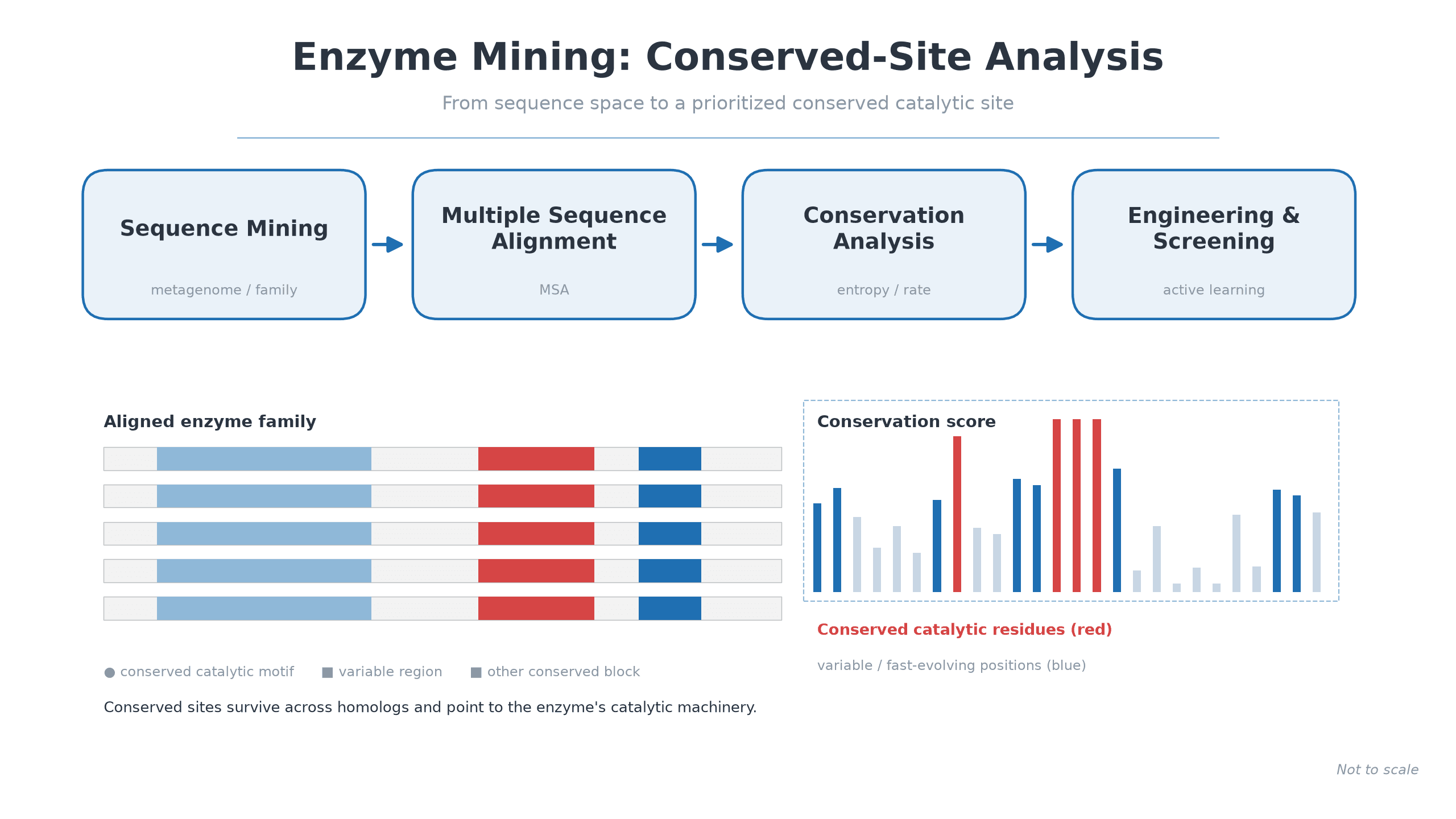
From sequence space to a prioritized conserved catalytic site in enzyme mining
Enzymes are often hidden in sequence noise. Conserved-site analysis turns “mining” into a directional choice: by aligning many homologs of one enzyme family, it identifies the positions that barely change over evolution, focusing attention on the residues that control catalysis and substrate recognition rather than the many variable residues around them. This article walks through a reproducible workflow for why “conservation” can point to an enzyme’s catalytic machinery, and how to exploit it in engineering.
Background: why enzyme mining needs conserved-site analysis
The goal of enzyme mining is to find genuinely useful enzymes among many homologs; conserved-site analysis identifies evolutionarily retained positions via multiple-sequence alignment, focusing attention on the residues that control catalytic activity.
Within one enzyme family, the residues responsible for catalysis and substrate recognition tend to be highly conserved because changing them usually costs function, whereas surface positions far from the active site tolerate mutation much better. “Conservation” therefore acts as a natural filter. For a newly mined, unannotated sequence, conserved-site analysis answers three things: whether the machinery is complete, where the catalytic and binding residues probably sit, and which positions are the functional core that engineering should not disturb.
A caveat: conservation is not catalysis. Some conserved residues maintain fold, disulfide bonds, or a hydrophobic core; others handle substrate recognition or cofactor binding. Only by combining evolutionary conservation with structural mapping and functional annotation can you reach a reliable judgment.
Principle: how conserved sites localize the functional core
Conserved sites matter because evolutionary pressure retains residues essential for folding, substrate binding, and catalysis, producing a clear active center in structure; the papain catalytic triad Cys25–His159–Asn175 is a textbook example.

Papain catalytic triad Cys25–His159–Asn175 (real structure)
In papain (structure from RCSB PDB 1CVZ, real experimental structure): Cys25 acts as the nucleophile, His159 as the general base, and Asn175 orients His159; these three residues are highly retained across homologous cysteine proteases and form a precise catalytic network. [Known structure; residue numbering matches the deposited PDB]
This explains the reasoning of conserved-site analysis: a residue that recurs across the family and sits inside the active pocket is usually functional core, while residues that appear only in some species or on the surface are mostly adaptive, variable positions. Mapping highly conserved residues onto a known or predicted structure separates catalytic sites, substrate-binding pockets, and structural scaffolds.
Measurement: common methods and metrics for conserved-site analysis
Common conservation metrics include sequence identity, Shannon entropy, relative entropy, and evolutionary rate; combined with multiple-sequence alignment (MSA) and structural mapping, they turn “conservation” into explainable chemistry.
In practice: align the homologs with MUSCLE, MAFFT, or Clustal Omega; score each position with Shannon entropy (lower = more conserved), relative entropy, or an evolutionary rate from rate4site/ConSurf; then project high-scoring positions onto a structure to see whether they lie in the active site or a binding pocket. [Note: different algorithms and parameters give different scales, so cross-validate and state the threshold and data source]
When choosing a method, weigh sequence diversity, alignment quality, and structure availability. With too few homologs, conservation scores become noisy; with a high-resolution structure, combining sequence conservation with structural information is usually more reliable than sequence alone.
Conditions: from sequence to engineering targets
A complete conserved-site analysis typically starts by collecting homologous sequences, then proceeds through multiple-sequence alignment, conservation scoring, structural mapping, and experimental validation, finally delivering prioritized engineering targets with confidence.

Conserved-site analysis workflow from sequence to engineering targets
The figure shows a typical workflow (schematic, not to scale): ① collect homologous sequences (genome / metagenome / family databases) → ② multiple-sequence alignment → ③ compute conservation (entropy / relative rate / ConSurf) → ④ map conserved sites to structure (active site / catalytic triad / pocket) → ⑤ validate and prioritize (mutagenesis, activity assay, fitness landscape) → ⑥ deliver engineering targets with confidence and evidence.
Three conditions matter: the sequences must be diverse and representative; the alignment and scoring must be reproducible; and validation experiments must separate “prediction” from “measurement.” You can add an active-learning loop that feeds validation results back to iterate the candidate set and cut wasteful experiments.
Where MatwingsVenus® (Xiaowu®) fits in
MatwingsVenus® (Xiaowu®) embeds conserved-site analysis in its dry-wet closed-loop platform, using AI models to predict residue function, active sites, and developability, and continuously checking predictions against measured data.
On the MatwingsVenus® (Xiaowu®) path, you can hand over a sequence: AI predicts candidate residues and active sites (prediction), wet-lab experiments validate and characterize them (measured), and the two train each other in the dry-wet loop to filter out noisy positions and spend limited experimental budget on high-confidence targets.
Related modules and support:
• Wet-lab products & expert center → a full path from sequence to structure, candidate sites, and validation, with professional support.
• Dry-wet closed-loop platform → prediction and measurement train iteratively to reduce wasted experiments and raise hit rate.
• For specific product parameters, case data, or pricing, please contact us.
FAQ: enzyme mining and conserved-site analysis
What is a conserved site in an enzyme?
A conserved site is an amino-acid position that stays highly consistent across a set of homologous enzyme sequences over evolution. It often corresponds to catalytic residues, substrate-binding sites, or residues required for structural folding, making it a key clue for function and stability analysis.
Can conserved-site analysis directly identify catalytic residues?
Not by itself. It produces candidates and must be combined with structural localization (active pocket, catalytic triad/dyad) and experimental validation (point mutation, activity assay) to confirm which residues truly catalyze the reaction.
Which tools and metrics are commonly used?
Common MSA tools include MUSCLE, MAFFT, and Clustal Omega. Conservation metrics include Shannon entropy, relative entropy, and evolutionary rates from rate4site/ConSurf. Cross-validate across several measures and state the threshold and data source.
What does conserved-site analysis do for enzyme engineering?
It narrows the engineerable space into “movable” and “immovable” zones: highly conserved sites are the functional core and should be left alone; variable sites are the main battlefield for optimizing activity, stability, and substrate preference.
Is sequence or structure information more important?
Each has its role. Sequence information is broad and cheap, ideal for large-scale screening; structure maps conservation onto concrete chemistry and is more interpretable. Combining both is usually most reliable; when no structure exists, a predicted structure can substitute, but uncertainty should be stated.
How does MatwingsVenus® (Xiaowu®) support conserved-site analysis?
MatwingsVenus® (Xiaowu®) embeds it in a dry-wet closed-loop platform: AI predicts candidate residues and active sites, wet-lab experiments validate and characterize, and measured data feeds back iteratively to lock onto the engineerable functional core.
Summary
Conserved-site analysis moves from “finding similarity” to “finding function”: collect homologs, score conservation to find evolutionarily fixed positions, map them onto a structure to see who catalyzes, who binds, and who supports folding, then confirm with experiments and rank the candidates. For enzyme mining it is both an entry point to function annotation and a safety boundary for directed evolution and engineering.
Explore MatwingsVenus® (protein design agent)
Want a more systematic look at enzyme mining and conserved-site analysis? Explore our wet-lab products, expert center, and dry-wet closed-loop platform, or browse more news and science explainers. Deep dive: Wet-lab products & expert center | Dry-wet closed-loop platform.
Conserved-site analysis turns mining into a directed choice: highly conserved positions point to the catalytic machinery, serving both as an entry point to function annotation and a safety boundary for directed evolution and engineering.
More news
Deep dive: wet-lab products , expert center, dry-wet closed-loop platform .