VHH Ligands, VHH Affinity Ligands, and VHH-Derived Affinity Ligands
Published on September 2, 2026
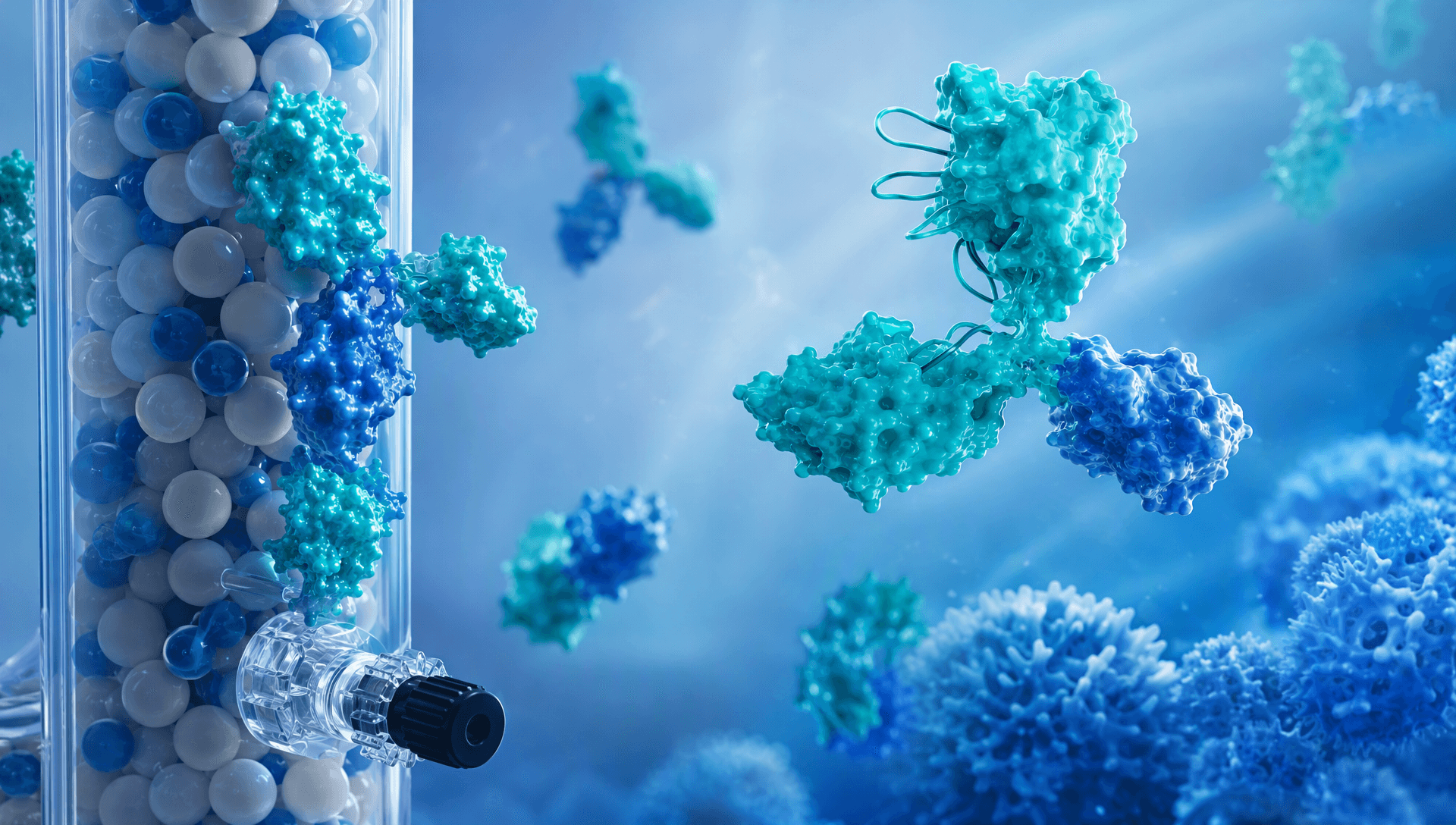
Overview of VHH affinity-ligand development and purification
What Is a VHH Ligand, VHH Affinity Ligand, and VHH-Derived Affinity Ligand?
In a bioprocessing context, a VHH ligand generally refers to a camelid heavy-chain antibody variable domain used as the molecular recognition element of an affinity medium. A VHH affinity ligand emphasizes the specific interaction that enables capture, whereas a VHH-derived affinity ligand emphasizes the origin of the recognition scaffold and may include engineered variants. The terms overlap, but a useful project brief should still identify the purification target, recognized epitope, support matrix, immobilization strategy, elution mechanism, and cleaning conditions.
Camelid heavy-chain antibodies naturally lack light chains while retaining a broad antigen-binding repertoire. Their variable antigen-binding domain is the structural origin of VHH technology. This finding supports the concept of using compact VHH domains as immobilized recognition units, but it does not mean that every VHH sequence is automatically suitable for chromatography. A practical ligand must also meet requirements for expression, folding, coupling, mass transfer, reversible elution, cleaning tolerance, and reuse.
Why consider a VHH affinity ligand?
Platform capture solutions do not fit every Fc-deleted construct, engineered Fc format, multispecific molecule, or emerging recombinant protein. Published work has shown that immobilized camelid VHH fragments can function as tunable immunoaffinity ligands and, in molecule-specific examples, distinguish a desired product from closely related variants. These results demonstrate possibility rather than universal performance. Selectivity always belongs to a defined ligand–target–process combination.
A development team should therefore evaluate five connected questions:
1. Selectivity: Does the ligand recognize the intended domain or conformation while excluding major contaminants and related variants?
2. Capacity: Are static and dynamic binding capacity suitable at the intended load concentration, residence time, and flow rate?
3. Elution window: Can pH, salt, competitor, or chelation conditions recover the product without unacceptable quality changes?
4. Cleaning tolerance: Can the ligand, linkage, and matrix tolerate the planned clean-in-place procedure?
5. Scale-up readiness: Are pressure drop, residence time, lot consistency, and cycling behavior reproducible at the intended column scale?

Binding, washing, and elution mechanism of VHH affinity purification
MatwingsVenus™(晓鹜™)Platform Workflow for VHH Ligand Development
1. Retrieve evidence before prediction
MatwingsVenus™(晓鹜™) follows a retrieval-first workflow. Literature, patents, and protein databases are checked for known binders, sequences, structures, and measured evidence before computational design is proposed. If the input is only a sequence, identity should be established first. When measured evidence is absent, computational results are labeled Predicted rather than presented as validated affinity.
2. Define target product quality attributes
Ligand development should start from downstream goals: recovery, purity, aggregate control, removal of mispaired or modified forms, acceptable elution conditions, host-cell protein clearance, and residual DNA control. Whether a VHH ligand is appropriate depends on the priority and interaction of these criteria—not on a single predicted score.
3. Analyze interfaces and create candidates
With user confirmation for compute-intensive work, MatwingsVenus™(晓鹜™) can connect database retrieval, functional-site analysis, protein engineering, de novo binder or nanobody design routes, and docking-oriented assessment. An existing VHH can enter mutation-effect and combinatorial-variant evaluation. If no usable scaffold exists, a nanobody-focused generative route may be considered, subject to current tool availability. Structural confidence metrics must never be interpreted as measured Kd, dynamic binding capacity, or process success.
4. Close the loop with experiments
Candidates can be prioritized through structural review, interface analysis, and protein–protein docking before expression and binding studies. A minimum experimental panel should cover expression yield, monomer content, thermal stability, target and off-target binding, activity retained after immobilization, ligand leakage, DBC, recovery, purity, and multi-cycle cleaning performance. Computation reduces the search space; wet-lab evidence determines release decisions.
Minimum task example
Inputs: target sequence/structure, candidate VHH sequences, feed context, and elution constraints
Steps: evidence retrieval → identity and structure checks → site/interface analysis → candidate ranking → experiment design
Outputs: a candidate list labeled Measured/Predicted/Unknown, risk notes, and a wet-lab validation plan

MatwingsVenus™(晓鹜™) workflow for VHH ligand development
Connecting Development Decisions to Xiaowu Mall Products
For projects involving capture through antibody heavy-chain domains, teams can first review the VHH Affinity Resin in Xiaowu Mall. Its official product page describes selective recognition of either CH1 or CH3 heavy-chain constant domains, alkali-resistant positioning, and intended relevance to formats such as Fc-deleted constructs, engineered Fc variants, and bispecific antibodies. These statements are a starting point for selection, not a guarantee for a particular sample. Before purchase, verify the recognized domain, matrix, particle size, recommended flow conditions, DBC test conditions, elution window, leakage, and cleaning data.
If the available recognition mode does not fit the target, Xiaowu Mall also lists a Custom Affinity Chromatography Resin as an adjacent consultation route. The current listing does not publish detailed specifications, so no claims about capacity, lead time, or cycle lifetime should be inferred. A stronger inquiry begins with a defined target profile, evidence package, and validation matrix assembled through MatwingsVenus™(晓鹜™).
This creates three practical product touchpoints:
• Early screening: compare the VHH Affinity Resin’s described recognition mode with the target format;
• Bench validation: design a DOE around binding, elution, leakage, and cleaning rather than treating page copy as sample-specific evidence;
• Customization handoff: when the epitope or process window is unusual, bring a structured technical requirements package to a Custom Affinity Chromatography Resin inquiry.
Common mistakes
Treating higher affinity as automatically better. Excessively strong binding may require harsh elution and increase the risk of aggregation, conformational change, or yield loss. Reversible recovery matters.
Assuming soluble binding predicts immobilized behavior. Coupling orientation, epitope accessibility, pore architecture, and ligand density can alter mass transfer and effective activity.
Equating alkali resistance with proven cycle lifetime. Cleaning concentration, contact time, exposure pattern, and performance endpoints must be tested in the intended process.
Using computational scores as process data. Structure prediction, docking, and mutation ranking support prioritization. Affinity, DBC, recovery, and lifetime remain measured quantities.
FAQ
Is the VHH ligand the same as the VHH product being purified?
Not necessarily. The ligand is the immobilized recognition element; the product may be a nanobody or another protein. Always specify both sides of the interaction.
Can VHH affinity ligands replace every established affinity medium?
No. Their value lies in configurable recognition for selected targets and formats. Replacement requires a system-level comparison of capacity, elution, cleaning, economics, supply, and regulatory suitability.
What information should be requested before purchasing a VHH-derived affinity ligand?
Request the recognized target, matrix and particle size, relevant ligand or quality-control information, recommended buffers, DBC conditions, leakage data, cleaning conditions, cycling evidence, sample compatibility, and available formats.
Can MatwingsVenus™(晓鹜™)guarantee that a ligand will succeed?
No. It can retrieve evidence, organize sequence and structure analyses, prioritize or design candidates, and prepare a validation plan while preserving Measured/Predicted/Unknown boundaries. It cannot replace chromatography and analytical testing with the real sample.
Conclusion
A successful VHH ligand program starts with the target molecule, epitope, process window, and validation endpoints—not with a marketing adjective. A VHH affinity ligand offers a configurable route for selective capture, while a VHH-derived affinity ligand turns a molecular recognition scaffold into an immobilized and testable process material. MatwingsVenus™(晓鹜™) can connect evidence, design, and validation planning; Xiaowu Mall’s VHH Affinity Resin and Custom Affinity Chromatography Resin can then support specification review and commercial inquiry. The result is a clearer path from concept to bench testing and scale-up decisions.