Protein Function Labels: Turning Names into Evidence-Backed Annotations
Published on September 20, 2026
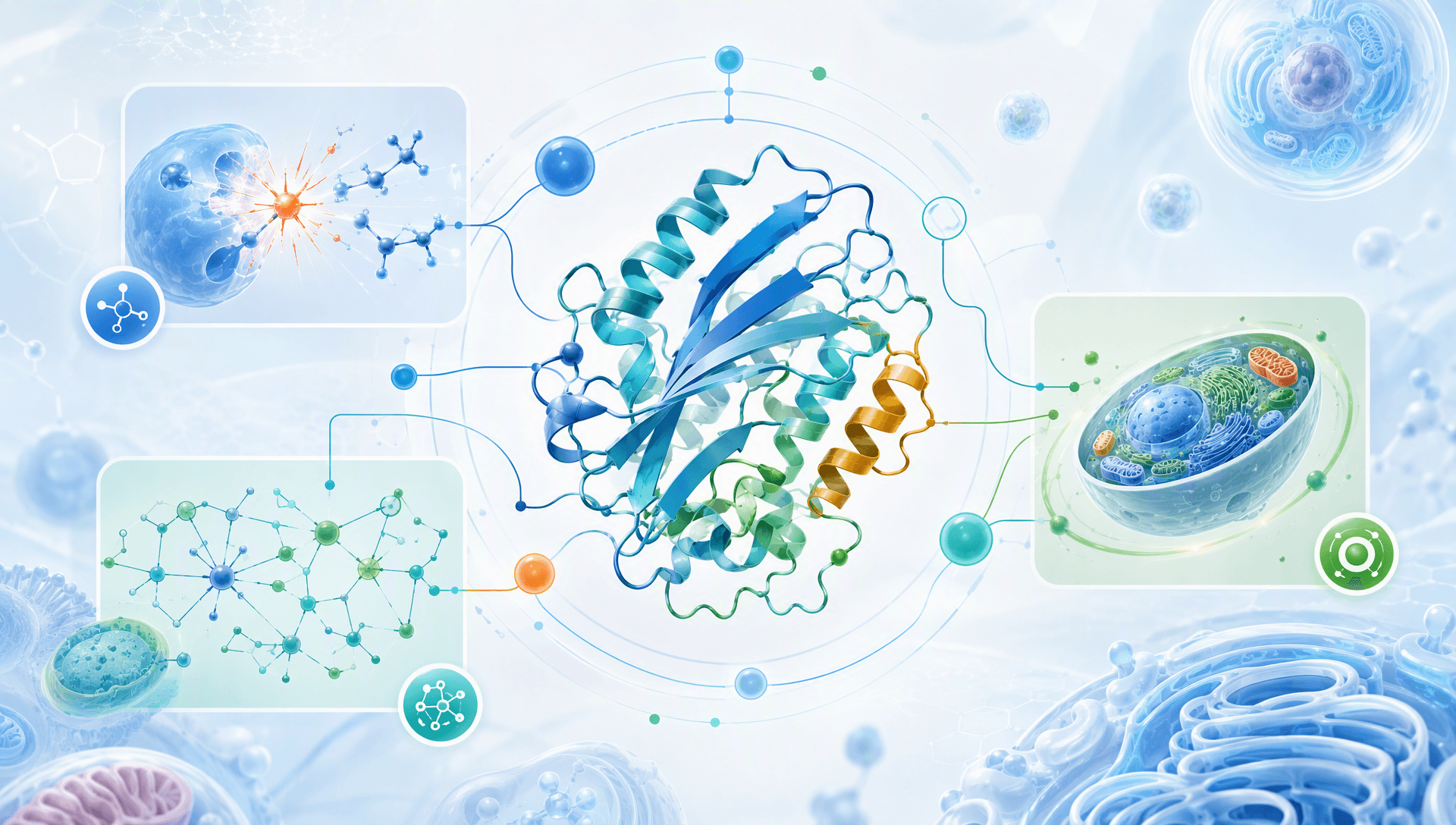
A protein connects to molecular activity, biological process, and cellular location
Category: Bioinformatics / Protein Function Annotation / Data Governance
Protein function labels are structured claims, not isolated names
“What does this protein do?” is often treated like a single-choice question. Biology is more layered. A protein may execute a molecular activity, contribute to a larger biological process, and perform that role in a specific cellular location. Human readers may understand these ideas when they are blended into free text, but computational systems struggle to compare, search, and update them consistently.
Standardized annotation provides a clearer framework. Gene Ontology annotations describe gene products through three aspects: Molecular Function, Biological Process, and Cellular Component. Molecular Function asks what activity is performed. Biological Process asks which larger program that activity helps accomplish. Cellular Component records where the activity occurs. These dimensions complement rather than replace one another.
A useful protein function label should therefore include an object, a controlled term, a relation, and evidence. The object identifies the specific protein or isoform. The term comes from a stable vocabulary. The relation states how the protein connects to that term. Evidence explains whether the association comes from an experiment, phylogenetic analysis, computation, curation, or automated annotation. Retaining these fields makes the label reviewable.
Identical labels can follow very different evidence paths

Experimental, phylogenetic, computational, and curatorial evidence converge on a function annotation
Two annotations with the same function name do not necessarily have the same evidential boundary. One may be supported by a direct experiment, another transferred through sequence or structural similarity, and another derived from phylogenetic analysis, a curatorial statement, or an automated rule. GO evidence codes organize support into categories including experimental, phylogenetic, computational, author statement, curator statement, and automatically generated annotation.
An evidence code is not a universal star rating. Direct experiments can provide strong support for a specific object, yet experimental scope may be limited to one isoform, tissue, or condition. Computational annotation expands coverage but depends on models and reference data. A manually reviewed inference is still an inference. Good annotation retains the evidence type, original reference, and applicable scope rather than collapsing all sources into a generic “high confidence” badge.
This distinction is especially important in dataset construction. Mixing experimental and automated labels without provenance can create leakage between training and evaluation and can propagate historical annotation bias. For experimental prioritization, labels should also distinguish confirmed knowledge, candidates, and currently Unknown areas so that researchers know which claims can guide immediate action and which require validation.
Protein function labels must separate missing, unknown, and negative
The absence of an annotation does not show that a protein lacks a function. Gene Ontology uses an open-world assumption: a missing association may indicate that the protein has not been studied, that relevant knowledge has not been captured, or that evidence remains insufficient. Encoding every blank field as “no” turns a knowledge gap into an unsupported biological conclusion.
A genuine negative claim requires relevant evidence. An experiment may demonstrate that a protein cannot perform an activity, or sequence analysis may show loss of an essential site. A single inconclusive or negative experiment should not automatically become a permanent negative annotation. Unknown is a useful scientific state because it preserves uncertainty honestly.
Versioning is equally important. Ontologies, term relations, and annotations change as knowledge advances. A protein may receive a more specific description in a later release, while an older label may be revised. Recording access date, knowledgebase release, protein sequence version, and coordinate system allows future users to reconstruct which knowledge was available at the time.
A label workflow should identify the sequence before inferring function

Function labels cycle through identity checks, retrieval, inference, validation, and version updates
For a raw sequence, the riskiest approach is to generate a complete-sounding function name immediately. The sequence may already have an authoritative record, or it may represent a fragment, isoform, fusion, or tagged construct. Without identity verification, downstream transfer can attach correct knowledge to the wrong object or coordinate system.
A defensible workflow checks sequence quality and identity first, then retrieves existing annotations. If database evidence is insufficient, researchers can introduce homology, structural, or functional-site prediction around a clearly defined question. Predictions should remain labeled Predicted and retain their reference object, coverage, and limitations. When experimental results arrive, they should update the annotation state and evidence rather than creating a disconnected record.
This approach turns label generation into knowledge maintenance. It explains not only what a protein may do, but why the claim was made, under which conditions it applies, and what action could reduce the remaining Unknown. For large sequence collections, structured claims are easier to search, deduplicate, and assign than unconnected narrative descriptions.
MatwingsVenus™(晓鹜™)places labels inside a research task chain
The official MatwingsVenus™(晓鹜™) website lists intelligent conversation, protein sequence analysis, structure prediction, and database retrieval among the platform’s capabilities. For function annotation, researchers can describe an objective in natural language and organize identity checks, retrieval of existing records, and any necessary sequence or structural analysis around the same question.
A researcher might use MatwingsVenus™(晓鹜™) to organize which annotations already exist for a sequence, whether they describe activity, process, or location, and where evidence gaps remain. Further prediction can address unresolved areas, but database facts, Predicted candidates, and Unknown fields should remain clearly separated in the public result.
The platform’s defensible value lies in connecting tasks and evidence, not in declaring every label to be fact. Whether a particular ontology mapping, export format, or automated curation feature is directly available should be confirmed from the current MatwingsVenus™(晓鹜™) interface and actual output. High-impact labels still need verification against source records or experiments.
Reusable labels should answer five questions
Before publication, model training, or research decisions, a protein function label should answer five questions. Which object is annotated? Does the term describe an activity, process, or location? What relation connects the object and term? What evidence supports it? To which sequence version and biological conditions does it apply? Missing any one of these can distort reuse across projects.
The display layer should not manufacture certainty through color. Color can separate semantic dimensions, borders or icons can identify evidence types, and explicit status can distinguish validated, predicted, and unknown claims. The conversational research organization supported by MatwingsVenus™(晓鹜™) can help researchers fill these fields and convert unresolved labels into executable next questions.
Conclusion: treat labels as maintainable units of knowledge
Protein function labels should be more than search-friendly names. They are structured claims with objects, relations, evidence, scope, and versions. Molecular activity, biological process, and cellular location describe complementary roles; evidence codes explain how conclusions arose; Unknown and version records preserve room for revision. By using MatwingsVenus™(晓鹜™) to connect database retrieval, sequence analysis, and structural information, researchers can turn static annotation into traceable, testable, and maintainable knowledge for protein research.