Plastic-degrading enzymes: when the shoulder blades start showing 'white pollution.'
Published on June 28, 2026
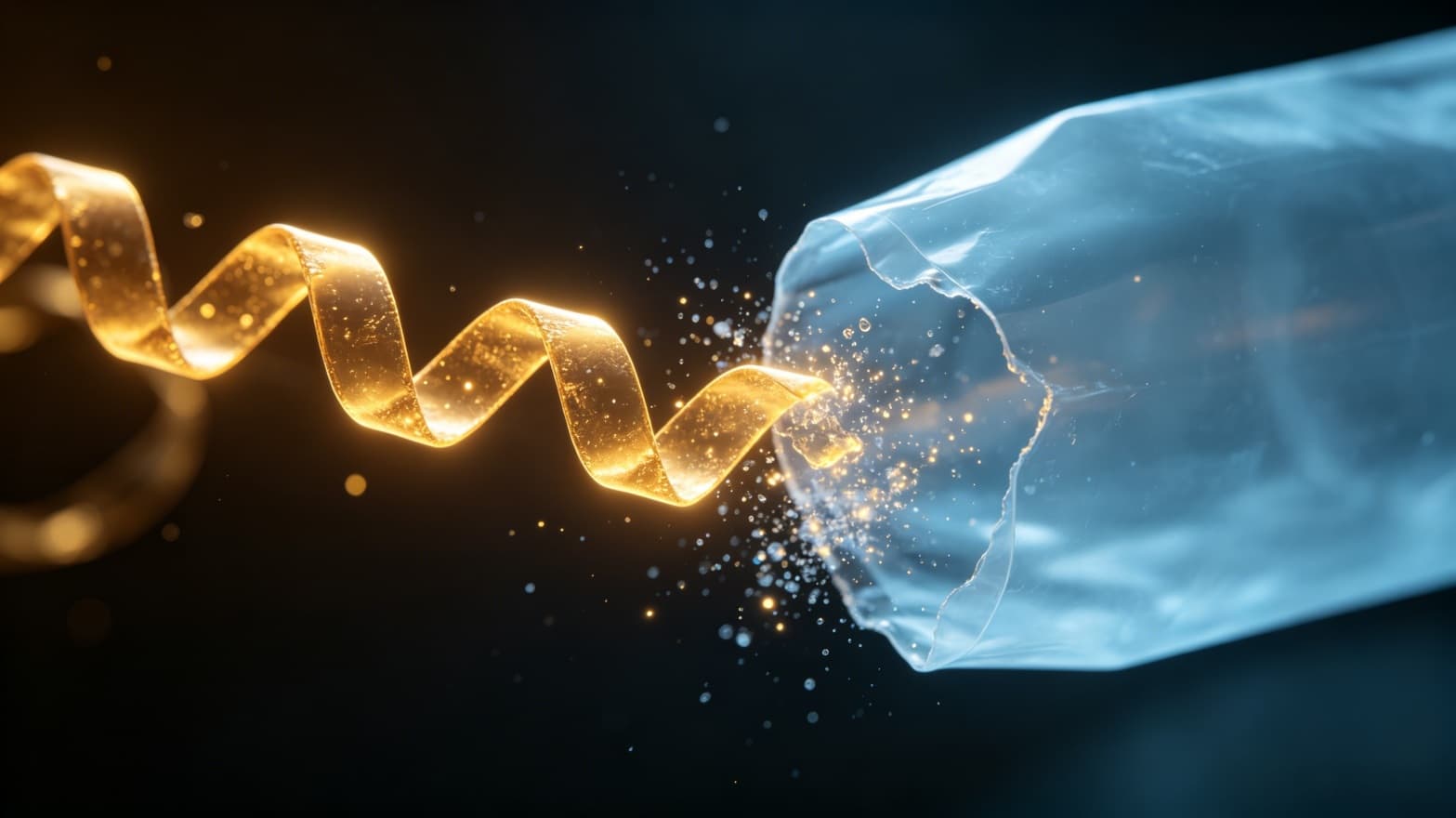
In a laboratory, discarded PET bottles, after being crushed and subjected to viscosity-increasing pretreatment, are placed into a constant-temperature tank at 65°C. Inside the tank, an enzyme precisely designed by AI is rapidly breaking down these plastic fragments. Within just a few hours, the plastic is completely "digested" and converted into raw monomers that can be reused to manufacture new plastic bottles, enabling plastic recycling and providing a novel solution to white pollution.
This heat-resistant, highly active plastic-degrading enzyme was not obtained through natural screening, but rather through mining and iterative optimization powered by AI protein foundation models.
Plastic waste is invading Earth's ecosystems at an unprecedented rate. Over 400 million tons of plastic waste are generated globally each year, with the overall effective recycling rate for all plastics sitting at only 9% (UN Environment Programme, Global Plastics Outlook). As the core polyester raw material for beverage bottles and food takeaway packaging, PET ranks among the top synthetic plastics in annual production. Tens of millions of tons of plastic waste flow into the oceans through waterways each year, and the total accumulated marine plastic pollutants currently reach hundreds of millions of tons. According to industry projections by the Ellen MacArthur Foundation, if current waste disposal patterns continue, by 2050 the total weight of plastics in the ocean could surpass that of fish.

Microplastic Pollution Beneath the Ocean Surface
Faced with this global white pollution crisis, traditional disposal methods such as landfilling and incineration readily generate leachate and toxic flue gases, causing secondary pollution while failing to recover plastic resources. Humanity urgently needs a green solution characterized by low energy consumption, zero pollution, and circular resource utilization. AI-empowered engineered plastic-degrading enzymes are emerging as the core breakthrough in solving the plastic pollution problem.
I. Why Is It So Hard for Plastics to Degrade Over Centuries? Natural PETases Have Intrinsic Industrial Shortcomings

Enzymatic Plastic Degradation & Rebuild
Many wonder: after a plastic bottle is discarded, it takes hundreds of years to decompose naturally—is there any organism that can directly "eat" plastic? The core reason plastics resist natural degradation lies in their extremely stable polymer structures, akin to interlocked steel chains. PET consists of ultra-long polymer chains whose monomers are firmly connected by stable ester bonds. More critically, PET's high crystallinity and hydrophobic surface make it difficult for enzyme molecules to access and cleave these ester bonds. Microorganisms in the natural environment lack efficient disassembly tools, rendering the decomposition process a matter of centuries.
1. Molecular Working Mechanism of Natural PET-Degrading Enzymes
In 2016, Japanese scientists discovered the plastic-eating bacterium Ideonella sakaiensis, which secretes PET hydrolase (IsPETase)—a precision molecular scissor that specifically cleaves the ester bonds between PET molecules. Within the enzyme protein lies a conserved Ser-His-Asp catalytic triad, and the entire hydrolysis proceeds in two steps: in the first acylation step, the serine residue attacks the carbonyl carbon of the ester bond, breaking the long-chain plastic molecule; in the second deacylation step, a water molecule intervenes to decompose the intermediate, ultimately yielding mono-(2-hydroxyethyl) terephthalate (MHET) as the primary intermediate. In nature, the bacterium also secretes another enzyme—MHETase—which further breaks down MHET into terephthalic acid (TPA) and ethylene glycol, two recyclable monomers. In modern industrial enzyme design, protein engineering is often employed to confer dual activity on PETase (possessing both PETase and MHETase activity), enabling "one-enzyme-does-it-all" complete depolymerization. The entire process requires no high temperature or high pressure, no toxic chemical reagents, and can be accomplished in a mild aqueous environment—an ideal green degradation pathway.
2. Fatal Defects of Natural Enzymes That Prevent Industrial Recycling
Natural IsPETase operates stably only at around 30°C, taking months to degrade an ordinary beverage bottle; above 40°C it rapidly inactivates. However, the optimal conditions for industrial PET recycling require temperatures above 65°C, where heating softens PET polymer chains and enhances enzyme-plastic contact. This thermostability shortcoming of natural enzymes directly precludes their large-scale application in factory plastic recycling.
II. Traditional Enzyme Engineering: Empirical Trial-and-Error in a High-Dimensional Sequence Space
To overcome the thermostability and activity deficiencies of natural degrading enzymes, researchers have long relied on directed evolution and rational design, but both approaches suffer from extremely low overall efficiency.
1. Directed Evolution: Massive Mutant Screening with Heavy Cost and Time Burdens
Directed evolution relies on artificially induced random mutagenesis to construct million-member mutant libraries, followed by high-throughput screening. Liu Hao, CTO of Matwings Technology, illustrated the challenge with intuitive numbers: for a 361-amino-acid degrading enzyme, a single amino acid substitution yields nearly 7,000 combinations; double substitutions skyrocket to over 23 million; triple mutations reach 53.3 billion combinations. The vast number of candidates demands extensive wet-lab validation, with a single round of engineering taking months to years and entailing prohibitive R&D costs.
2. Rational Design: Single-Point Mutations Often Disrupt Overall Protein Function
Rational design relies on three-dimensional protein structures to guide site-directed mutagenesis of key residues. While seemingly precise, it is highly constrained in practice. The dynamic conformational landscape of PETase is complex; altering a single catalytic residue can easily destabilize the overall protein fold, frequently resulting in "local activity gains but global activity loss."
Taken together, traditional protein engineering suffers from three major pain points: low screening success rates, multi-year R&D cycles, and exorbitant experimental costs. Training a seasoned protein engineer requires 5 years of systematic accumulation, and the development of a qualified industrial degrading enzyme remains a distant prospect, unable to keep pace with the rapid expansion of the plastics circular economy.
III. AI Enters the Arena: From Blind Trial-and-Error to Precision Design—Three Pathways for Engineering Degrading Enzymes

AI Protein Design Three-Stage Workflow
The deployment of machine learning and AI protein foundation models has fundamentally restructured the enzyme R&D pipeline, equipping plastic degrading enzyme engineering with an intelligent navigation system and addressing the inherent inefficiencies of traditional approaches from the ground up.
Pathway 1: AI Driven 3D Structural Scanning to Localize Protein Instability Hotspots
Research teams have utilized the MutCompute model, employing 3D convolutional neural networks to analyze complete protein conformations, precisely identifying defective sites responsible for poor thermostability and weak catalytic activity. The resulting FAST-PETase overcomes the 40°C inactivation bottleneck of the natural enzyme, maintaining stable catalytic activity at 50°C. Academic data show that this enzyme, without complex pretreatment, can degrade 51 types of waste—including beverage cups and PET foam—within one week, with monomer recovery exceeding 90%. In the 40–50°C range, its degradation activity is tens of times higher than that of the natural enzyme and significantly improved over earlier rationally designed variants.
Pathway 2: Transformer Sequence Models to Uncover Correlations Between Amino Acids and Activity
AI Transformers treat amino acid sequences as a biological language, trained on massive enzyme family sequences to decipher the intrinsic connections among amino acid arrangement, protein folding, and catalytic performance. The iteratively optimized TurboPETase achieves a substantial performance leap: under industrial high-solid-content conditions, it can depolymerize the vast majority of PET feedstock within ten hours, with monomer productivity ranking among the highest reported for PET-degrading enzymes. Its catalytic efficiency is dozens of times that of natural IsPETase, enabling near-complete depolymerization of plastics.
Pathway 3: AI De Novo Design of Entirely New Enzyme Scaffolds, Liberated from Natural Templates
To overcome the inherent thermostability limitations of natural enzymes, research teams first employ diffusion models (such as RFdiffusion) to generate novel protein 3D backbones, then use ProteinMPNN inverse folding algorithms to assign optimal amino acid sequences to these scaffolds, and finally validate correct folding via structure prediction tools (e.g., AlphaFold2). Using this toolkit, they have developed new hydrolases that completely break free from the evolutionary constraints of natural PET hydrolases, possessing independent molecular architectures that thoroughly overcome temperature limitations and maintain stable catalytic activity under moderate-to-high temperature conditions.
IV. Industrial Practice: AI Drastically Cuts R&D Cycles and Delivers High Performance Industrial Degrading Enzymes

hift from Trial Error to AI Optimization
While general-purpose AI models primarily focus on basic protein prediction, domestic vertical biomanufacturing enterprises have built specialized industrial foundation models that bypass redundant structural simulation, directly predicting protein function from sequence—a strategy more aligned with industrial deployment needs.
Matwings Technology, for example, has constructed an ultra-large protein dataset containing nearly 9 billion sequences. In addition to conventional biological protein resources, it has leveraged the "Mingyuan Project" to collect special protein sequences from extreme environments such as volcanoes and deep-sea trenches, enriching the pool with heat-resistant, acid-/alkali-resistant high-quality protein materials. Among these, nearly 500 million sequences bear precise functional labels, clearly documenting protein performance under different temperatures, pH levels, and pressures.
Trained on this massive annotated data, Matwings Technology, in collaboration with Shanghai Jiao Tong University, developed the MatwingsVenus™ AI protein design platform, achieving a leap in enzyme engineering R&D efficiency. According to publicly disclosed data, the platform shortens traditional protein engineering cycles from 2–5 years to 4–6 months and reduces tens of thousands of potential mutant candidates to fewer than 100 for wet-lab testing, delivering a geometric increase in R&D productivity. This foundational AI protein design technology is broadly applicable, capable of developing industrial plastic degrading enzymes as well as designing oral peptides and ocular/joint local delivery protein carriers—a single platform covering both biopharma and green biomanufacturing.
Through iterative platform optimization, the team developed the benchmark degrading enzyme KbPETase, with results published in Nature Communications. Following AI-directed evolution, this enzyme exhibits excellent high temperature tolerance, maintaining stable catalysis at nearly 80°C, with optimal activity approaching a 100 fold improvement over natural IsPETase. The technology has also received national recognition: in 2025, the Ministry of Industry and Information Technology announced its first batch of AI in Biomanufacturing Typical Application Cases, and Matwings Technology's "Protein Engineering Foundation Model AIACCLBIO™" was selected.
V. Industrialization Progress and Existing Real-World Challenges
With continuous advances in AI protein design, AI-engineered plastic-degrading enzymes have moved beyond the laboratory into industrial pilot-scale and production-line deployment.
At the same time, three major barriers remain for industrial plastic biodegradation, requiring sustained industry efforts:
High-crystallinity PET degradation bottleneck: PET enzymatic degradation is a solid-liquid heterogeneous reaction. Once the amorphous surface layer is degraded, the densely packed molecular chains in the crystalline interior are difficult for enzymes to penetrate, making this a primary efficiency bottleneck.
Inability to balance high- and low-temperature activity: The optimal industrial reaction temperature is 65–70°C, but current high-activity engineered enzymes are only adapted to high-temperature conditions; at ambient or low temperatures, catalytic activity plummets, rendering them unsuitable for scenarios such as composting of municipal solid waste or in-situ cleanup of floating ocean plastics.
Lack of efficient degradation systems for polyolefins: All currently mature degrading enzymes target only PET, which contains ester bonds. PE, PP, and other bulk polyolefins lack ester bonds entirely, and no industrial-grade biological enzyme capable of efficiently decomposing these plastics has yet been developed globally; current breakthroughs are confined to the PET sector.
Given the current pace of technological advancement, AI-designed high-performance degrading enzymes are expected to achieve nationwide large-scale deployment within 5–10 years, fully establishing a closed-loop circular system of "waste PET plastics → high purity monomers → new plastic products," thereby reducing white pollution at its source.
VI. Conclusion
From the discovery of a natural plastic-eating bacterium in 2016 to the development of industrial degrading enzymes with nearly 100-fold efficiency improvements via AI foundation models, plastic biodegradation technology has grown from an obscure laboratory curiosity into a green industry with full commercial potential in just ten years.
The degradation reaction occurring inside the 65°C constant-temperature tank is, in essence, humanity's rapid reverse engineering of natural evolution: nature took hundreds of millions of years to evolve the catalytic scaffold of the serine hydrolase superfamily—enzymes originally tasked with degrading natural polyesters like plant cutin. The advent of plastics enabled some of these enzymes, through substrate promiscuity, to acquire weak PET-degrading abilities as an evolutionary contingency. AI protein design has propelled this chance evolutionary starting point to industrial-level catalytic efficiency within months.
When AI begins to "digest" white pollution, the fate of plastic waste is no longer as accumulated refuse in landfills and oceans. Discarded beverage bottles, takeaway containers, and foam packaging are no longer single-use waste but infinitely recyclable industrial raw materials, returning to the production line.
Plastics will not vanish entirely, but their life cycles can be fundamentally restructured by AI. Novel degrading enzymes developed through AI-driven protein engineering are continuously accelerating the global circular plastics economy, offering a sustainable biomanufacturing solution to white pollution.