Fc-Free Antibody Fragment Purification: A Resin Selection Guide
Published on September 3, 2026
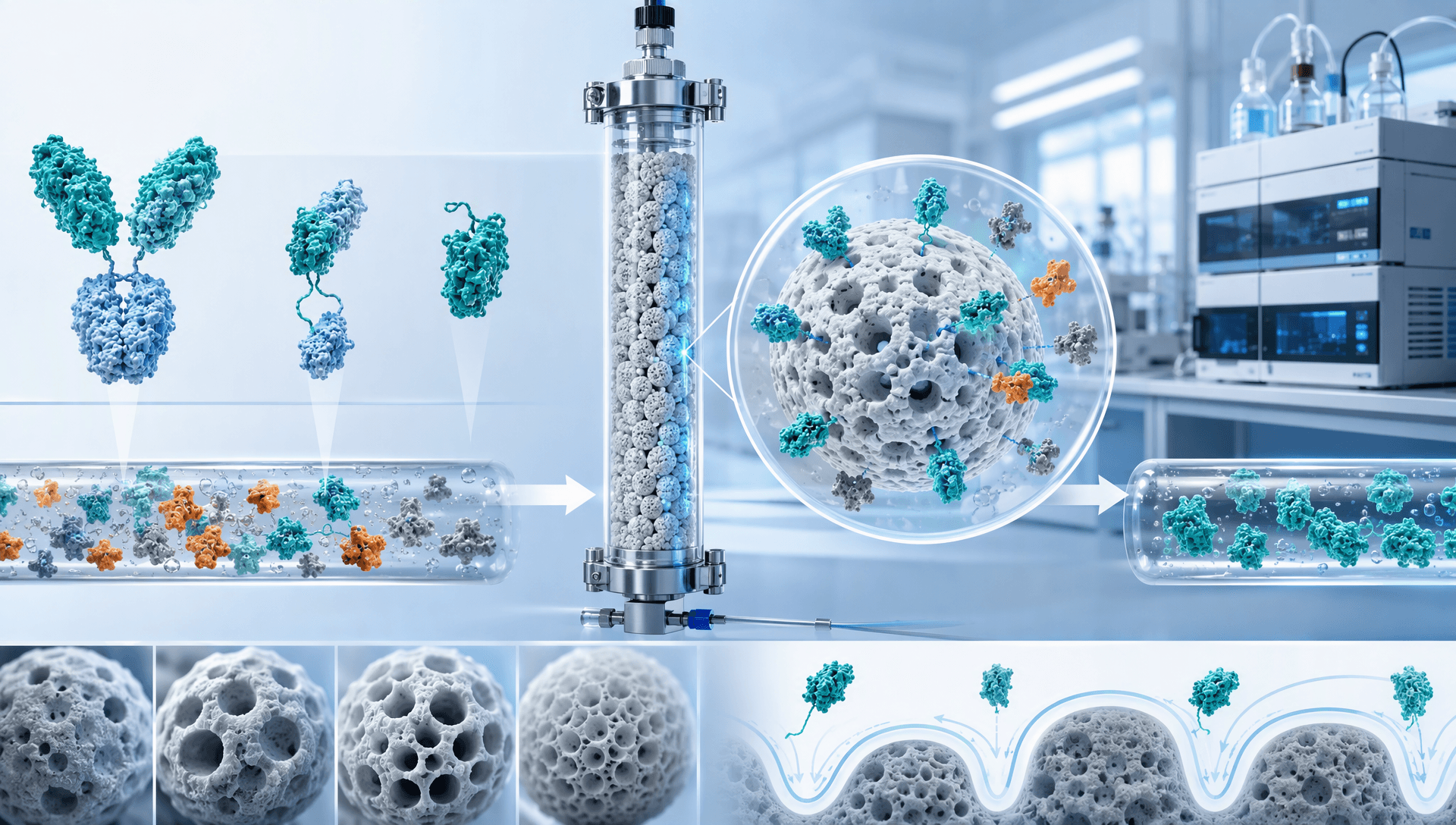
Chromatographic purification of Fc-free Fab, scFv, and VHH antibody fragments
Figure 1 | Chromatographic purification of Fc-free Fab, scFv, and VHH antibody fragments. The schematic does not represent the performance of a specific resin.
The central difficulty in Fc-Free Antibody Fragment Purification is the absence of a universal Fc capture handle combined with substantial structural diversity. Fab contains paired heavy- and light-chain regions, scFv links VH and VL with a flexible peptide, and VHH is a single-domain format. Their molecular size, isoelectric behavior, aggregation tendency, expression host, and available affinity sites differ. One resin platform cannot be assumed to cover every project.
Route Fc-Free Antibody Fragment Purification by molecular architecture
The first process decision is not a vendor or particle size. It is the structural feature retained by the target.
Fab and light-chain-containing scFv: If a compatible kappa variable region is present, Protein L can enter capture screening. Protein L affinity chromatography has been described as useful for compatible kappa-containing antibody fragments, and ligand affinity can influence purity, recovery, and dynamic binding capacity. Binding varies with V-kappa subgroup and conformation, so representative material must be tested.
VHH and other single-domain fragments: These formats do not contain a conventional light chain, so Protein L is not a universal native capture route. Engineered His, Strep, or other tags can support affinity capture. Untagged constructs may instead require ion exchange, hydrophobic interaction, or a validated format-specific ligand. Whether a tag can remain in the final molecule depends on intended use, cleavage strategy, and residual-risk requirements.
Proteolytically generated fragments: Digestion feeds may contain intact IgG, Fc, over-digested material, and residual protease. Protein A or Protein G can then function as negative depletion: the Fc-free target is collected in flow-through while Fc-containing impurities bind. A material balance is still needed to detect nonspecific target loss.
This architecture-first approach prevents a common mistake: treating “Fc-free” as one molecular class. Fc absence is shared, but surface chemistry is not.
Choose capture by selectivity, not familiarity
Capture should balance selectivity, recovery, throughput, and elution stress.
Protein L affinity chromatography
Protein L is relevant to experimentally confirmed, compatible kappa-containing Fab or scFv molecules. It directly recognizes the fragment without an Fc region. Its limitation is format coverage, and elution may require low pH or other conditions that affect stability. Screening should combine breakthrough loss, recovery, aggregation, activity, dynamic binding capacity, and ligand leakage rather than relying on nominal capacity.
Tag-affinity chromatography
Recombinant fragments are often designed with affinity tags for selective capture. Tags accelerate research-scale and early process development, but may influence folding, activity, immunogenicity, or final-use requirements. If tag removal is required, protease cleavage, recapture, and residual enzyme control become additional unit operations.
Ion-exchange capture
When no affinity handle is suitable, ion exchange can provide primary capture. Cation- or anion-exchange mode depends on target pI, operating pH, and feed conductivity. The platform is scalable and offers broad media choice, but overlap between product and host proteins requires systematic pH-conductivity screening.
Alternative affinity ligands can also be developed, but should not be labeled universal without broad evidence. One Fab study used phage biopanning to identify peptide ligands and demonstrated an affinity column in complex culture fluid; binding still differed among Fab molecules . The lesson is that ligand breadth must be established experimentally.

Relationship between Fc-free antibody formats and capture mechanisms
Figure 2 | Relationship between Fab, scFv, VHH, and Protein L, tag-affinity, charge-based, hydrophobic, and size-based separation.
Let the hardest impurity define polishing
Fc-Free Antibody Fragment Purification should not use polishing as a fixed template. The dominant impurity determines the orthogonal mechanism.
• Aggregates or conformational variants: screen hydrophobic interaction, ion exchange, or size exclusion while controlling additional aggregation caused by high salt, low pH, concentration, or long processing time.
• Host-cell proteins and nucleic acids: evaluate anion-exchange flow-through, mixed-mode media, or membrane adsorption under controlled feed conductivity.
• Residual intact IgG or Fc: use Protein A/G negative depletion, followed by charge- or size-based separation if needed.
• Low-molecular-weight fragments or free tag: use size exclusion for high-resolution polishing and analytical confirmation, recognizing its capacity and throughput limits.
A recombinant scFv study used a multistep train of Protein L capture, cation exchange, and gel filtration, then applied design of experiments and scale-up verification. Its buffer recipe is molecule-specific, but the general development principle is transferable: recovery, aggregation, purity, and scale-up robustness must be evaluated together.
Apply one scorecard from screening to scale-up
A useful decision matrix spans product quality, function, chromatography performance, economics, and robustness:
At least three representative feed lots are preferable to purified standards alone, and a target mass balance should be completed. Low-titer material makes capture and concentration critical; aggregation-prone fragments require explicit control of time, temperature, and interfaces. Cost and throughput comparisons become meaningful only after candidate trains meet predefined quality limits.
Narrowing the experimental space with MatwingsVenus™(晓鹜™)

Workflow from fragment information to chromatography screening and quality verification
Figure 3 | Workflow from fragment information and impurity definition to chromatography screening and quality verification.
A concrete task chain begins with the fragment sequence, expression system, tag status, and priority impurities. The deep-research capability of MatwingsVenus™(晓鹜™)can return a sourced summary of purification mechanisms and publications. The protein-database query capability of MatwingsVenus™(晓鹜™)can organize sequence, domain, and known annotation data into a molecular information card. Where measured properties are unavailable, the protein-property prediction capability of MatwingsVenus™(晓鹜™)may provide explicitly labeled hypotheses about pI or stability. The next step is to translate those outputs into pH, conductivity, ligand, and polishing screens with representative feed.
The platform organizes evidence and generates testable hypotheses. It does not replace chromatography experiments, SEC or electrophoretic analysis, functional testing, scale-up, method validation, or product release.
Final decision standard for Fc-Free Antibody Fragment Purification
A successful process is not necessarily the shortest train or the method with the highest single-step purity. It is a demonstrated balance among recovery, retained function, impurity clearance, robustness, and cost. Protein L serves validated compatible kappa-containing fragments; tag affinity serves deliberately engineered constructs; ion exchange, hydrophobic interaction, and size exclusion supply orthogonal selectivity. Architecture-first routing, impurity-driven polishing, representative-feed testing, and boundary verification are the basis of a reproducible process.