Artificial Intelligence, the 'New Partner' of Life Sciences
Published on June 7, 2026
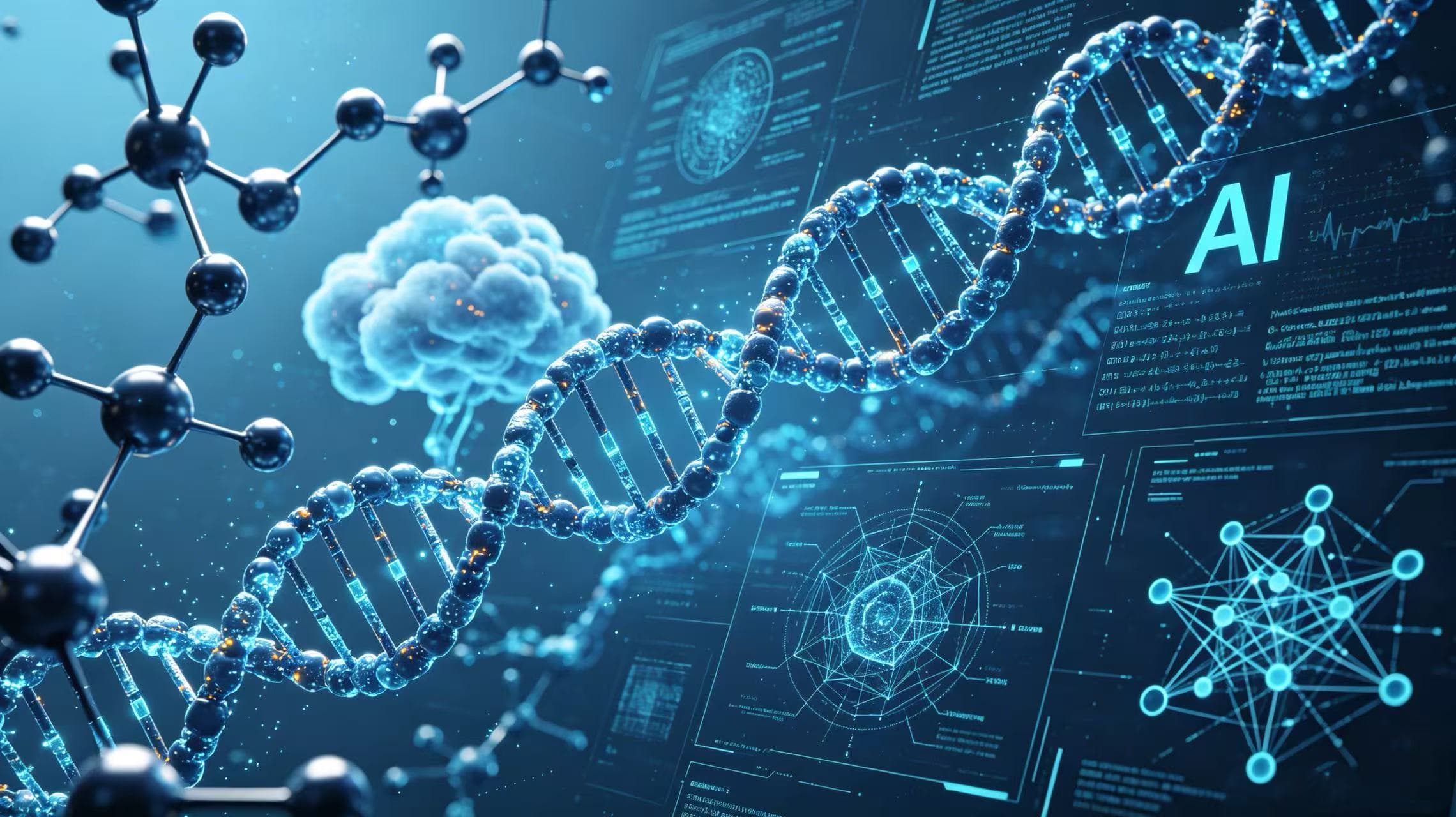
Artificial Intelligence, the 'New Partner' in Life Sciences
Have you ever wondered why it takes on average ten years and more than a billion dollars for a new drug to go from the laboratory to patients? Why, even though we can easily identify tens of thousands of genes, are we still helpless when facing many difficult diseases?
The answer lies in the complexity of biological systems. There are tens of thousands of types of proteins in a cell, and the possible interactions between them are almost infinite; a small molecule drug often needs to screen billions of candidate molecules to find the one effective target protein. This is not a domain that human intuition can easily cover, nor is it a problem that can be quickly solved by piling on manpower.
In recent years, an interesting shift has been occurring—artificial intelligence has begun to seriously participate in solving life science problems as a 'partner.' It is not just handling auxiliary tables or image recognition, but directly predicting protein structures, designing novel molecules that do not exist in nature, and unraveling the multilayered networks behind diseases. MatwingsVenus™ (Xiaowu™) agent launched by Matwings Technology is a very tangible example of this change: it transforms the advanced capabilities of AI into a research partner that is online anytime, capable of conversation, and able to provide experimentally feasible plans.
So, what happens when artificial intelligence truly enters the field of life sciences?

AI For Life Sciences
What can artificial intelligence actually do in life sciences?
If traditional biologists use a "microscope" to view life, then AI is more like a "mathematical lens"—it can read statistical patterns from massive amounts of data that the human eye cannot see.
Take proteins as an example: for a long time, figuring out the three-dimensional structure of a protein can cost PhD students several years of their youth. When DeepMind's AlphaFold was released in 2018, it pushed structural prediction close to experimental precision. Eventually, scientists no longer just focus on natural proteins—generative AI can "create" entirely new proteins with specific functions, like drawing, such as enzymes that degrade plastics and antibody analogs that can precisely cut off viruses.
Let's look at the drug discovery. In the past, screening out lead compounds was like repeatedly testing hundreds of thousands of keys into a single keyhole. Now, graph neural networks and molecular generation models can "test the lock" in advance in the digital world, narrowing the candidate pool from millions to dozens, so expensive wet experiments are used only on the most promising molecules.
These are the tangible momentum AI brings to life sciences. It is not about replacing biologists, but about completing high-dimensional calculations that the human brain struggles to handle, and saving the time saved for the segments that truly require creative judgment.
But problems soon followed: these seemingly impressive technologies don't work well in most life sciences labs.
Because to truly solve a research task, such as "designing an enzyme that can withstand high temperatures while maintaining activity," it often requires calling protein language models, structure generation models, and mutation effect prediction models simultaneously, combined with multiple rounds of screening combined with biochemical rules. If every step requires writing code, setting up the environment, and adjusting parameters, the efficiency of artificial intelligence will be greatly reduced.
At this point, the concept of agents begins to make sense.
An AI research partner who can understand human speech: MatwingsVenus Intelligent Agent
Matwings Technology's MatwingsVenus™ (Xiaowu ™) intelligent agent: packaging life sciences AI capabilities scattered across different papers, models, and tools into a natural conversational gateway.

MatwingsVenus Agent
You don't have to worry about which large model is working behind the scenes. Just tell MatwingsVenus™ ™ your needs, such as "Help me design a PET hydrolase that increases thermal stability by 5°C and has enzyme activity no less than 80% of wild-type," and it will automatically break down the task, scheduling modules such as protein structure prediction, mutation scanning, and sequence generation. After multiple rounds of internal validation, it directly outputs a set of candidate sequences with experimental reference value, along with confidence level notes for each step.
For example, if you input a sequence of a target protein, it can help you analyze potential binding pockets and generate small ligand structures targeting those pockets, while conveniently marking similar proteins that may have off-target risks. The whole process felt like discussing a solution with a reliable colleague, rather than facing a cold command-line interface.
MatwingsVenus™ integrates core modules ™ such as intelligent dialogue, protein sequence analysis, directed mutation design, enzyme mining, de novo design, structure prediction, and database retrieval. These capabilities are packaged into a single conversation entry, making the previously complex process of using multiple software, writing scripts, and consulting databases all connected in just a few rounds of natural dialogue. It is precisely this integration of interaction that has transformed AI applications in life sciences from a state that "requires a computational biology team to support it" into a daily tool that "a graduate student can independently use." For many small and medium-sized biotechnology companies and university laboratories, lowering the threshold may be more effective than a slight improvement in single-component precision.
Artificial intelligence is changing the "tactile feel" of scientific research
If AI is seen merely as an accelerator, one may be underestimating the profound changes it brings. It actually changes the rhythm of interaction between scientists and unknown questions.
In the era without AI, a bold assumption often means extremely high cost of trial and error. For example, if you want to test a fusion enzyme that can degrade PET and polyethylene simultaneously, it might take months of gene synthesis, protein expression, and enzyme activity testing, only to find that the design direction simply doesn't work. Now, with agents like MatwingsVenus™ ™, you can obtain an initial feasibility assessment and dozens of candidate sequences within an hour, quickly trial and error in the virtual world, then select the most promising designs for wet experiments.
This cycle of "asking—immediate exploration—rapid correction" directly changes scientists' habits of hypothesis. When verification costs become extremely low, curiosity easily arises, and more imaginative yet scientifically based ideas are dared to be explored. Many important discoveries in history stem precisely from this kind of non-mainstream idea of "why don't we give it a try?"
The Next Step in Human-Computer Collaboration: AI Is Not a Replacement, but a 'Super Intern'

Human-AI collaboration
This highly efficient cycle also brings up a question that everyone is concerned about: Will artificial intelligence take away scientists' jobs?
From the current state of intelligent agents like MatwingsVenus™ (Xiaowu™), the answer is clear: it is more like a 'super intern' that never gets tired, has excellent memory, and a solid foundation. It can exhaustively review the literature, scan for possible mutations, and provide evidence-based candidate molecules, but it still cannot propose a truly original scientific question on its own, nor does it possess a real understanding of human aesthetics, ethics, or intuition.
True creative breakthroughs still require a human 'moment of shiver'—a sudden insight in the face of anomalous data, an intuition drawn from cross-disciplinary analogy, or deep empathy for a particular disease problem. These are qualities that artificial intelligence currently does not have and are the irreplaceable value of scientists.
Interestingly, when AI takes over a large amount of tedious calculation and screening, researchers' attention is actually more likely to focus on areas that truly require intelligence: mechanistic reasoning, experimental strategy design, and cross-disciplinary connections. This new division of labor may make future life sciences papers include both more 'Aha moments' and more solid high-throughput data support.
Written at the End
Looking back from 2026, the role of artificial intelligence in life sciences has undergone its first transformation: from an auxiliary computational tool to a collaborator capable of independently undertaking design tasks. MatwingsVenus™ (Xiaowu™), an intelligent agent from Matwings Technology, is a microcosm of this wave, delivering these capabilities to more researchers in a softer and more accessible way.
Of course, challenges still remain. Data standardization, model interpretability, and the absence of fundamental biological principles all remind us that there is still a long way to go before artificial intelligence can truly 'understand life.' But one increasingly clear trend is that the next golden era of life sciences is likely to be defined by the combination of human curiosity and machine computing power.
Perhaps soon, in the acknowledgments of a groundbreaking study, we will read a sentence like: 'Thanks to MatwingsVenus™ (Xiaowu™) for its deep involvement in critical molecular design and data analysis.' That would be a vivid footnote to the true alliance between humans and artificial intelligence in the realm of science.
What is your view of AI's application in life sciences? Is it a practical tool or a deeper partner for the future? Feel free to share your observations in the comments.